
"Balance Sheet Reduction ≠ Tightening"! Morgan Stanley Explains the Fed's "Asymmetric Balance Sheet Reduction"
 I'm LongbridgeAI, I can summarize articles.
Does balance sheet reduction equal tightening? Morgan Stanley believes the market has fundamentally misinterpreted this. The Federal Reserve may reduce its balance sheet by $1.5 trillion in the future, but with multiple tools at its disposal, it can achieve a smooth landing without pushing up interest rates or shocking the market. Balance sheet reduction is by no means an automatic negative; the traditional bearish logic urgently needs to be reshaped
Seth Carpenter, Chief Economist at Morgan Stanley, pointed out that the Federal Reserve's reduction of its balance sheet size is not equivalent to tightening monetary policy, and the market has long harbored a fundamental misinterpretation of the relationship between the two.
According to Morgan Stanley's latest report, the bank believes that the Federal Reserve could reduce its balance sheet by approximately $1.5 trillion over the next few years. Carpenter emphasized in the report that this seemingly large figure may have a far lower actual impact on the market than expected—the key lies in the fact that the Federal Reserve possesses multiple operational tools. It can complete the balance sheet reduction while maintaining the "ample reserves" framework and ensuring market liquidity, without significantly pushing up market interest rates or tightening financial conditions.
The above view directly challenges the market's conventional logic. Carpenter pointed out that the market is accustomed to mechanically linking the size of the balance sheet with asset price trends, ignoring the underlying accounting mechanisms and operational details. He warned that the upcoming policy discussion is "more about accounting than about the market." This means that the previous analytical framework, which equated balance sheet reduction with tightening and thus automatically adopted a bearish stance on risk assets, may need to be re-examined.
With Multiple Tools at Hand, Balance Sheet Reduction Need Not Disturb the Market
Carpenter outlined several paths for balance sheet reduction available to the Federal Reserve in the report, most of which have limited direct impact on the market.
The Treasury General Account is the most direct entry point. Currently, the cash balance held by the Treasury Department at the Federal Reserve is approximately $800 billion to $1 trillion. Reducing this by up to $500 billion would directly compress the size of the Federal Reserve's balance sheet with no impact on the market.
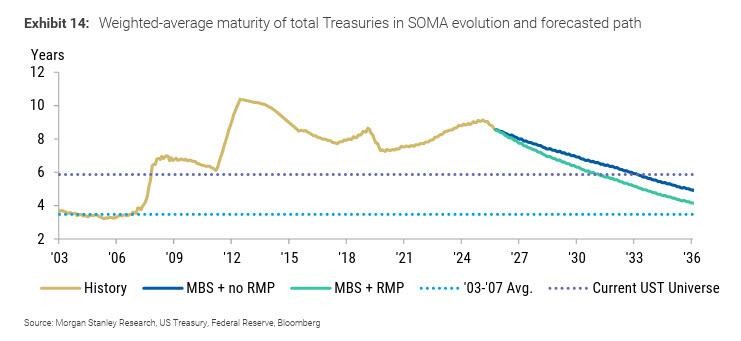
Holdings in the reverse repurchase agreement facility by foreign official institutions are another source that can be compressed. In recent years, holdings by foreign official institutions in the Federal Reserve's reverse repo pool have swollen to approximately $350 billion, and the Federal Reserve can bring this down by adjusting relevant terms.
The tiering mechanism for the Interest Rate on Reserve Balances (IORB) may be the most far-reaching tool. Carpenter believes that the Federal Reserve can continue to pay a rate close to market levels on a portion of reserves held by banks, while significantly lowering the interest paid on excess holdings—making it clearly lower than the yield on short-term Treasury bills. This will encourage banks to shift excess reserves into holding Treasury bills, thereby compressing the actual required reserve scale to about half of the current level while maintaining the "ample reserves" regime.
In addition, adjustments to regulatory rules such as the Liquidity Coverage Ratio (LCR) may also reduce banks' demand for holding reserves, further creating space for balance sheet reduction.
Treasury Supply Structure Is Key; Duration Risk May Not Rise
During the process of balance sheet reduction, the Federal Reserve will release the Treasury securities it holds, and the Treasury Department must refinance them in the market. Carpenter believes that this is precisely the core of the "asymmetry."
When banks increase their holdings of short-term Treasury bills due to IORB adjustments, it is natural for the Treasury Department to expand the issuance scale of short-term Treasury securities to meet the new demand—and this aligns highly with the Treasury Department's consistent preference for short-end financing. Carpenter estimates that issuing an additional approximately $1 trillion in short-term Treasury securities will not push their proportion out of the historical normal range.
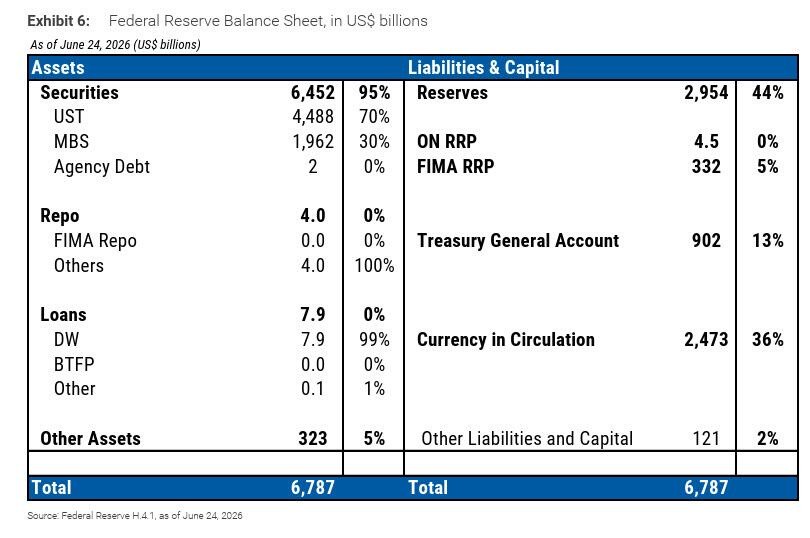
The ultimate result is: the Federal Reserve's balance sheet shrinks, but the overall duration risk borne by the market may not rise significantly. This forms a clear contrast to the logic commonly worried about in the market that "balance sheet reduction increases upward pressure on long-end interest rates."
Expectations for Balance Sheet Reduction Heat Up Under Warsh's Leadership, But Risks Remain
The report points out that current Federal Reserve Chair Warsh has long preferred to compress the Federal Reserve's market presence, a stance that has long been established. Although Warsh gave no clear guidance on the interest rate path or the direction of the balance sheet in his public statements in June, Morgan Stanley still judges that there is a high probability of substantive balance sheet reduction.
Carpenter also highlighted major risk factors. Once the Federal Reserve initiates active sales of Mortgage-Backed Securities (MBS), and if the scale is large, the market impact will be significant. In addition, the final direction of the balance sheet largely depends on the Treasury Department's debt issuance decisions, meaning that the Federal Reserve's balance sheet itself is not the only variable.
Carpenter emphasized that monetary policy stance and balance sheet size are two independent dimensions, and investors should not confuse them. Simply using the size of the balance sheet as a proxy indicator for policy tightness fundamentally ignores the complexity at the operational level.