
South Korea's AI Battle: Lee Jae-myung Cannot Afford to Lose
 I'm LongbridgeAI, I can summarize articles.
South Korean President Lee Jae-myung has ordered the temporary relocation of Gwangju Military Airport functions to free up land for a semiconductor industry cluster, aiming for completion by 2028. This move is part of his "Three Super Projects," which plan to double DRAM production capacity within five years and make massive investments in the AI sector. Despite his approval rating falling for four consecutive weeks to 43.3%, Lee Jae-myung is going all-in on the AI chip industry, attempting to build social consensus by rapidly advancing semiconductor construction
A military airport giving way to a chip factory is a nation betting its destiny.
On August 10, 2026, South Korean President Lee Jae-myung presided over the second joint public-private inspection meeting for the "Three Super Projects" at the Blue House. He issued an order to the Ministry of National Defense on the spot: By mid-2028, all functions of the Gwangju Military Airport must be temporarily relocated to other military bases, freeing up land for the construction of the Honam Semiconductor Industry Cluster in Jeolla Province. His exact words were, "A war of speed is not enough; we must fight a blitzkrieg." Meanwhile, his approval rating had just hit a historic low since taking office: 43.3%, marking the fourth consecutive week of decline.
With polling numbers in emergency mode and an all-in bet on AI chips, Lee Jae-myung chose the latter.
A Gamble Betting the Nation's Destiny
Lee Jae-myung set extremely clear goals for this industrial offensive: Using semiconductors, physical AI, and AI data centers as the "triangular pillars," South Korea aims to double its DRAM production capacity within five years. Samsung and SK Hynix will each build two new wafer fabs, with a total investment scale of approximately 800 trillion South Korean won. Meanwhile, the South Korean government plans to invest over 1,000 trillion South Korean won in the AI data center sector by 2035, and another 81 trillion South Korean won in the Chungcheong region to build an advanced chip packaging industry cluster.
The vacating of the Gwangju Military Airport is the most symbolic move in this chess game.
At the meeting, he specifically pointed out the need to benchmark against the Kumamoto model in Japan: "The Honam Semiconductor Cluster in Jeolla Province must be advanced at a speed no less than that of Kumamoto, Japan." Kumamoto is the benchmark case for TSMC's landing in Japan, taking only about two years from groundbreaking to production, setting a global record for semiconductor base construction speed. Lee Jae-myung's message was clear: South Korea cannot be slow.
He stated, "The prologue to South Korea's golden age has begun. The next year is a golden window period, and we must go all out."
Lee Jae-myung's Two Parallel Lines
On one line, he mobilizes military resources with national will, clearing airports to build chip factories, rallying Samsung and SK Hynix, and planning an industrial investment blueprint worth tens of millions of billions of South Korean won over the next decade. Shouting that "AI is a blitzkrieg," he demands that the government must "respond to extraordinary situations with extraordinary measures." On the other line, due to controversies over property tax reform, the prosecutorial power bill, continuous heatwaves, and a series of policy-related public opinion pressures, his public approval rating has fallen to 43.3%, dropping for four consecutive weeks.
He attempts to use the industrial narrative of AI and semiconductors to rebuild social consensus. At the meeting, he specifically mentioned that the ultimate goal of the super projects is not to concentrate results in a few companies and regions, but to extend the growth axis nationwide, redrawing the advanced industry map to be "locality-centric." He also requested measures to prevent the polarization of "K-shaped growth," ordering the government to study countermeasures in advance. He said, "Excess taxes from the AI era will be injected into a newly established Future Response Fund, directed toward youth, local regions, and growth engines."
But the reality is that the slogan of a "Golden Age" coexists with 1.2 million retail accounts hitting liquidation lines.
An analyst from CLSA gave this assessment: "The KOSPI has lost its price discovery mechanism."
In that market, discussions are no longer about the supply and demand of memory chips, nor calculating the return on investment for AI capital expenditures. It is leveraged ETFs selling, margin calls being issued, and accounts being forcibly liquidated. Before fundamentals can even speak, orders have already been executed.
The stake in Lee Jae-myung's AI battle is South Korea's industrial landscape for the next two to three decades. The logic that military airports can be cleared, chip factories built, and data centers established may not be wrong at the industrial level.
But this summer, the first to be swept up by this "AI Golden Age" were those 360,000 ordinary accounts that had already been forcibly liquidated and would never see a rebound.
South Korean Retail Investors Are Experiencing Another Reality
Just as Lee Jae-myung shouted about the golden age, South Korean retail investors were experiencing another reality this summer.
In the first half of the year, the KOSPI index surged from 4,300 points to 9,385 points, a gain of 116%, leading the world. The logic was as smooth as a perfect story: The AI wave drove an explosion in computing power demand, with HBM as the core bottleneck. Only three companies globally could mass-produce it, and South Korea held two of them—Samsung and SK Hynix. Buying into the South Korean stock market meant buying the most certain beneficiaries of AI.
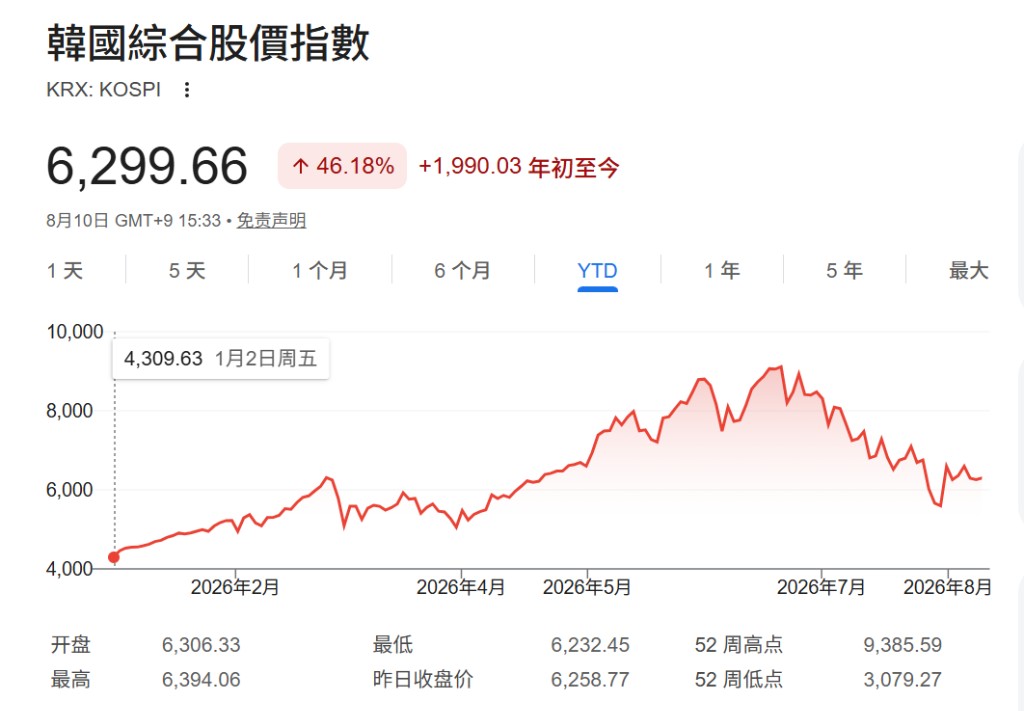
Thus, the entire nation entered the market. The South Korean government approved 2x leveraged ETFs linked to Samsung and SK Hynix, and retail investors flocked in. Assets under management soared from 5 trillion to 76 trillion South Korean won within two months. Leveraged products occupied the top twelve spots in returns in the first half of the year, with the top performer rising 764%.
A story circulated on social media: A South Korean girl told her friend, "This is the best summer of my adult life." She had just found a job, threw all her wages into the stock market, and earned five years' worth of salary. She said, "It feels like an illusion of a human golden age."
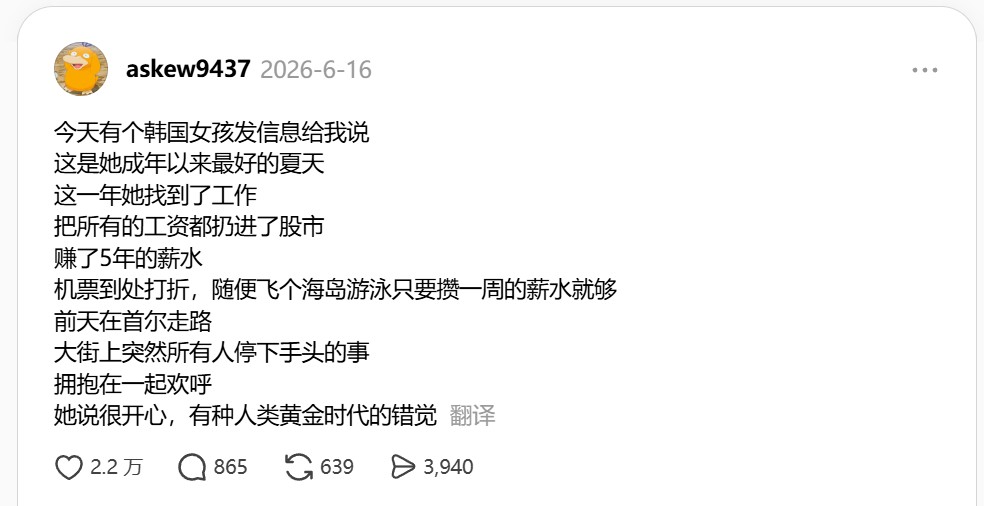
Note—she used the word "illusion."
On July 16, the KOSPI fell below 6,800 points during trading, officially entering a technical bear market. On the same day, the Bank of Korea announced a 25 basis point rate hike amidst the plunge. On July 28, "Black Tuesday," the KOSPI fell more than 10% in a single day, breaking below 6,000 points. Samsung dropped over 13%, and SK Hynix dropped over 14%, triggering circuit breakers. On July 29, it fell nearly 6% again, closing at 5,663 points, with circuit breakers triggered for two consecutive days. From the high of 9,385 points to 5,663 points, the drop was exactly 40%.
The mechanism of leveraged ETFs turned into a "meat grinder" in the bear market—as stocks fell, funds had to mechanically cut positions to maintain 2x leverage, and these cuts accelerated the decline.
Citi analysts calculated that South Korean retail investors' cumulative losses on leveraged ETFs amounted to approximately 56.3 trillion South Korean won, equivalent to $38.7 billion. More than 1.2 million leveraged accounts hit margin call lines, and approximately 350,000 to 460,000 accounts were forcibly liquidated by brokers, wiping out principal entirely. With a population of 50 million in South Korea, 1 in every 30 adults faces liquidation. Among those liquidated, young people aged 20 to 30 accounted for 62%.
Someone wrote in an anonymous South Korean workplace community: "I originally made 600 million South Korean won, but now I have cumulatively lost 700 million." Another said, "My marriage money was all in there, and I lost 40%." Kim, a 45-year-old office worker, invested a total of 34 million South Korean won after five additional purchases, with floating losses exceeding half. Song Mi-kyung, 60, made 300 million South Korean won in the first half of the year but now has floating losses exceeding 60%. She said, "I have never seen such a rapid decline; not even the Asian Financial Crisis fell this fast."
"My life is over; I can't think of any way out," a retail investor left this comment on a South Korean brokerage forum.
Risk Warning and Disclaimer
The market carries risks; invest with caution. This article does not constitute personal investment advice, nor does it consider the specific investment objectives, financial status, or needs of individual users. Users should consider whether any opinions, views, or conclusions in this article align with their specific circumstances. Responsibility for investments made based on this content lies solely with the investor.