
From GPUs to storage, then to semiconductor equipment and cloud computing! Asset management giant BlackRock increased its holdings in AI computing power in Q2, accurately predicting the rise of cloud giants
 I'm LongbridgeAI, I can summarize articles.
BlackRock's Q2 U.S. stock holdings increased to $6.73 trillion, a quarter-on-quarter growth of 18%. Its top ten holdings show clear signals: continuing to increase investments in AI computing infrastructure and cloud computing giants. The increase in holdings covers GPU, storage, semiconductor equipment, and cloud service providers like Amazon and Google, reflecting its ongoing optimism about the surge in global AI computing demand
According to the disclosure by the U.S. Securities and Exchange Commission (SEC), the largest asset management giant on Wall Street, BlackRock, submitted its second-quarter U.S. stock market holdings report (13F) for the period ending June 30, 2026.
Statistics show that BlackRock's total holdings market value in the second quarter was $6.73 trillion, up from $5.72 trillion in the previous quarter, indicating a significant 18% quarter-over-quarter increase in BlackRock's U.S. stock holdings during the second quarter, a period marked by profit-taking pressure in the stock market. The firm added 274 new stock positions in its portfolio during the second quarter, increased holdings in 3,606 stocks, reduced holdings in 1,322 stocks, and completely exited 263 stocks. The top ten holdings accounted for 28.01% of the total market value, reflecting a relatively high total weight of BlackRock's top ten holdings.
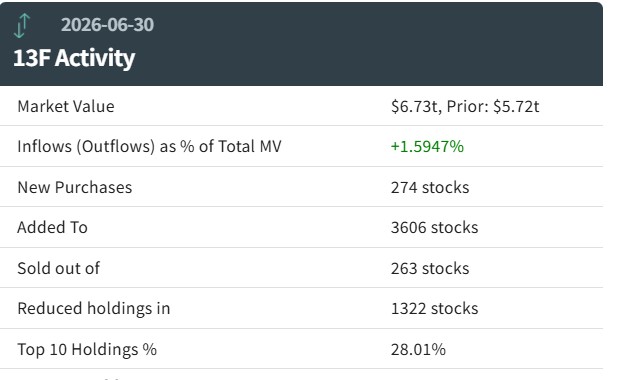
Among BlackRock's top ten heavy stock positions in the second quarter, the asset management giant sent a very clear signal of "continuing to increase investment in AI computing infrastructure and cloud computing giants." The new positions taken by BlackRock were not concentrated in a single GPU leader but were significantly spread along the entire AI computing capital expenditure chain, including "GPU/ASIC—HBM and DRAM—semiconductor equipment—data center high-speed optical interconnect—cloud computing infrastructure," particularly increasing positions in AMD, Broadcom, Micron, Applied Materials, and KLA, as well as ramping up investments in cloud computing leaders like Amazon, Google, and Microsoft (these cloud giants subsequently saw significant stock price increases in the third quarter). This indicates that BlackRock's vast capital has not dismissed the entire AI Capex cycle and the surge in global AI computing demand led by Anthropic and OpenAI due to fluctuations in AI hardware, but rather continues to hold and increase exposure to the multi-layered demand for "AI computing capacity bottlenecks."
The 13F submitted by BlackRock is a consolidated report at the group level, covering numerous investment management entities and product holdings under its discretionary investment authority, including a large number of iShares ETFs, index funds, mutual funds, and actively managed accounts, primarily reflecting the comprehensive holdings of client funds/fund products managed by BlackRock as an asset manager.
From a market structure perspective, the context of BlackRock's latest increase in holdings is particularly noteworthy: from the end of the second quarter to early July, AI hardware and semiconductors were experiencing significant deleveraging and profit-taking. According to Goldman Sachs Prime data, as of early July, U.S. hedge funds had net sold information technology and semiconductor/hardware stocks for the fourth consecutive week, with the "AI computing barometer" SOX (Philadelphia Semiconductor Index) dropping 4.2% in the week ending July 3; ** meanwhile, the market repeatedly questioned whether AI capital expenditures could deliver returns, whether storage price increases had peaked, and whether high valuations had exhausted future potential. It is in this environment of reduced risk appetite that BlackRock's holdings continued to increase in Nvidia, Broadcom, AMD, Micron, Applied Materials, and KLA, the "shovel sellers" of the AI era **
More importantly, this configuration logic is highly consistent with BlackRock's 2026 mid-term investment outlook: The BlackRock Investment Institute, a research arm of BlackRock, explicitly advises investors to continue gaining exposure to AI computing infrastructure by overweighting U.S. stocks, emphasizing that what is truly scarce in the current AI boom is not a specific AI large model, but rather the entire delivery process of AI data centers that encompasses AI GPUs/AI ASICs, high-performance CPUs for data centers, DRAM/NAND/HBM storage, AI PCBs, liquid cooling systems, data center optical interconnect systems, ABF substrates/glass substrates, MLCCs, advanced electronic fabrics, and extensive wafer foundry and advanced packaging, among others.
In the context of short-term capital deleveraging, extreme bullish positions and valuation compression in AI hardware and semiconductors, the world's largest asset management platform has sold off leading consumer giants like Costco and typical value stocks such as Berkshire Hathaway and AT&T, while firmly maintaining and even increasing its structural holdings in AI physical infrastructure. Notably, BlackRock is not only increasing its position in NVIDIA but is also adding to AMD, Broadcom, Micron, Applied Materials, KLA, and North American cloud computing giants. This approach of "spanning technology sectors such as cloud computing, networking, AI chips, storage, and semiconductor equipment" in AI thematic allocation seems more like a bet that the entire AI capital formation cycle is still in its early to mid-stages.
Specifically, the "AI chip leader" NVIDIA (NVDA.US) stock remains BlackRock's largest holding, with approximately 1.942 billion shares, a total holding market value of about $388.558 billion, accounting for 5.77% of the portfolio, an increase of 0.85% compared to the previous quarter.
The American consumer electronics giant Apple (AAPL.US) stock ranks as BlackRock's second-largest holding, with approximately 1.163 billion shares, a holding market value of about $336.525 billion, accounting for 5.00% of the portfolio, an increase of 1.60% compared to the previous quarter.
One of the cloud computing giants, Microsoft (MSFT.US) stock ranks as BlackRock's third-largest holding, with approximately 607 million shares, a holding market value of about $226.560 billion, accounting for 3.37% of the portfolio, an increase of 2.37% compared to the previous quarter.
The world's largest cloud computing leader, Amazon (AMZN.US) stock ranks as BlackRock's fourth-largest holding, with approximately 748 million shares, a holding market value of about $178.374 billion, accounting for 2.65% of the portfolio, an increase of 1.75% compared to the previous quarter.
Another cloud computing giant, Alphabet - A (GOOGL.US) stock ranks as BlackRock's fifth-largest holding, with approximately 461 million shares, a holding market value of about $164.738 billion, accounting for 2.45% of the portfolio, an increase of 3.13% compared to the previous quarter
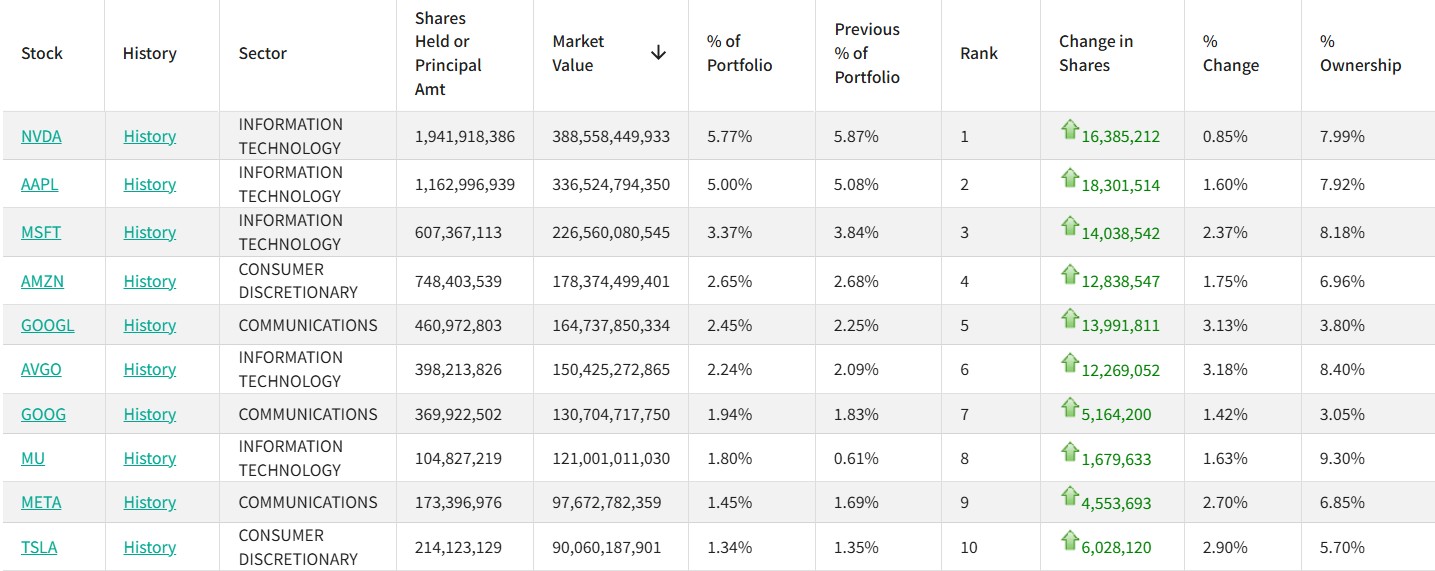
Among the top ten heavy positions, the stocks ranked 6-10 in BlackRock's position as of the end of the second quarter are: Broadcom (AVGO.US), Google Class C shares (GOOG.US), Micron Technology (MU.US), Facebook's parent company Meta Platforms (META.US), and Tesla (TSLA.US). Among them, Broadcom holds approximately 398 million shares, with a market value of about $150.425 billion, accounting for 2.24% of the portfolio, an increase of 3.18% from the previous quarter; Google Class C shares hold approximately 370 million shares, with a market value of about $130.705 billion, accounting for 1.94%, an increase of 1.42%; Micron Technology holds approximately 105 million shares, with a market value of about $121.001 billion, accounting for 1.80%, an increase of 1.63%; Meta holds approximately 173 million shares, with a market value of about $97.673 billion, accounting for 1.45%, an increase of 2.70%; Tesla holds approximately 214 million shares, with a market value of about $90.060 billion, accounting for 1.34%, an increase of 2.90%. Notably, the number of shares held in BlackRock's latest top ten heavy positions has all increased compared to the previous quarter, with core assets in AI computing power and cloud computing such as NVIDIA, Microsoft, Amazon, Google, Broadcom, and Micron still occupying the most important positions in the portfolio.
From the perspective of changes in holding ratios, the top five buying targets for BlackRock in the second quarter are: Micron, AMD, Applied Materials, Marvell Technology, and KLA; the top five selling targets for BlackRock in the second quarter are: Costco (COST.US), Honeywell (HON.US), Berkshire Hathaway B (BRK.B.US), AT&T (T.US), and Johnson & Johnson (JNJ.US).
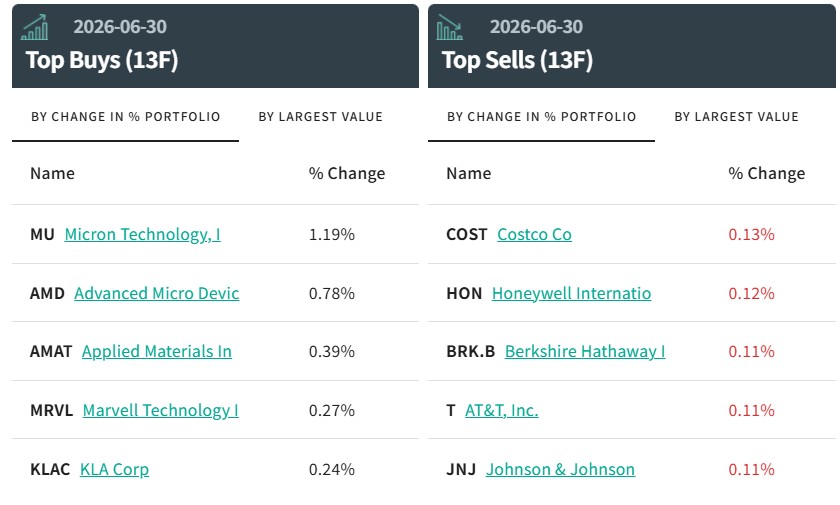
BlackRock's latest stock increase direction is highly concentrated on AI computing infrastructure and semiconductor capital expenditure chains: Micron corresponds to HBM/DRAM storage bottlenecks, AMD corresponds to AI GPUs and server computing clusters, Applied Materials and KLA correspond to advanced semiconductor equipment needed for advanced processes and storage expansion, while Marvell directly benefits from high-speed optical interconnects, custom AI ASICs, and optical communication demands in AI data centers. This highlights that despite the severe deleveraging and valuation compression in the semiconductor sector in the second quarter, BlackRock's overall holding structure is still further strengthening its heavy preference for investments in the main line of "GPU + storage + WFE + interconnect" and other AI physical infrastructure Unlike the top five purchases, which are almost entirely concentrated in semiconductors and AI infrastructure, BlackRock's reduction in allocations spans traditional defensive and value sectors such as consumer staples, industrials, financials, telecommunications, and healthcare, further highlighting the stark contrast in BlackRock's asset allocation structure in the second quarter—while AI-related tech assets experienced severe selling pressure, its portfolio did not significantly shift towards traditional defensive sectors for risk aversion, but instead relatively increased the weight of key "shovel sellers" in the AI computing power supply chain, showing a clear tendency of "reducing defensiveness and increasing allocation to AI computing infrastructure."