
First Time Since 1983! US Strategic Petroleum Reserve Falls Below 300 Million Barrels; Crude Oil Surges Over 4% Intraday
 I'm LongbridgeAI, I can summarize articles.
The release of strategic petroleum reserve data coincides with fluctuating expectations regarding the reopening of the Strait of Hormuz, leading oil prices to re-price supply risks
The US Strategic Petroleum Reserve (SPR) hit a new low last week, falling below 300 million barrels for the first time since 1983.
Data from the US Department of Energy shows that for the week ending August 7, the US SPR decreased by approximately 6.1 million barrels to 298.3 million barrels. This not only breached the 300 million barrel threshold but also refreshed the lowest level since 1983, continuing its approach toward the record low of around 270 million barrels set in April 1982.
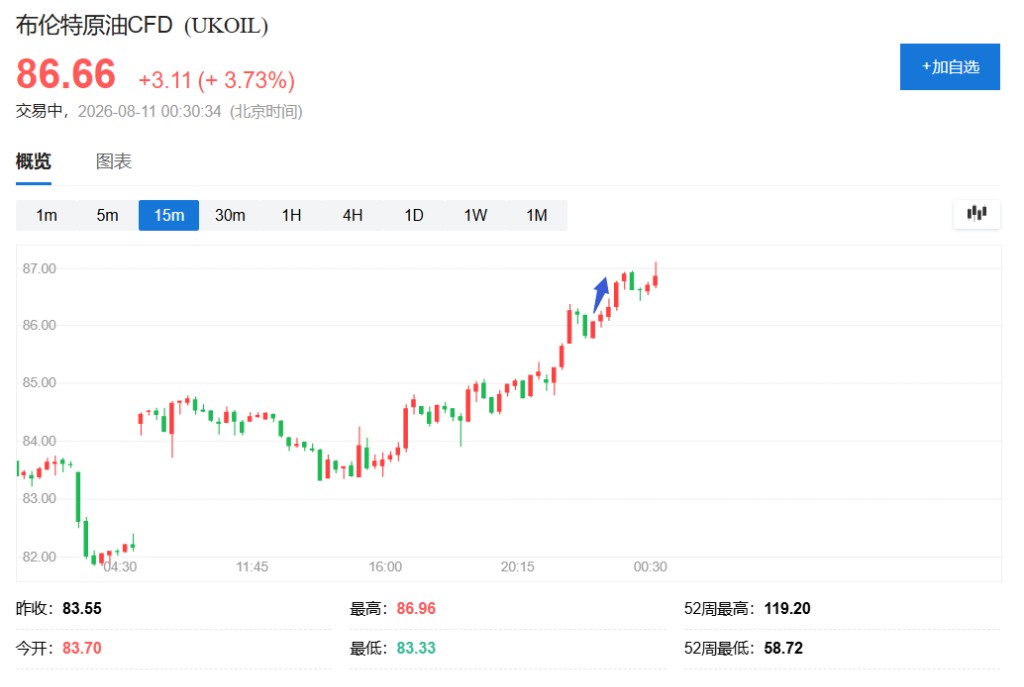
Following the release of the above SPR data, gains in international oil prices expanded further. Toward the end of the early US trading session, US West Texas Intermediate crude futures briefly rose above $81.30, while Brent crude surged past $86.90, with intraday gains for both exceeding 4%. In the previous two weeks, WTI and Brent had cumulatively fallen by more than 10%, as the market had bet on the restoration of navigation in the Strait of Hormuz and an easing of supply risks. However, the latest developments have once again caused these expectations to fluctuate.
Strategic Petroleum Reserve Continues to Refresh Lows Not Seen Since 1983
The drop in the SPR to 298.3 million barrels marks another key node in the ongoing downward trend of US strategic oil reserves in recent years.
Data released by the US Department of Energy last month already showed that the SPR in mid-to-late July fell to its lowest level since 1983; S&P Global had also previously reported that US SPR inventories had dropped to their lowest level since 1983.
As inventories declined further, the US strategic petroleum reserve has now continuously refreshed this record, officially falling below 300 million barrels.
The historical lowest inventory level for the US SPR was 270.5 million barrels, recorded in April 1982. In the early 1980s, the US government was in the phase of massively building up its strategic petroleum reserves, after which the SPR long remained at scales far higher than current levels.
The background to this inventory decline is related to the continuous release of the SPR by the US in recent years. The US massively released strategic reserves in 2022 when energy supply concerns were triggered by the Russia-Ukraine conflict. Since then, inventories have remained near historical lows. Although replenishment has begun in recent years, the recovery speed has been insufficient to reverse the previous sharp decline.
Therefore, the significance of the current inventory level is not just a reduction of a few million barrels, but rather that the policy buffer space the US strategic petroleum reserve can provide against future supply shocks is shrinking.
Fluctuating Expectations for Hormuz Reopening Lead Oil Prices to Re-price Supply Risks
An important backdrop for the rise in oil prices on Monday was the shaking of market expectations regarding the normalization of navigation through the Strait of Hormuz.
According to reports, Iran stated that its agreement with Oman regarding a new channel in the Strait of Hormuz had entered the final stages, but Iran simultaneously proposed other conditions, leaving uncertainty about when normal commercial shipping in the strait would resume. Analysts stated that traders would not fully remove the geopolitical risk premium previously priced into oil until they saw "verifiable evidence" such as actual tanker transit or formal agreements.
Reports pointed out that Iran's demands for the reopening of Hormuz, including US troop withdrawal, lifting of sanctions, and war reparations, have caused the market to reassess the likelihood of the strait returning to normal shipping operations in the short term.
This has changed the trading logic of the oil market.
In the previous two weeks, oil prices had fallen significantly, with the market primarily trading on expectations that the Strait of Hormuz might resume navigation and supplies would gradually recover. However, as uncertainty surrounding related negotiations and navigation arrangements heated up again, crude oil prices began to re-price the risk of supply disruptions.
International crude oil futures remained mostly higher throughout Monday. They briefly turned slightly lower before the European stock open, but turned higher during the early European session and maintained an upward trend. After data emerged toward the end of the early US session showing the US SPR had fallen below 300 million barrels, gains in oil prices expanded further.
Cumulative Drop of Over 10% in Previous Two Weeks; Oil Prices Had Largely Digested "Supply Recovery"
This rise occurred after oil prices had fallen sharply for two consecutive weeks.
As of last Friday, WTI had risen for two consecutive days after three straight declines, while Brent had risen for three consecutive days after two straight declines. However, the two benchmark oil prices still cumulatively fell by 7.67% and 4.98% respectively last week. In the two weeks leading up to last Friday, WTI cumulatively fell 12.46%, and Brent cumulatively fell 13.67%.
In other words, before this round of rebound, oil prices had already undergone a considerable adjustment, and the market had largely digested expectations such as the reopening of Hormuz and the easing of supply risks.
On Friday, WTI September crude oil futures closed up $0.89, or 1.15%, at $78.18 per barrel; Brent October crude oil futures closed up $1.06, or 1.29%, at $83.55 per barrel.
Oil prices breaking back above the $80 mark on Monday means the market is partially reclaiming the risk premium that had previously disappeared.
The Lower the SPR, the More Limited the US Buffer Space Against Supply Shocks
For the crude oil market, the SPR falling below 300 million barrels does not mean the US is about to face an oil supply shortage.
The US still possesses huge commercial crude oil inventories, high domestic crude oil production, and the ability to obtain supplies from the global market. Therefore, one cannot simply equate the decline in SPR inventories with a crisis in US oil supply security.
However, the role of strategic reserves is inherently to provide additional buffering in the event of major supply disruptions.
This means that with supply risks still present in the Strait of Hormuz, the continuous decline in the SPR will make the market focus more on one question: If global oil supplies suffer a severe shock again, to what extent can the US government stabilize the market by releasing strategic reserves?
Although the current US SPR is still higher than the historical low of 270.5 million barrels in 1982, it is getting increasingly close to this level.
More importantly, the current inventory level appears at a time when there is significant uncertainty in the global oil supply chain itself. The Strait of Hormuz carries about one-fifth of global oil transportation, and any delay in the process of restoring navigation could quickly push up the supply risk premium in the crude oil market again.