
HOOD: Is the 'Robin Hood' of US retail investors really Trump's lost cause?
 I'm LongbridgeAI, I can summarize articles.
Many Longbridge community members asked Dolphin Research to update our take on HOOD's Q2 print. I reviewed the data and highlight a few key points. Shares moved higher as investors reappraised the benefit of Trump administration backing.
1) The $25k pattern day trading equity restriction was lifted on Jun 4, and under the Trump accounts program, Robinhood provides the front-end white-label app and customer service. These two developments reinforced the perceived Gov. support, helping the stock. 2) Jun markets were hot: storage names surged and SpaceX listed. The U.S.-Canada-Mexico World Cup kicking off in early Jun also set the stage for event contracts to scale. 3) Robinhood's Jun operating data showed sharp beats vs. sell-side expectations in equities, options, and event contracts, excluding crypto. Investors concluded that even with a soft virtual-asset backdrop, Robinhood is back.
When the company reported on Jul 29, the overall outcome was solid and broadly in line with elevated expectations. For short-term trading capital, the positive catalyst was priced, and a myopic tape turned soggy. Profit-taking and some capital rotation were normal.
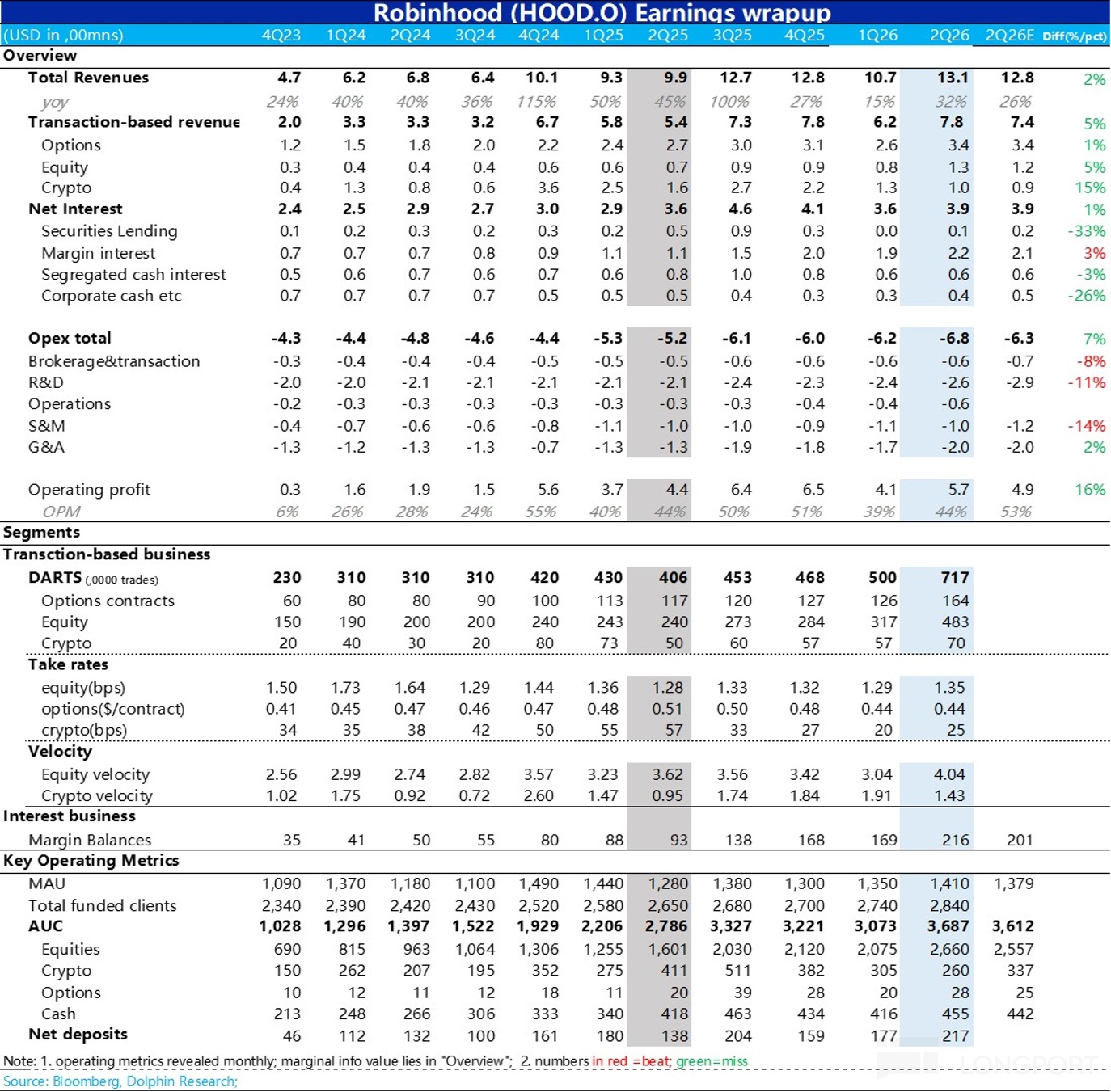
Dolphin Research is more focused on the longer-term trends reflected in each quarter's evolution. Below are the key structural takeaways.
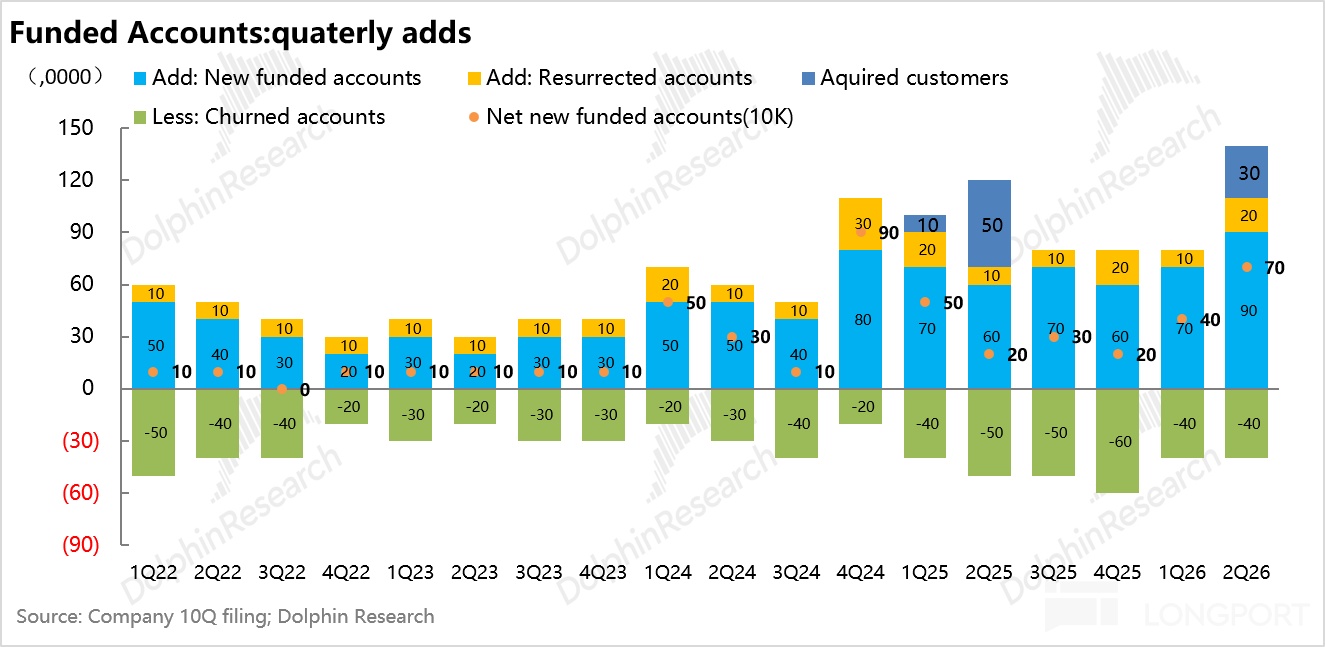
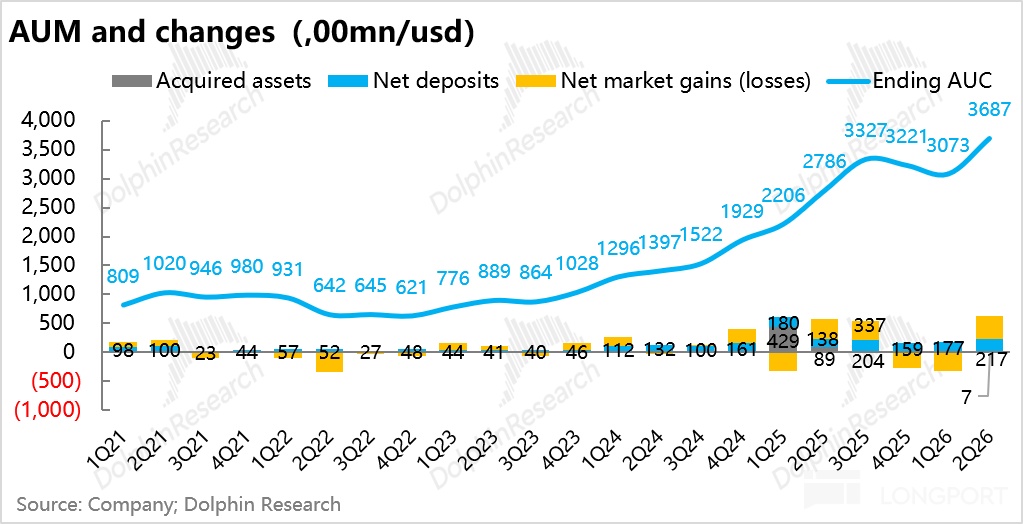
1) User and asset growth: Excluding the 300k users acquired via the Canadian crypto platform, net adds of funded accounts reached 700k, indicating faster customer acquisition. Net asset inflows were $21.7bn, a record high for a single quarter, and quarterly net inflows have been >$10bn for two and a half years. Momentum in both users and assets remains robust.
2) Rapid product innovation: a) Rothera event-contract platform: Robinhood formed a JV with Susquehanna (SIG) to acquire 90% of Rothera's predecessor. In Jun, Rothera, a CFTC-licensed exchange and clearinghouse, completed the tri-license loop of exchange, clearing, and brokerage for event contracts. This allows Robinhood to price at a $0.01 take rate per contract vs. the traditional $0.02, with per-contract revenue at ~$0.0118 (including $0.01 take plus clearing/settlement fees). Q2 event-contract trading revenue reached $156mn, second only to options within transaction revenues and above equities, offsetting ~40% YoY weakness in crypto trading.
b) AI Agent trading services: Users can connect their self-built trading agents, via MCP, to dedicated agent sub-accounts on Robinhood. AI then assists with trading under user-defined models. The design introduces some user-level adoption thresholds but importantly avoids compliance risks for new products, showcasing fast platform innovation.
c) Virtual-asset lending: Based on the native Robinhood Chain and its stablecoin USDG, the platform launched Robinhood Earn lending services. This expands the crypto financial stack around HOOD's ecosystem.
d) Robinhood Social: Already live for some time, the company now set a clear goal: not only should trading happen on Robinhood, but idea generation should be contributed by the platform. HOOD aims to seriously build content and post distribution to support decision-making.
e) Robinhood Strategies: A managed advice service—effectively HOOD's asset management offering—allocating portfolios per user goals, horizons, and risk tolerance. From $50, users access ETF portfolios managed by Robinhood's investment team, and at $500+, single-stock allocations within portfolios unlock. This lowers the entry bar for discretionary and model-driven allocation.
f) Robinhood Cortex (AI research assistant): Currently supports AI summaries of news and trading signals, analyzes trading trends and opportunities, and serves as a conversational assistant for order placement and account settings. Feature depth is expanding steadily.
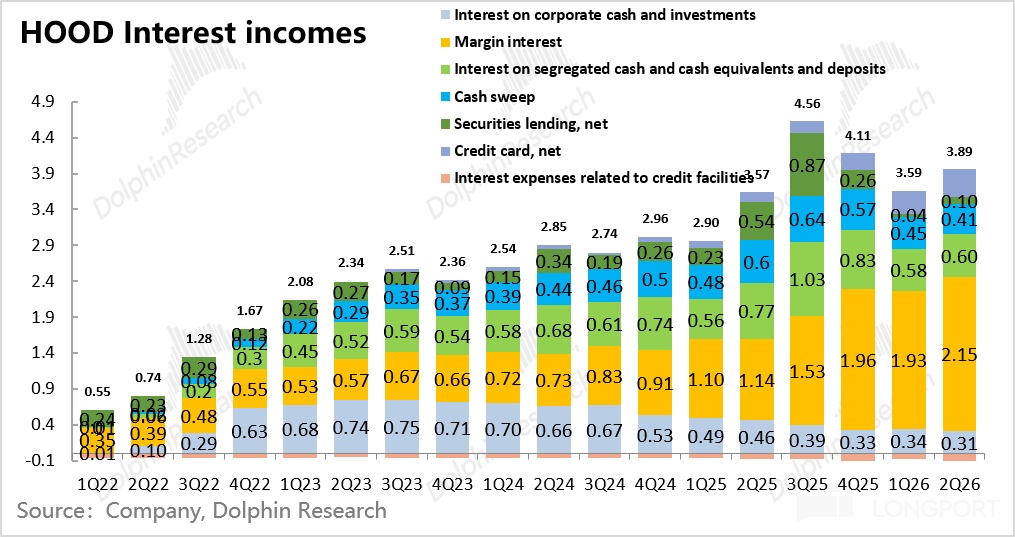
3) Has the lifting of the $25k day-trading equity rule helped yet? Previously, margin accounts engaged in day trading had to maintain ≥$25k in equity (positions + cash − margin debt). With the PDT flag removed, that $25k threshold is gone; brokers now calculate purchasing power based on holdings and maintenance margin. Post-lifting, users can essentially max out purchasing power for intraday round trips, and borrowing platform funds intraday carries no interest. This benefits HOOD in two ways: a) higher trading activity and frequency, and b) if borrowing extends past T+1, the balance shifts from non-interest-bearing to interest-bearing, boosting interest income. However, this policy only took effect on Jun 4, leaving less than a month in Q2, and the company did not provide quant metrics this quarter, implying no clear observable conclusion yet. Still, interest-based revenues show margin lending carrying more than half the load, reaching $216mn, with margin balances at $21.6bn (+128% YoY).
To fund margin lending, the company moved part of user cash sweep balances (deposits invested in partner banks' products) onto HOOD's balance sheet within user cash balances. Users receive equivalent interest, effectively providing low-cost funding for margin. This balance-sheet shift supports scalable lending economics.
4) Is the Trump accounts service showing results? This program offers securities accounts for U.S. children under 18 with SSNs, with combined personal and employer contributions capped at $5,000 per year. Funds can only buy specified low-fee broad U.S. equity index funds/ETFs. For children born 2025–2028, the Gov. seeds $1,000 per account for free (the recent market quip: teaching Americans to invest from childhood). Withdrawals are barred before age 18, after which accounts convert to traditional IRAs. Per company description, Dolphin Research understands HOOD primarily handles the white-label app front end for Trump accounts, plus some customer service, custody, and brokerage, while the Treasury operates and controls the app. Pricing follows a cost-plus model. There are 7mn registered children; those nearing 18 can convert to standard IRAs. If clients do not transfer out, HOOD effectively gains funded accounts and assets at low acquisition cost. Near-term IT infra revenue is modest ($25mn recognized this quarter), with low GPM given cost-plus and limited scale effects. The long-term goal matters far more: retaining these users after conversion to traditional IRAs so that, at 18, they become the young, higher-frequency, higher-asset users HOOD seeks.
What reassures Dolphin Research is that rapid product rollout is paired with financial discipline. Q2 headcount was cut by 10%, ending at 2,998; excluding ~450 employees from M&A, organic headcount was ~2,500. Layoffs drove ~$23mn in restructuring charges.
Stripping one-offs, SBC, and D&A, Adj. EBITDA reached $741mn with a 57% margin. Sequentially, revenue rose $240mn, of which $200mn converted to incremental profit, underscoring strong execution. Operating leverage is tracking well.
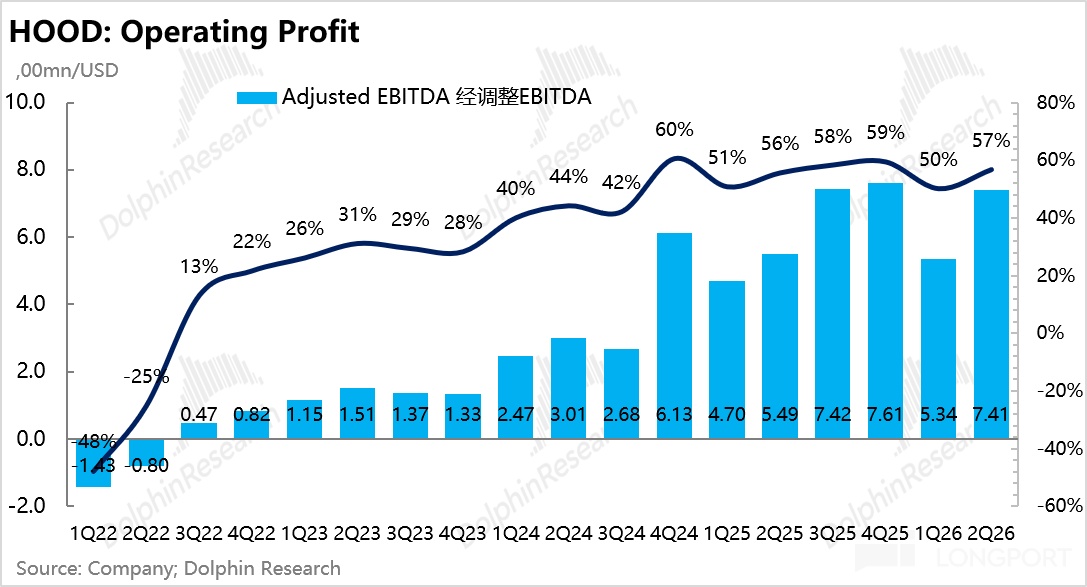
In sum, after two years of rapid iteration and innovation, HOOD's product lines have become quite diversified. Last year, when crypto was in a bull phase, the concern was who would fill the hole if that cycle faded by 2026; event contracts have stepped in on time. Building the Trump accounts framework also adds a layer of Gov. platforming and endorsement. Longer-term, most lines appear set for steady growth, with user adds and net asset inflows trending higher. After sustained observation over the past couple of years, Dolphin Research believes HOOD's execution and credibility are steadily improving.
That said, HOOD remains a big Beta play to market conditions and cannot soar like Gov.-backed, CAPEX-heavy AI names. Even if it rallies faster than fundamentals for a spell, pullbacks and base-building are likely until earnings catch up. Currently, quarterly revenue is still below $1.5bn, or <$6bn annualized.
Even assuming $6bn revenue in 2027 with a 60% margin, annual profit would be ~$3.6bn. At 30x PE, that implies a ~$100bn market cap, broadly consistent with Dolphin Research's Q4 view. That suggests ~15% upside, but with market beta risk, making it somewhat unappealing near term.
For high-quality names with strong long-term prospects but high near-term Beta, investors willing to hold should wait for risk-off tapes to create better entry prices. Then, as markets recover, valuation elasticity can work in your favor. Timing the cycle improves risk-reward.
Dolphin Research notes HOOD fell from ~$120 at the start of the year to ~95 now even after some recovery, leaving many investors still underwater. Some therefore joke HOOD is the least impressive among companies supported by the Trump administration. Compared to the hot hand at INTC this year, HOOD does look plain. But the core issue is that last year's market fed the company too many 'mirage-like' stories and linearly extrapolated valuations, while the brokerage platform industry is a super Beta. Mean-reversion in valuation was inevitable.
Post re-rating, the current multi-line growth at HOOD gives us more confidence in our view: Robinhood is a short-term Beta and long-term Alpha asset worth sticking with. <End>
Risk disclosure and statement: Dolphin Research disclaimer and general disclosure