
 I'm LongbridgeAI, I can summarize articles.
The iPhone 18 Pro Max could see its bill of materials costs rise by up to $300 due to soaring prices for memory, NAND, and 2nm chips. Counterpoint Research predicts Apple will adopt a "graded asymmetric" pricing strategy, raising prices primarily on high-capacity models to mitigate the impact on entry-level devices. Meanwhile, Apple will rely on its services business (such as AI subscriptions), supply chain diversification, and refurbished device channels to hedge against these pressures
Apple's upcoming iPhone 18 series is facing significant cost pressures. Rising prices for memory, storage, and advanced-process chips could push the bill of materials (BOM) costs for new devices up by approximately $300, making Apple's pricing strategy a key focus for the market.
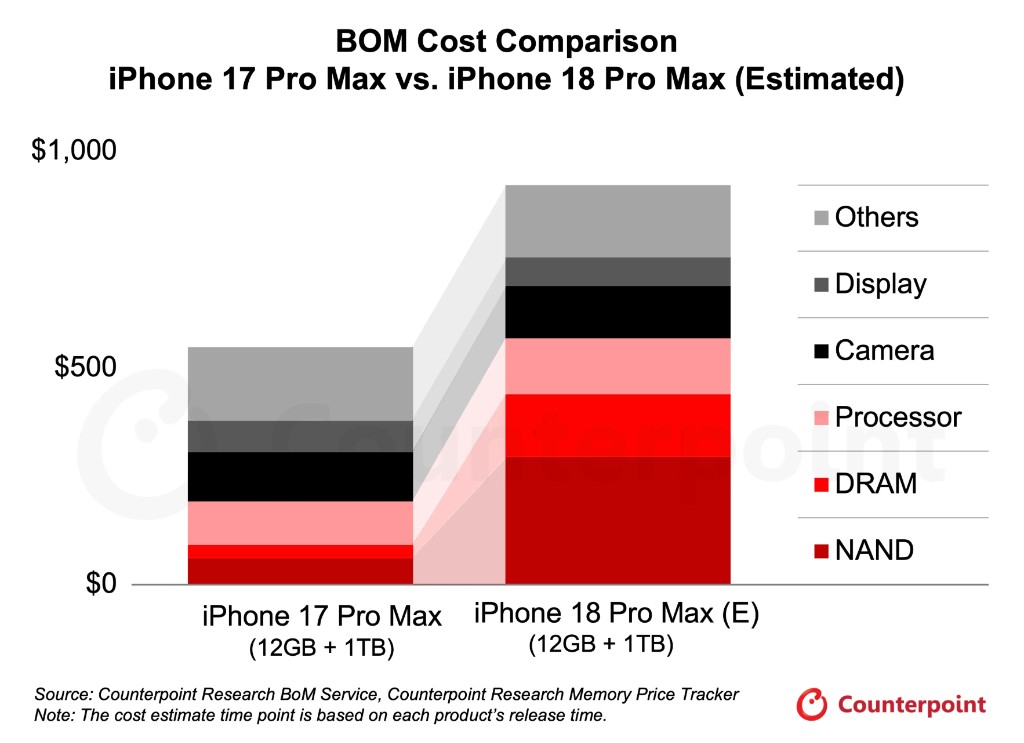
According to analysis by global technology market research firm Counterpoint Research, the BOM cost for the iPhone 18 Pro Max (12GB+1TB) could increase by about $300 compared to the previous generation, while the cost increase for the base and Pro models with 256GB and 512GB storage would be around $200 to $250. The firm expects Apple to implement a "graded, asymmetric" pricing strategy, concentrating larger price hikes on high-capacity models to reduce the price shock for entry-level devices.
At the same time, Apple will hedge against cost pressures through its services business, supply chain adjustments, and leasing and secondary markets. Analysts believe the current component price hike cycle will last at least another 18 months, potentially having a sustained impact on the pricing strategies for future generations of iPhones.
Memory and Advanced Processes Drive Up Costs
Counterpoint Research's BOM calculations show that cost increases across different capacities and models are uneven. Since high-capacity versions plan to use more cost-effective NAND solutions, the proportional cost increase for mid-to-low capacity models is actually higher.
The core drivers of cost increases come from two directions. According to Counterpoint Research's monthly memory and storage price tracker, over the past 12 months, the average price of DRAM has risen by 400%, and the average price of NAND has increased by over 300%.
Meanwhile, Apple is shifting to A-series chips based on the 2nm process for the iPhone 18 series, and TSMC's wafer prices for advanced processes have undergone multiple rounds of increases, further driving up Apple's procurement costs.
In terms of supply chain priorities, current chip capacity allocation follows the order of data centers, automotive, PCs, with smartphones ranking last. This means Apple's bargaining power in negotiations with suppliers has weakened.
Price Hikes May Concentrate on High-End Models
Facing cost pressures, Counterpoint Research expects Apple to adopt a "graded asymmetric" pricing strategy—concentrating larger price increases on high-capacity versions while keeping rises relatively moderate for entry-level versions to avoid excessive price shock for consumers.
The logic behind this strategy is that high-capacity versions use more cost-effective NAND solutions, so nominally larger price hikes are actually more conducive to improving profit margins; meanwhile, keeping entry-level versions relatively low-priced helps Apple maintain price attractiveness in competition with Android phones.
Neil Shah, an analyst at the firm, pointed out that this is essentially a strategic choice rather than purely a cost issue: if Apple prioritizes capturing Android user share, price increases for entry-level models will remain restrained, with high-end models bearing more of the pressure; if protecting profit margins is the priority, price increases across all tiers will tend to be consistent.
Services Business Becomes a Key Buffer
Beyond hardware, the services business may become an important tool for Apple to hedge against cost pressures. Apple's services business generates annual revenue of approximately $120 billion and boasts high profit margins.
The firm expects that Apple may explore subscription monetization through Apple Intelligence. If it launches a subscription service focused on on-device AI for about $10 per month, it could generate $10 billion to $20 billion in new services revenue in the first year.
However, willingness to pay for Apple Intelligence remains to be verified, and large-scale commercialization may not materialize until the second year of the iPhone 18's lifecycle.
On the supply chain front, Apple is also promoting supplier diversification, signing long-term procurement agreements, and continuing to compress costs for non-memory components such as displays, cameras, and casings. Changxin Memory Technologies (CXMT) is listed as a potential memory supplier, but its actual role remains uncertain.
Additionally, carrier subsidies, leasing plans, and the secondary market may also help reduce consumer sensitivity to price hikes. If the device usage cycle extends to 36 to 40 months, a $200 price increase amortizes to about $5 per month, making the actual payment pressure relatively limited.
Three Key Variables Determine Final Pricing
The market will closely watch three signals in the future: first, the price gap between the base and high-end iPhone 18 models, which will reflect Apple's trade-off between market share and profits; second, the subscription pricing and user penetration rate of Apple Intelligence; and third, the progress of Apple's long-term procurement agreements with memory suppliers.
Furthermore, the upgrade to 16GB memory for the iPhone 19 and subsequent models, as well as Apple and Google's promotion of on-device quantization and compression of AI models, will also influence memory demand and cost trends over the next two years.
Against the backdrop of component price hikes that may persist for at least 18 months, the price increase for the iPhone 18 may just be the beginning. What Apple truly needs to resolve is how to find a new balance among costs, profits, and market share.