
Philadelphia Semiconductor Index Poised to Return to 'Bull Market,' Analysts Pour Cold Water
 I'm LongbridgeAI, I can summarize articles.
Driven by strong earnings from downstream AI companies, the Philadelphia Semiconductor Index rose 2.5% on Wednesday, just 1% shy of a technical bull market. However, Dan Kemp, founder of Portfolio Thinking, noted that CoreWeave's revenue guidance was conservative and interest expenses were high, suggesting that backlog orders may not translate into realized revenue. Brian Mulberry, chief strategist at Zacks, affirmed the spread of demand to infrastructure but warned of fundamental divergence, noting that not all chip stocks are benefiting
The U.S. chip sector rebounded sharply driven by strong earnings reports, coming within a step of a technical bull market. However, some analysts warned that backlog figures do not necessarily equate to realized revenue, and questions remain about the sustainability of AI infrastructure investment.
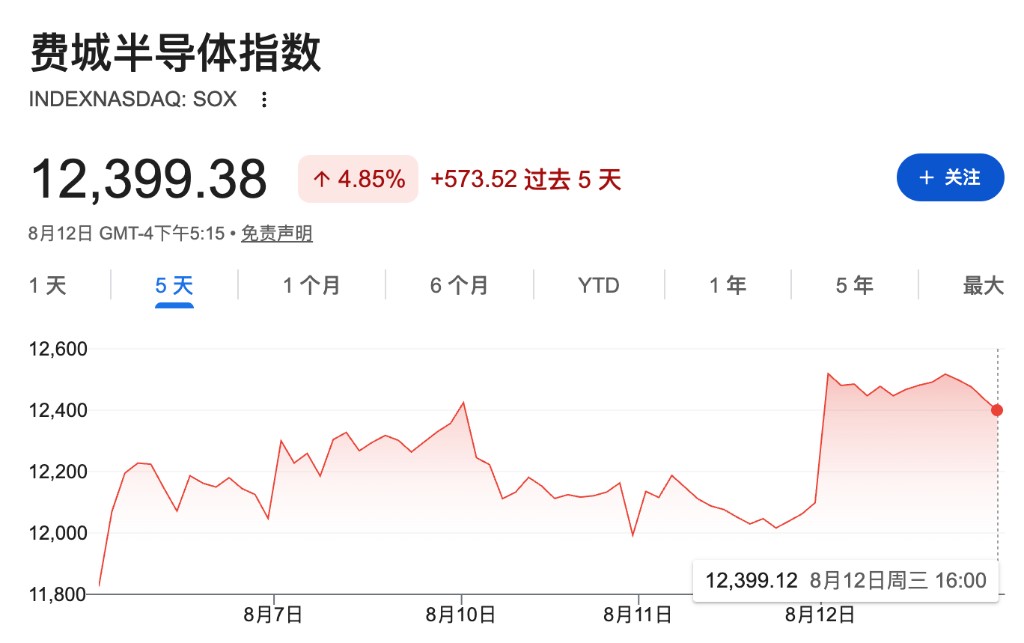
On Wednesday, the Philadelphia Semiconductor Index (SOX) closed up 2.49% at 12,399.38 points, just about 1.1% away from the 12,536.99 points required to enter a bull market. This rally was ignited by earnings reports from CoreWeave, Super Micro Computer, and Lumentum, all of which showed that AI spending remains robust, with their shares surging approximately 19%, 19%, and 13% respectively in a single day.
However, Dan Kemp, founder of investment advisory firm Portfolio Thinking, poured cold water on market sentiment.
He pointed out that CoreWeave raised its full-year capital expenditure plan from $31–35 billion to $35–39 billion, yet its revenue guidance remained "far more conservative," and the company's net interest expense for the quarter reached $640 million, while adjusted operating profit was only $128 million. He stated, "We have not yet seen consumer and corporate spending sufficient to support commitments of this magnitude."
Downstream AI Chain Earnings Boost Sector Sentiment
On Wednesday, the rally in chip stocks was broad-based. In the memory chip sector, SanDisk rose about 6%, Micron Technology rose about 5%, and SK Hynix's American Depositary Receipts surged 9%; AI chip leader Nvidia rose 3%.
The direct catalyst for this rise came from multiple earnings reports released after the bell on Tuesday. Brian Mulberry, Chief Market Strategist at Zacks Investment Management, stated in written comments that these earnings reports "help confirm that the reach of the AI trade is expanding, not just growing in scale."
He explained that CoreWeave confirmed that GPU demand remains strong, while Lumentum demonstrated how this demand is further driving the need for data center power and operational infrastructure.
Dan Kemp also agreed that the earnings reports of companies downstream in the AI supply chain, such as CoreWeave and Super Micro, which are responsible for chip connectivity and installation, provided investors with a window to observe real chip demand, further supporting market optimism for the sector.
In addition, he believed that the U.S. Consumer Price Index (CPI) data released on Wednesday, which largely matched Wall Street expectations, also contributed to the rise in chip stocks.
Backlog Figures Raise Questions
Despite high market sentiment, some analysts remain reserved about the substance of backlog figures. Both CoreWeave and Super Micro emphasized their growing order backlogs in their earnings reports, with Super Micro reiterating that its new orders for the June quarter exceeded $60 billion.
Dan Kemp expressed skepticism about these figures, citing the possibility that some orders could be canceled or delayed. "Investors have the right to view the huge order backlog as a positive signal, but it should be priced as a range of possible outcomes rather than realized revenue," he said.
He further pointed out that for long-term investors, the core question is whether the growth rate of demand is faster than the expectations implied by stock prices. He stated, "On this point, the evidence is far less reassuring."
Fundamental Divergence: Not All Chip Stocks Benefit Equally
Brian Mulberry emphasized that not all chip companies can benefit equally from this AI boom, and fundamentals will ultimately be more important than simple price momentum. He stated that investors are currently seeking accelerated growth rather than simply chasing the rally.
In his view, the companies with the most solid fundamentals include Nvidia, Broadcom, and optical network supplier Coherent—the latter's stock rose more than 8% on Wednesday. Dan Kemp held a similar view, believing that the degree of match between demand growth and valuation is the key to judging long-term investment value.