
Morgan Stanley Analyzes SpaceX's Fastest Path to '1 Terawatt Compute': Not Data Centers, but 2.2 Billion Robots
 I'm LongbridgeAI, I can summarize articles.
In a latest research report, Morgan Stanley analyst Adam Jonas pointed out that the fastest path for SpaceX to achieve 1 terawatt of computing power is not through traditional data centers, but by relying on a cluster of 2.2 billion robots expected by 2040. With each robot equipped with 500 watts of computing power and connected via Starlink to form a "distributed inference cloud," the total computing power could reach 1.1 terawatts. This view, which has been overlooked by the market, far exceeds Morgan Stanley's own model prediction of 380 gigawatts, emphasizing the importance of a hybrid architecture of edge nodes under the collaboration between Tesla and SpaceX
The fastest path to 1 terawatt of computing power may lie in a place no one is talking about—the robot swarm.
According to Zhuifeng Trading Desk, on August 13, Morgan Stanley analyst Adam Jonas released a latest research report analyzing four key narratives for SpaceX this year. He proposed a judgment overlooked by the market: by 2040, the distributed computing power of robot clusters could help SpaceX reach the 1 terawatt compute target faster than any data center.
2.2 Billion Robots: Another Path to 1 Terawatt Compute
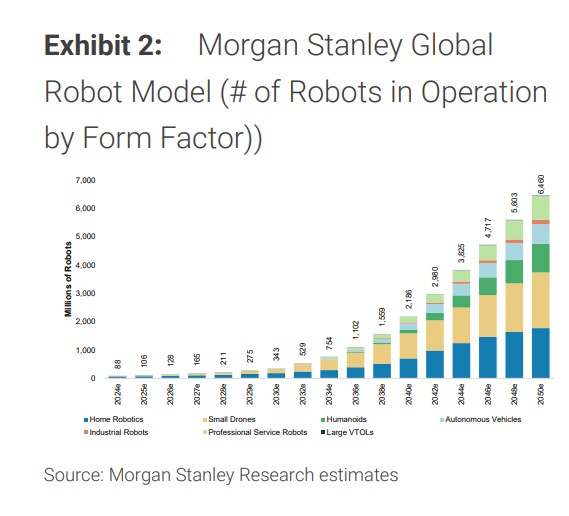
In its global robotics model, Morgan Stanley estimates that the total number of robots of various forms will reach approximately 2.2 billion by 2040.
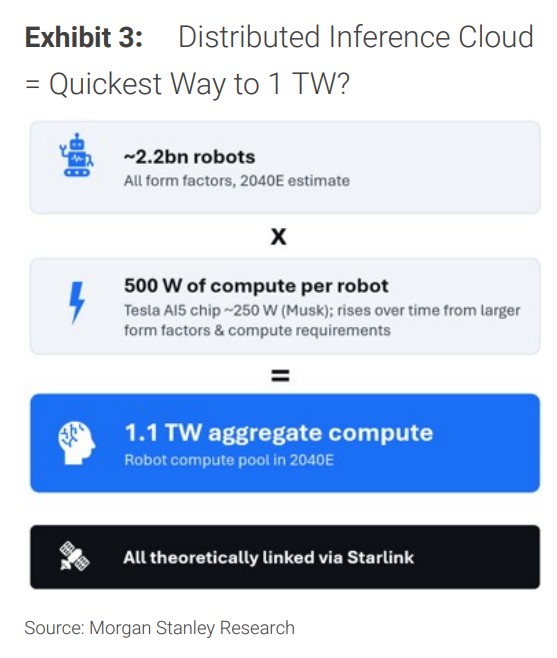
The key assumption is that each robot is equipped with 500 watts of computing power, meaning 2.2 billion units would collectively generate about 1.1 terawatts of computing power. The reference basis is Elon Musk's statement that the Tesla AI5 chip designed for the Optimus humanoid robot has a power consumption of 250 watts. Morgan Stanley believes this figure will rise over time as computing demands increase and forms expand.
Thus, 2.2 billion units × 500 watts = 1.1 terawatts, which could theoretically all be connected via Starlink.
This is what Morgan Stanley calls the "distributed inference cloud"—a network composed of fixed and mobile edge nodes connecting to large-scale data center clusters, forming a hybrid computing architecture.
For comparison, Morgan Stanley's own SpaceX model predicts that SpaceX's computing scale will be approximately 380 gigawatts by 2040, far below 1 terawatt. Musk has publicly discussed plans to build a "Terafab" (terawatt-scale compute factory), but external discussions have almost exclusively focused on ground-based or orbital data centers, with little attention paid to this path.
Morgan Stanley pointed out that Tesla investors are familiar with the concept of a "distributed inference cloud"—Musk has frequently discussed leveraging idle vehicles and Megapods (modular AI compute boxes) deployed at Supercharger stations to build a large-scale distributed computing network. As collaboration between SpaceX and Tesla deepens, SpaceX investors also need to become familiar with this compute deployment logic.
Grok: From Catching Up to the Forefront
Beyond the compute narrative, Morgan Stanley is also paying attention to the progress of SpaceX's AI models.
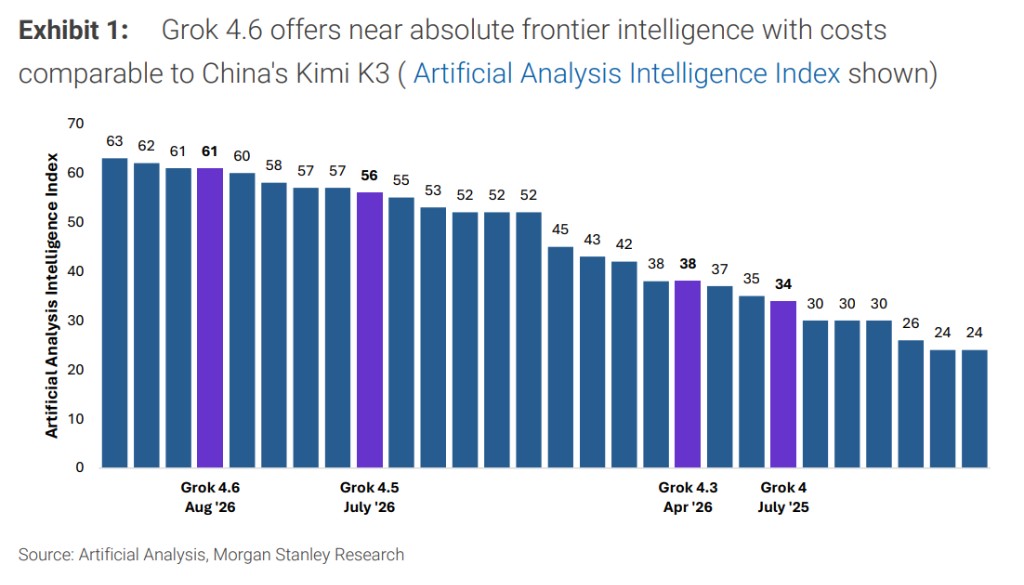
Grok 4.6 has reached a score of 61 on the Artificial Analysis Intelligence Index, close to the current highest score of 63, and higher than Grok 4.5 (56 points) released in mid-July and Grok 4.3 (38 points) released in April. More importantly, its cost is comparable to China's Kimi K3, placing it on the cost-performance Pareto frontier.
Musk subsequently stated on X: "Grok 4.7 is much better than Grok 4.6 and should be ready in 3-4 weeks." Grok 4.7 is based on a new 2.1 trillion parameter foundation model, while Grok 5 is expected to be released by the end of the year with a parameter scale of 6 to 10 trillion.
Morgan Stanley noted that model capability is only one aspect; what truly matters is actual usage volume. During the Q2 earnings call, Musk mentioned that token usage tripled in the short term after the release of Grok 4.5 (as the default model for Cursor). However, Morgan Stanley also observed that the industry-wide tracking platform OpenRouter currently cannot capture usage data from X and Cursor—yet these two channels are the primary sources of Grok usage. Morgan Stanley expects that as the Cursor acquisition is completed in the coming weeks, relevant data will be disclosed in more detail during earnings reports.
Morgan Stanley believes that most investors currently still view SpaceX AI as a "moderately successful emerging cloud service provider." However, the firm points out that SpaceX does not need to reach Musk's stated goal of 10 gigawatts of compute by the end of 2027 to achieve significant valuation re-rating. Stripping out Morgan Stanley's DCF-implied valuation of $127 per share for the "Space + Connectivity" business from the current stock price of approximately $140, the implied valuation for the remaining AI business is only about 1.5x EV/Sales for 2028, which is below the average for similar emerging cloud service providers. "SpaceX proving its ability to maintain a leading position in AI models and translate this into real usage is key to achieving a substantial re-rating towards the $300 target price," Morgan Stanley wrote.
Compute Pricing: Conservative Forecasts Face Upside Pressure
Morgan Stanley also identified potential upside signals for SpaceX's valuation from CoreWeave's financial results.
Due to tight demand and customers migrating towards inference workloads, CoreWeave raised prices for all its SKUs by approximately 25% and has signed contracts for NVIDIA Ampere chips extending to 2029.
In its SpaceX model, Morgan Stanley predicts that the weighted average compute price in Q4 2026 will be approximately $31/watt. However, influenced by the launch of substantial industry capacity, this is expected to compress to about $17/watt in Q4 2027 (by which time the compute scale will be only about 5 gigawatts).
However, Morgan Stanley also conducted stress tests: if the price remains at $31/watt throughout 2027, it would bring approximately $42 billion in incremental revenue, with total revenue year-over-year growth of about 3 times (the current model predicts about 2 times); if priced at $50/watt, revenue growth would approach 4.5 times—and this is still under the premise that the compute scale is only about half of Musk's expected target.
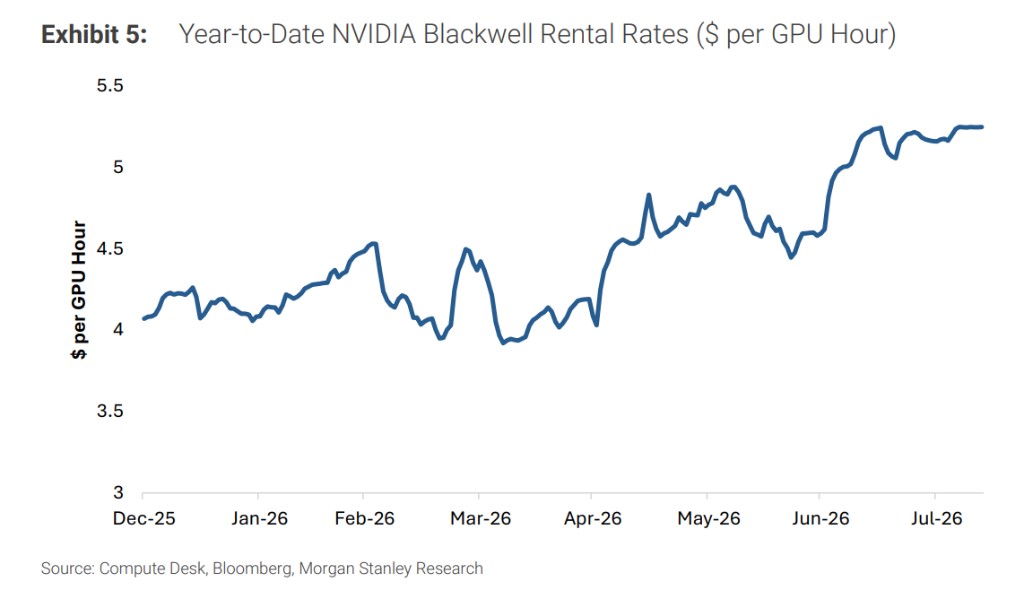
Morgan Stanley also cited data from Compute Desk, pointing out that Blackwell GPU rental prices have risen by about 30% since the beginning of the year, currently standing at approximately $5.25 per GPU hour, which translates to about $20-25/watt.
Starship's 14th Flight: The Most Important Catalyst Since IPO
Morgan Stanley believes that, aside from earnings reports, the 14th flight of Starship is one of the most important catalysts for SpaceX's stock price since its IPO.
The 14th flight is expected to be the first attempt to catch the Starship upper stage/spaceship. Currently, Booster 21 completed cryogenic testing around July 20 and is undergoing engine installation, with static fire tests expected around August 20. Referring to the recent pace of about two weeks from static fire to flight for V3 boosters, the hardware timeline points to a September flight.
On the regulatory front, SpaceX still needs to obtain FAA permission for the spaceship tower catch. The existing Part 450 operating license covers launch and booster catch, but catching the spaceship requires a license modification. Referencing the precedent of the 5th flight (first booster catch), new information was submitted in mid-August 2024 and was not approved until the day before the flight in mid-October. Morgan Stanley maintains early September as the baseline expectation.
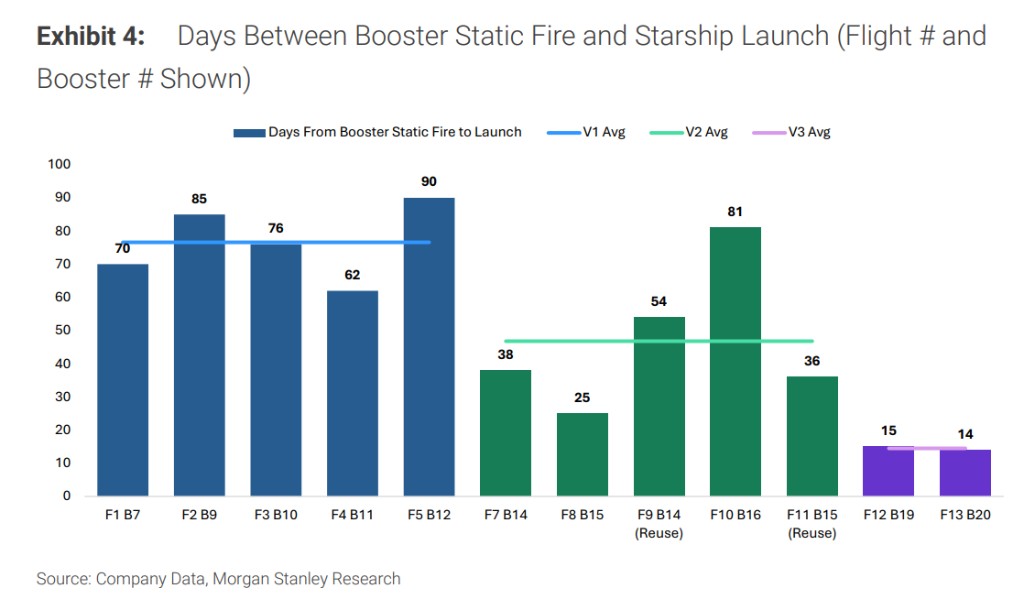
Morgan Stanley wrote: "If SpaceX can successfully 'catch the spaceship' during the 14th flight... we believe this will represent one of the most important milestones in the history of spaceflight." From an investor perspective, "catching" implies a significant reduction in orbital 'real estate' costs, opening up space for new growth in space, connectivity, and AI businesses.
If the 14th flight is successful, the 15th flight is expected to achieve simultaneous catch of both the spaceship and the booster, which is even more difficult.
The above exciting content comes from Zhuifeng Trading Desk.
For more detailed interpretations, including real-time analysis and frontline research, please join [Zhuifeng Trading Desk ▪ Annual Membership]

Risk Warning and Disclaimer
The market involves risks, and investment requires caution. This article does not constitute personal investment advice, nor does it take into account the specific investment objectives, financial status, or needs of individual users. Users should consider whether any opinions, views, or conclusions in this article align with their specific circumstances. Investors bear full responsibility for their own investment decisions.