
 I'm LongbridgeAI, I can summarize articles.
Deutsche Bank believes that the fifth "explosive" rally phase of gold, which began in 2024, is still ongoing. Central bank gold demand, measured in real US dollars, has hit a record high, with approximately half of this demand unreported to the IMF. Global ETF fund inflows have turned positive again, with Asian buying being particularly prominent. The bank sets its year-end target range for gold at $4,700-$5,100 per ounce, driven primarily by the continuous expansion of US government debt. Current futures positions remain low, indicating that the upside potential is not yet fully priced in
With central banks continuing to increase their holdings and ETF funds flowing back in, Deutsche Bank believes that the "explosive" rally phase for gold is not yet over.
According to Zhuifeng Trading Desk, on August 14, Michael Hsueh, commodities strategist at Deutsche Bank, released his latest research report, "Commodities: Gold explosive phase." Hsueh argues that the fifth "explosive" rally phase of gold, which started in 2024, is still ongoing. Central bank gold purchases and ETF fund inflows constitute dual sources of inelastic demand support, with a year-end price target range of $4,700-$5,100 per ounce.
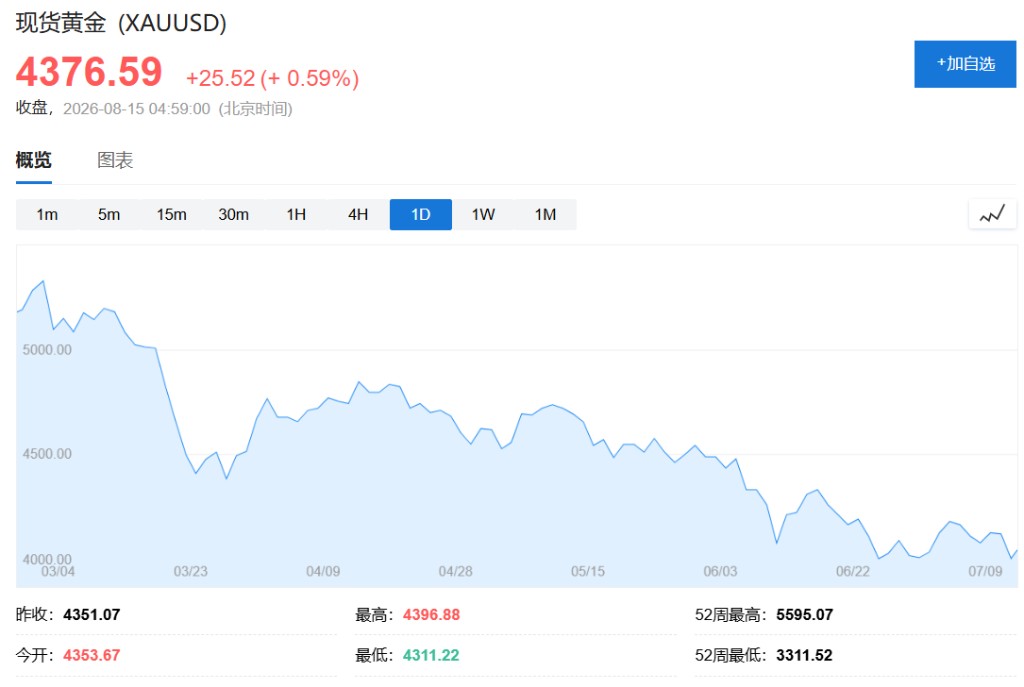
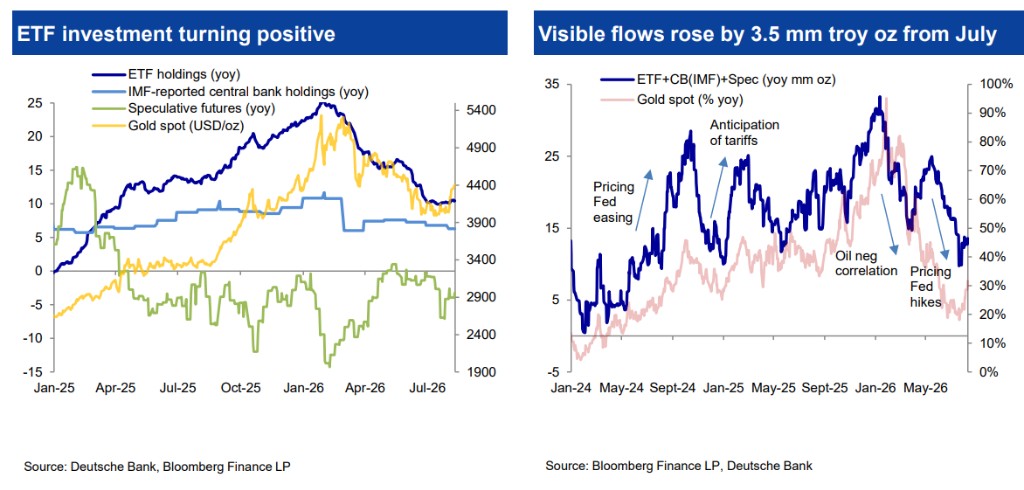
At the time of the report's release, the spot price of gold was already trading above $4,300 per ounce. Deutsche Bank pointed out that the 30-day net inflow into ETFs reached 1.5 million ounces, and global ETF holdings have increased by approximately 4 million ounces year-to-date, with fund flows turning positive again. Meanwhile, central bank gold demand hit a record high in real US dollar terms in the first quarter of 2026, reaching $38.88 billion.
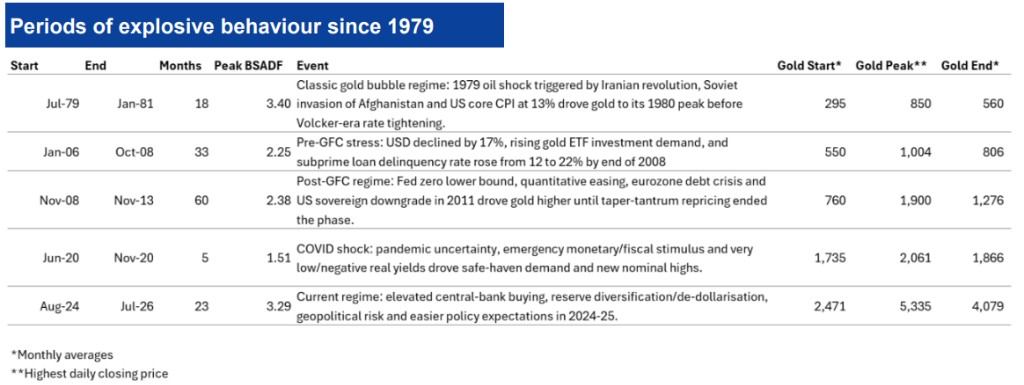
"Explosive" Phase: The Fifth Since 1979, Still Ongoing
Deutsche Bank uses the BSADF statistical test method to identify periods of "explosive" behavior in gold prices. Since 1979, gold has experienced five such phases. The current fifth phase began in 2024, and the test statistic remains within the trigger zone.
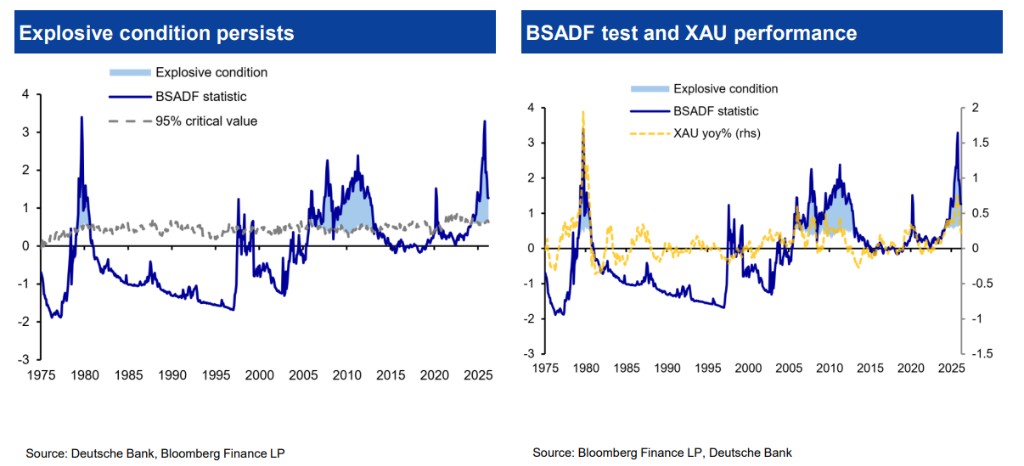
Historical data shows that after gold enters an "explosive" state, the probability of positive returns over the next five years is higher (approximately 80% vs. 68% in non-explosive states), and the average magnitude of gains during upswings is also larger. Specifically, in scenarios where the price rises by 10%-15% over two weeks, the probability of gold rising after 12 months is 67%, and in such cases, the average gain can reach 31%.
Currently, the gold price range appears compressed relative to the BSADF statistic—the model indicates that gold "should" rise to $6,400 but could also fall to $3,700, with the current price situated in the compression zone between these two levels.
Central Bank Gold Purchases: Demand Hits Record High, Half Unreported
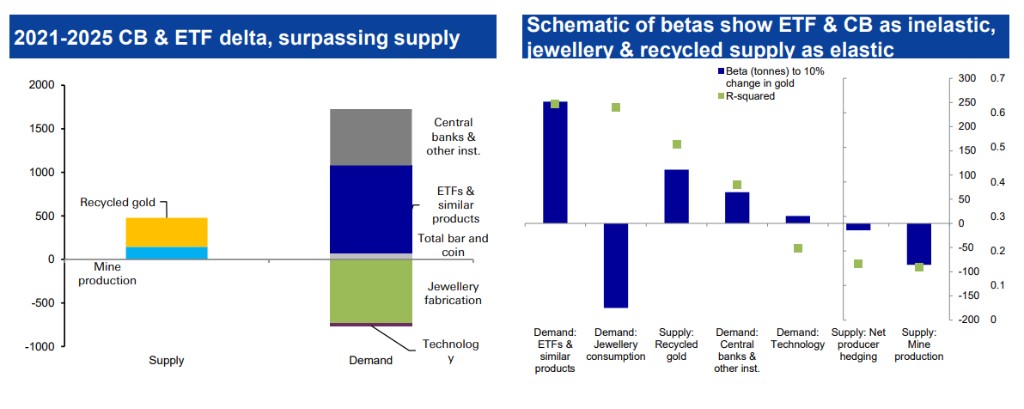
Central banks are currently the most critical structural buyers in the gold market. Data shows that annualized central bank gold purchases reached 203.1 tons in the first half of 2026 based on IMF data. Furthermore, central bank demand is insensitive to price—even as gold prices continue to rise, the pace of purchasing has not slowed.
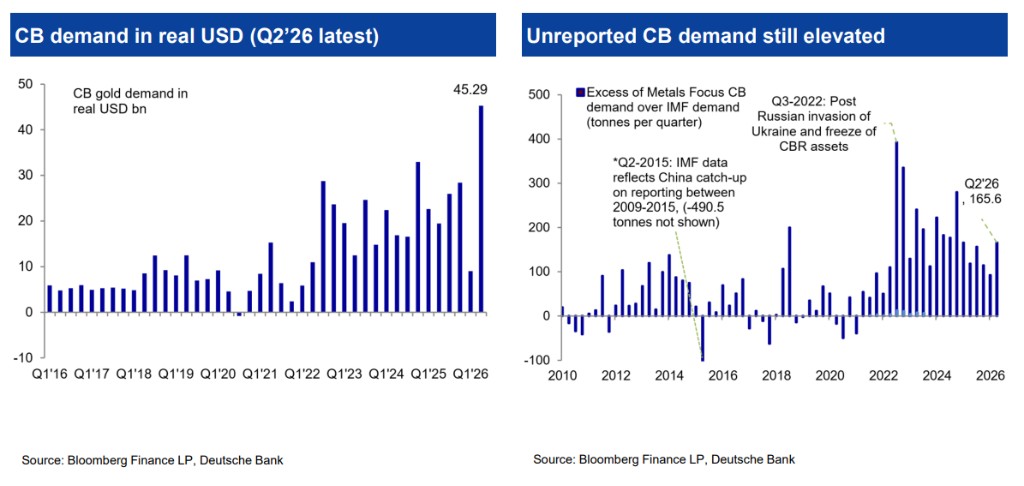
More notably, the report points out that approximately half of central bank gold demand is not reported through IMF channels. Metals Focus data indicates that since the third quarter of 2022, the quarterly volume of unreported demand has jumped from an previous average of 95 tons per quarter to 286 tons per quarter.
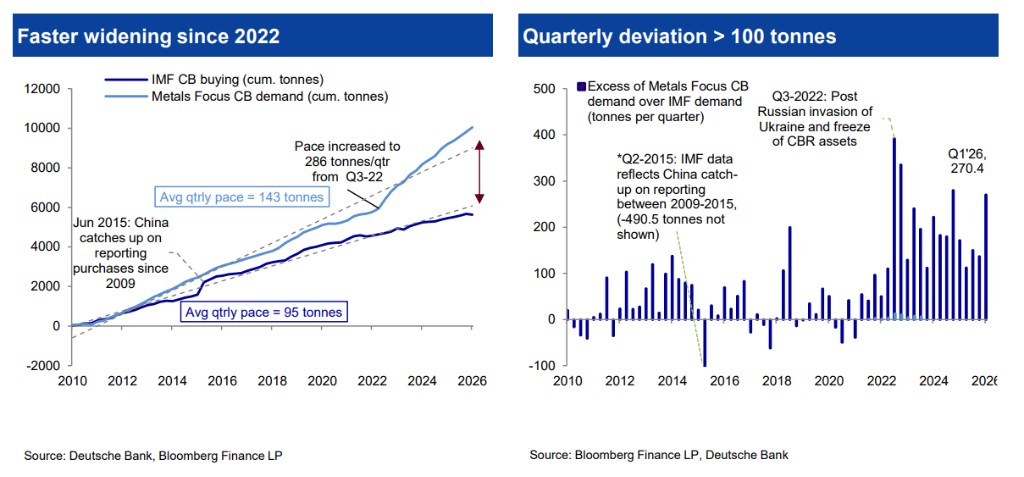
The data also shows that Poland, Turkey, and China are the central banks that have increased their gold holdings the most recently.
ETF Funds: Asian Buying, Developed Market Selling, Overall Turnaround
ETF fund flows are the most sensitive marginal variable for gold prices. According to Deutsche Bank data, year-to-date in 2026, the combined net inflow into ETFs in the five major markets of the US, Europe, China, Japan, and India was approximately 4 million ounces, returning to positive territory overall.
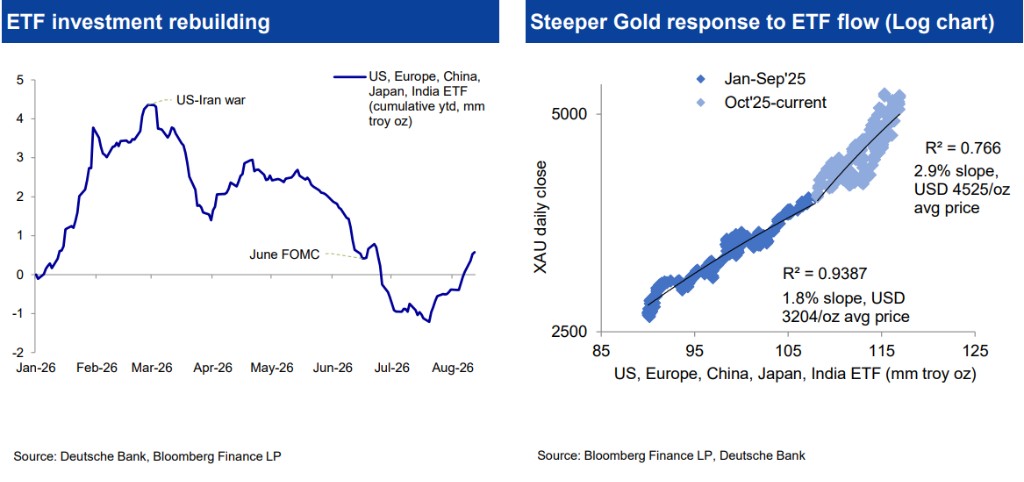
In terms of regional structure, Asia (China, Japan, India) is a net buyer, while developed markets (DM) are net sellers. Chinese ETF holdings saw their first annual net increase since 2020, with the pace of buying accelerating significantly since late July.
Deutsche Bank's quantitative analysis shows that for every 1 million ounce increase in ETF holdings, the gold price rises by approximately $14 per ounce (nominal value), translating to a price elasticity of about 1%. Currently, ETF and central bank demand jointly offset the net selling pressure from speculative futures positions.
Price Model: Year-End Target $4,700-$5,100, Core Driver is US Debt
Deutsche Bank's long-term gold pricing model uses the expansion of US government debt as the core variable, supplemented by the US dollar exchange rate, the 10-year TIPS real interest rate, and the equity risk premium.
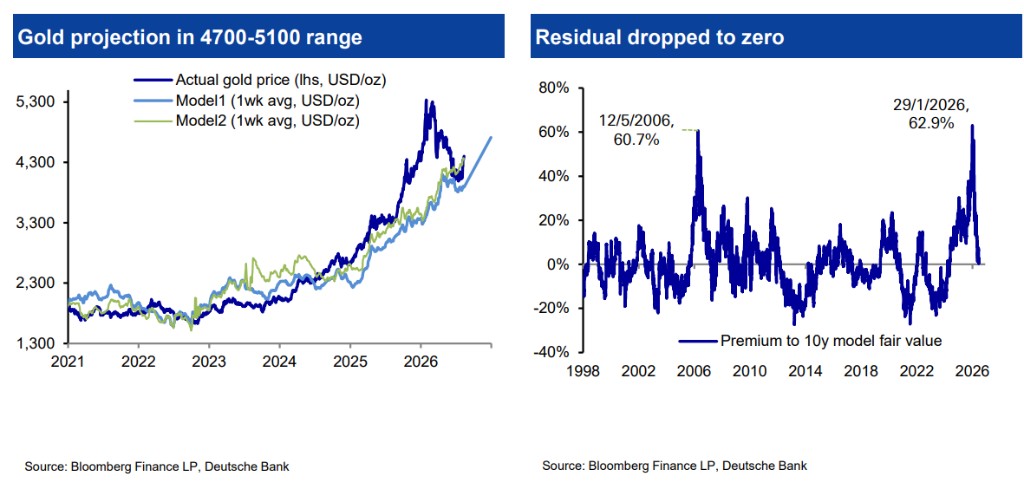
Data shows that the year-over-year growth rate of US public debt is projected to be 15% in 2026 and 10% in 2027, far exceeding levels seen in the early 2000s. The model predicts a year-end gold price range of $4,700-$5,100 per ounce, and the current price has converged with the model's fair value, with residuals close to zero.
Deutsche Bank notes that significant declines in gold prices have historically been associated with two scenarios: first, extreme US dollar strength (such as the 77% rise in the US Dollar Index from 1981-1984); second, unexpectedly hawkish tightening by the Federal Reserve (such as the 2013 Taper Tantrum and the 2021-2022 rate hike cycle). Currently, neither of these risks is prominent.
Demand Structure: Jewelry Demand Falls to Post-Pandemic Low, Does Not Affect Overall Landscape
The structure of gold demand is undergoing a profound shift. The report shows that global jewelry demand in the second quarter of 2026 fell to 278.2 tons, the lowest level since the pandemic. India and China together account for 73% of jewelry demand, with high gold prices significantly suppressing consumption in both countries.

However, Deutsche Bank believes that the decline in jewelry demand does not constitute a systemic risk. The reason is that central banks and ETFs represent "inelastic demand," which is insensitive to price; whereas jewelry and recycled gold supply are "elastic," adjusting automatically with price. The hedging effect between the two keeps physical investment demand relatively stable.
Market Sentiment and Positions: Call Option Premium Returns, Futures Positions Remain Low
From the perspective of market sentiment indicators, the 25-delta three-month risk reversal for gold has returned to the call premium zone, after briefly falling into negative territory on March 19, 2026.
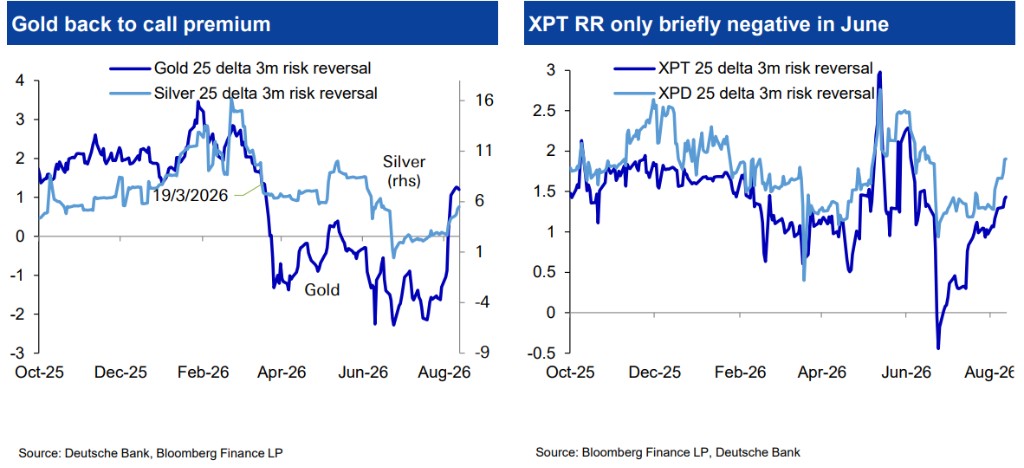
However, futures market positions remain low. Deutsche Bank data shows that open interest in gold futures once fell to its lowest level since 2009, implying that current market positioning is not crowded. If funds continue to flow in, there is still room for upward price movement.
Deutsche Bank also pointed out that the negative correlation between gold and the US dollar strengthened temporarily in the second quarter of 2026, with the 60-day rolling beta reaching -7.12 at one point, but it has now returned to near its long-term mean (-1.18). The correlation between gold and Fed rate cut expectations remains significant, with the rate pricing for the Fed's December 2026 FOMC meeting being the most relevant short-term anchor.