
Is a Copper Shortage Inevitable? Jefferies: Major Miners Cut Q2 Output by 3.9%, Global Deficit Could Reach 442,000 Tonnes by 2026
 I'm LongbridgeAI, I can summarize articles.
On Monday, the LME cash premium hit its highest level since 2021. A Jefferies report showed that major miners, covering 55% of global supply, saw copper production fall 3.9% year-on-year in the second quarter, dragged down by operational disruptions and declining ore grades. The bank believes supply risks are clearly skewed to the downside, forecasting a global copper deficit of 442,000 tonnes in 2026 that will continue to widen, maintaining a bullish medium-term outlook
Signals from both the supply and demand sides of the copper market are tightening in sync. The LME copper cash premium has expanded to its highest level since 2021, while major miners' output dropped significantly year-on-year in the second quarter. These two forces have resonated, pushing copper prices up nearly 16% year-to-date and continuing to approach historical record highs.
According to previous reports by Wallstreetcn, the LME copper cash price on Monday was once $478 per tonne higher than the three-month contract, marking the largest premium since the 2021 short squeeze. David Wilson, a metals analyst at BNP Paribas, attributed this to the continuous flow of copper to the United States—before the Trump administration's tariff decisions were finalized, large amounts of copper inventory were shipped to the U.S., reducing available supply in other regional markets.
On the supply side, according to Zhuifeng Trading Desk, Jefferies' latest research report indicates that major miners, covering approximately 55% of global mine copper supply, saw their second-quarter copper production decline by 3.9% year-on-year. Freeport-McMoRan, Ivanhoe Mines, Antofagasta, BHP, and Newmont all saw output dragged down by operational disruptions, declining ore grades, or execution issues. Jefferies analysts believe that mine supply risks are clearly skewed to the downside, and even in a scenario where global GDP growth is only 2%, the copper market will still experience a significant deficit over the next 12 months or more.
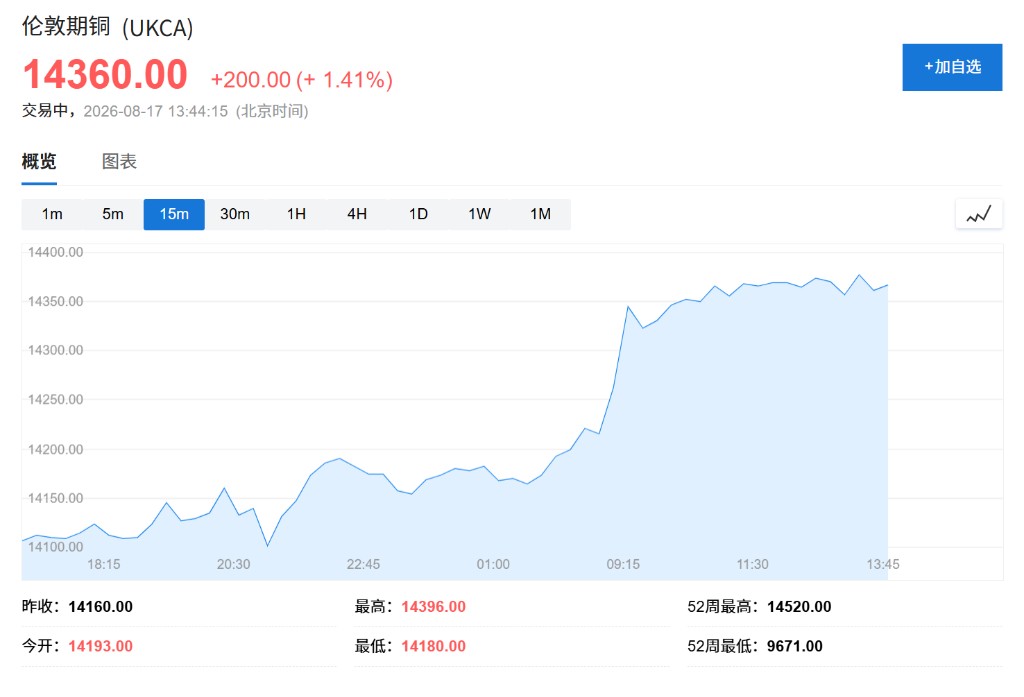
As of press time, LME three-month copper rose 1.4% to $14,360.50 per tonne, poised for its eighth consecutive weekly gain and moving closer to the historic intraday high of $14,527.50 per tonne set in January this year.
Abnormal Cash Premiums; Tariff Expectations Exacerbate Supply Diversion
The LME copper cash premium of $478 per tonne over the three-month contract is extremely rare in normal market conditions, typically indicating severe tightness in spot supply in the short term.
Bloomberg, citing David Wilson's analysis, pointed out that the root of the problem lies in distorted arbitrage logic: as long as shipping copper to the United States remains profitable, the incentive to deliver to LME warehouses is greatly reduced. Before the Trump administration's tariff policies became clear, the market continued to ship copper inventories to the United States, leading to a structural shortage of deliverable LME inventories in Europe and other regions.
On Monday, all six base metals on the LME rose, with copper leading the gains, aluminum rising 0.5%, and zinc rising 0.7%.
Major Miners' Q2 Output Under Collective Pressure
According to Jefferies' copper mine production tracking report released on August 16, the combined production of miners who disclosed second-quarter data was 3.113 million tonnes, a 3.9% year-on-year decline, but a 2.7% quarter-on-quarter increase.
The miners with the most significant declines included: Ivanhoe Mines (Kamoa-Kakula project, down 43% year-on-year to 64,000 tonnes), Newmont (down 53% year-on-year to 17,000 tonnes), Freeport-McMoRan (down 18% year-on-year to 357,000 tonnes), Antofagasta (down 11% year-on-year to 142,000 tonnes), and BHP (down 5% year-on-year to 492,000 tonnes). The production cuts by these miners all point to common causes: operational disruptions, declining ore grades, and execution issues in some projects.
Notably, some miners performed relatively robustly. Zijin Mining's second-quarter production reached 239,000 tonnes, an increase of about 8.6% year-on-year; Teck Resources' production was 136,000 tonnes, an increase of about 24% year-on-year; and MMG's production was 138,000 tonnes, also showing significant year-on-year growth. However, these highlights were insufficient to offset the overall production shortfall from top-tier miners.
Supply-Demand Deficit Expected to Widen; Analysts Maintain Medium-Term Bullish Outlook
Jefferies explicitly stated in the report that it maintains a bullish stance on the medium-term trend of copper, with the core logic being the coexistence of sustained global demand growth and severe supply constraints.
According to Jefferies' supply and demand model forecasts, global copper demand in 2026 is expected to reach 28.184 million tonnes, exceeding supply of 27.742 million tonnes by 442,000 tonnes, forming a deficit. The scale of the deficit is expected to further expand in the following years, reaching a deficit of 782,000 tonnes by 2030. The main drivers on the demand side come from grid construction, renewable energy, and electric vehicles—according to Jefferies' forecast, global grid-related copper demand will grow at an average annual rate of 5.0% between 2025 and 2030, while copper demand for electric vehicles will grow at a high average annual rate of 9.6%.
Regarding copper price forecasts, Jefferies expects the average price in 2026 to be $13,380 per tonne (approximately $6.07 per pound), rising to $14,330 in 2027, and reaching $17,637 in 2030.
In terms of individual stock ratings, Jefferies maintains "Buy" ratings for major copper miners such as Freeport-McMoRan, Anglo American, Glencore, First Quantum, Teck Resources, and Lundin Mining, with target prices offering varying degrees of upside potential compared to current market prices.
Controversy Over Expected Supply Increases, But Risks Skew Downside
Although there are concerns in the market about supply oversupply, with some views suggesting that the continued ramp-up of projects such as Kamoa-Kakula, QB2, the Oyu Tolgoi underground mine, Cobre Panama, and Grasberg will bring substantial incremental supply, making it difficult for the market to experience a true deficit before the late part of this decade, Jefferies analysts remain reserved about this view.
The report points out that even if the above-mentioned new capacity is included in the model, the overall supply risk remains clearly skewed to the downside. Continuous grade decline and resource depletion are long-term structural factors constraining supply growth, coupled with recent operational disturbances at several major mines, indicating that supply-side resilience is significantly weaker than previously expected by the market. Assuming the global economy remains relatively healthy, Jefferies believes that the upside risk for copper prices remains significant.