
30-Year U.S. Treasury Yield Hits Highest Level Since 2007; August U.S. Investment-Grade Bond Issuance Sets Record for the Period
 I'm LongbridgeAI, I can summarize articles.
On Monday, the 30-year U.S. Treasury yield briefly rose above 5.31%. Corporations issued bonds on a large scale to support the AI boom, exacerbating the supply-demand imbalance in the long-duration bond market. U.S. investment-grade bond issuance in August reached $145.2 billion, surpassing the monthly record of $136 billion set in August 2020. Meanwhile, the U.S. government's annual fiscal deficit of nearly $2 trillion continues to drive up Treasury supply
Long-end U.S. Treasury yields have continued to rise, reflecting deep-seated market concerns about expanding fiscal deficits, long-term inflation risks, and the Federal Reserve's policy path.
The 30-year U.S. Treasury yield rose above 5.31% on Monday, hitting its highest level since June 2007 and extending last week's selling momentum.
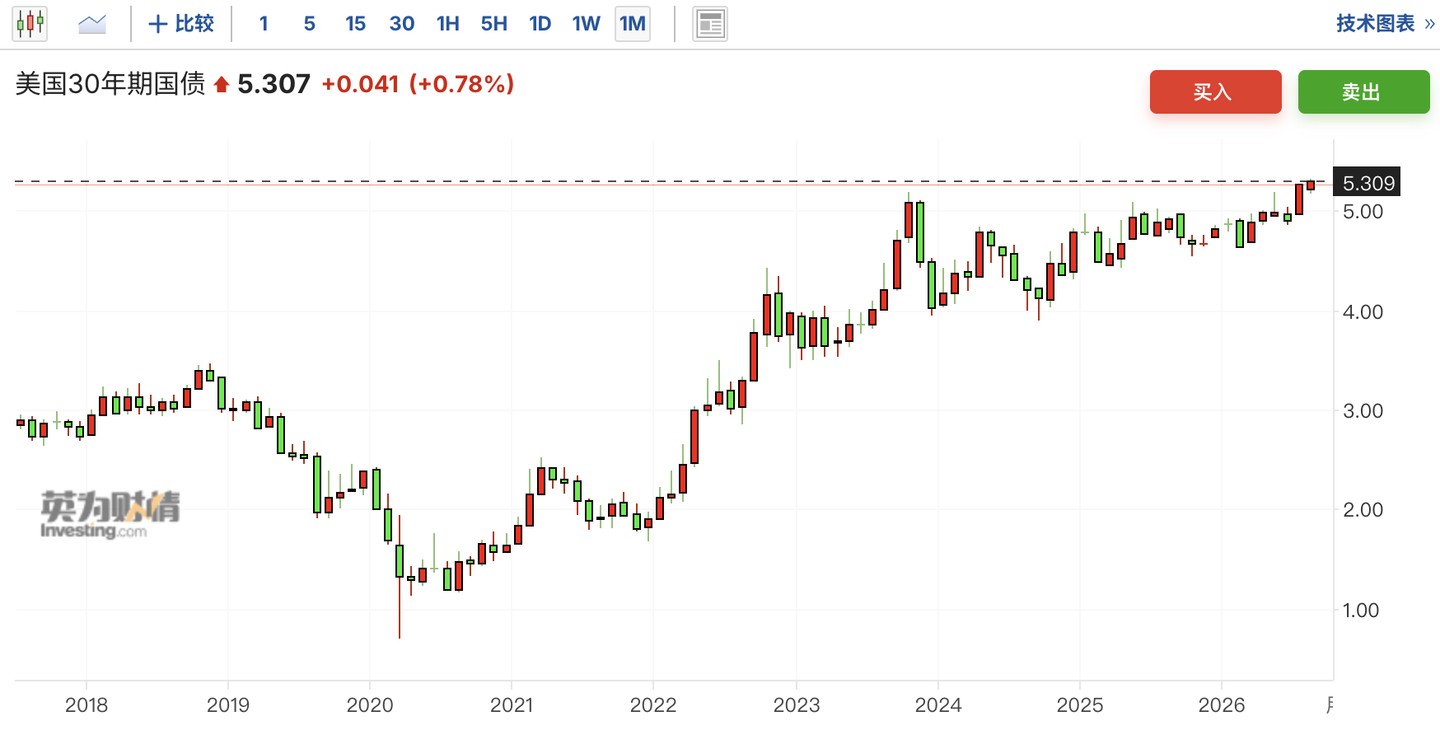
Prior to this, the U.S. Treasury completed a $25 billion auction of 30-year bonds at a yield of 5.216%, the highest rate for such an auction since 2001; the 10-year auction rate also touched a peak not seen since 2007.
Rising yields have transmitted to the real economy, pushing up mortgage loans and other credit costs. Trump administration officials predicted early last year that fiscal policy would lower long-end interest rates, but market trends have moved in the opposite direction. Meanwhile, Canada's 30-year government bond yield rose to its highest level since 2010, and European bond markets also showed correlation.
Multiple Pressures Converge, Making Long-End Rates Easy to Rise but Hard to Fall
This round of long-end selling is not driven by a single factor.
The U.S. federal government's annual fiscal deficit of nearly $2 trillion continues to push up Treasury supply, while corporations are issuing bonds on a large scale to support the artificial intelligence investment boom, further exacerbating the supply-demand imbalance in the long-duration bond market. At the same time, demand from traditional long-bond buyers is shrinking, intensifying the pressure on the market to absorb supply.
Anshul Pradhan, Head of Interest Rate Strategy at Barclays, stated:
"We have consistently advised against easily betting on the end of the long-end sell-off, and this stance remains unchanged. To hold an optimistic view on the long end, a combination of multiple conditions is required: fiscal contraction exceeding expectations, a slowdown in AI-related bond issuance, adjustments to the Treasury's debt issuance strategy, and continuously weakening economic data."
Nohshad Shah, Head of Fixed Income Sales for Europe, Middle East, and Africa at Citadel Securities, pointed out in a client report that although policy rates are 175 basis points below their peak, long-end yields remain near 20-year highs.
"In my view, this reflects the market's judgment that both the Federal Reserve and fiscal authorities tend to take the easier path when faced with difficult choices. As long as this expectation persists, it will pose a risk to the entire market."
U.S. High-Grade Bond Issuance Sets August Record High
U.S. investment-grade bond issuance has broken monthly records for the third consecutive month. As companies continue to increase investment in artificial intelligence infrastructure, corporate financing needs are rising, and the U.S. high-grade bond market is issuing bonds at the fastest pace in history.
According to data compiled by Bloomberg, as of August 17, U.S. high-grade bond issuance in August had reached $145.2 billion, surpassing the monthly record of $136 billion set in August 2020.
Year-to-date, the cumulative issuance volume of U.S. investment-grade bonds has reached $1.46 trillion, 8.5% higher than the same period in 2020. In 2020, driven by the pandemic which prompted massive corporate financing, U.S. investment-grade bond issuance set an all-time annual record.
Technology companies have become the main driving force for financing. Data shows that the largest single transaction in August's bond issuance came from Alphabet, with an issuance size of $25 billion.
This is the eighth U.S. investment-grade bond issuance this year with a size reaching or exceeding $25 billion, and all eight large transactions came from technology companies.
Financing demand from tech enterprises may increase further in the future. JPMorgan recently raised its forecast for U.S. dollar-denominated bond issuance by Technology, Media, and Telecom (TMT) companies in 2026 by approximately 20% to $540 billion.
Economic Data Softens, but Inflation Pressure Remains Unresolved
A series of weak data recently brought brief relief to the market but did not fundamentally change the upward logic for long-end interest rates.
Last week's data showed that core inflation retreated somewhat, U.S. employment unexpectedly declined in July, and retail sales saw their largest month-on-month drop in over a year. Additionally, the Producer Price Index remained flat month-on-month in July.
Signals of economic cooling led the market to lower expectations for a Federal Reserve rate hike in September, while also driving the yield curve to steepen—the spread between the 2-year and 30-year Treasury yields widened to 114 basis points, the highest since April.
However, inflation is still quite far from the Federal Reserve's 2% target. The Consumer Price Index rose 3.4% year-on-year last month, and Shah warned that more than 55% of core goods prices are still rising, cautioning against interpreting recent inflation improvements as a signal of a policy shift. He characterized the September policy meeting as "hard to predict."
On July 29, the Federal Reserve voted 9-3 to keep interest rates unchanged in the 3.50% to 3.75% range for the fifth consecutive time. The three dissenting members—Beth Hammack of the Cleveland Fed, Neel Kashkari of the Minneapolis Fed, and Lorie Logan of the Dallas Fed—all called for a 25-basis-point rate hike.
The market is currently awaiting the release of the July Federal Open Market Committee minutes on Wednesday for more clues on the policy path.
Global Resonance, Reassessment of Asset Allocation Logic
This rise in long-end interest rates has evolved into a global phenomenon, with investors in various countries demanding higher premiums to hedge against persistent inflation risks.
Correlations have appeared in Canadian and European bond markets, indicating that structural repricing in the global bond market is still underway.
Regarding the trend of AI investment, Shah pointed out that he believes the investment logic is shifting from frontier model development to cloud infrastructure. Hyperscale cloud service providers like Microsoft and Google are expected to monetize AI through computing power, inference, and distribution capabilities, offering clearer return expectations compared to frontier AI developers like OpenAI and Anthropic.
The July reading of the Personal Consumption Expenditures Price Index, corresponding to the Federal Reserve's 2% inflation target, will be released on August 26, providing further reference for policy direction.