
Long-End Yields Quietly Break Through; The Fed May Be Powerless This Time
 I'm LongbridgeAI, I can summarize articles.
Goldman Sachs traders believe that the rise in long-end interest rates is increasingly a supply issue rather than a matter of central bank discipline—massive sovereign deficits combined with annual AI capital expenditures potentially exceeding $1 trillion are being largely financed through debt markets, leaving the market with an overwhelming amount of "paper" to digest
U.S. long-term Treasury yields are quietly approaching critical technical thresholds, and this time the driving force may not be misguided monetary policy, but structural oversupply—the dual expansion of sovereign debt and AI capital expenditure is creating unprecedented pressure on the bond market.
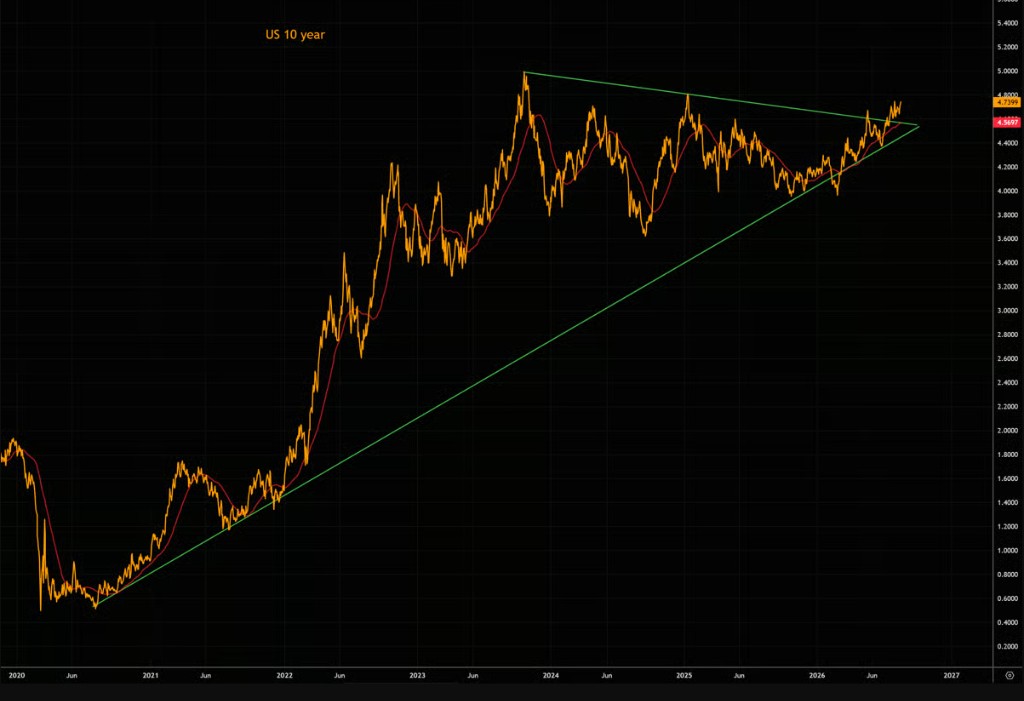
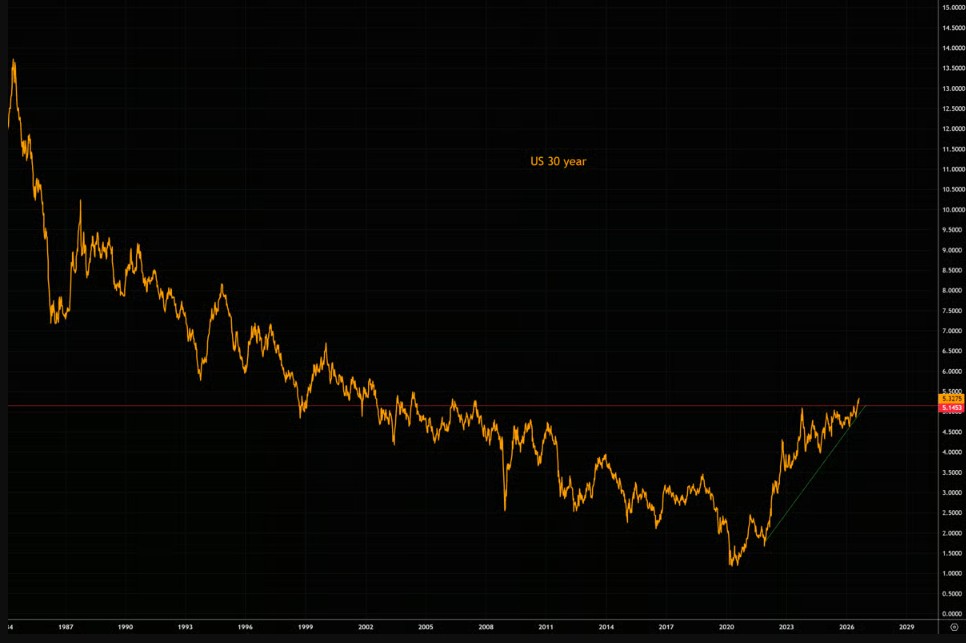
The yield on the 10-year U.S. Treasury note is threatening to break through the key resistance level of 4.8%, while the 30-year yield has already broken out of its long-term technical pressure range.
Rich Privorotsky, head of the Delta-one trading desk at Goldman Sachs, offers a cautionary assessment: the rise in long-end interest rates is increasingly a supply issue rather than a matter of central bank discipline—massive sovereign deficits combined with annual AI capital expenditures potentially exceeding $1 trillion are being largely financed through debt markets, leaving the market with an overwhelming amount of "paper" to digest.
Currently, interest rate volatility remains relatively contained, and the stock market has not yet fully reacted to the rise in rates. However, analysts warn that if interest rate volatility truly spikes, the correction in equities could far exceed current market pricing. Meanwhile, the implied volatility of S&P 500 options remains at its lowest level since January, making hedging costs relatively cheap—a window that may not last long.
Long-End Yields Approach Critical Breakout Point
From a technical perspective, the 10-year U.S. Treasury yield is at a critical juncture. If the closing price holds firmly above 4.8%, the market could face a genuine short squeeze.
According to analysis by The Market Ear, the market has formed a complex psychological structure after a prolonged period of range-bound trading. After such an extended consolidation, a significant breakout often creates a "vacuum zone," significantly increasing the risk of accelerated price movement.
The trend for the 30-year U.S. Treasury is more direct.
Long-term charts show that the 30-year yield has broken through several important long-term resistance levels. The Market Ear points out that this is not a game for short-term traders, but if this breakout is confirmed and sustained, the subsequent trend could be "quite ugly."
Dual Pressure from AI Debt Wave and Sovereign Deficits
Privorotsky's core argument is that the root cause of this rise in long-end interest rates is a structural imbalance on the supply side, rather than a repricing of the Federal Reserve's policy stance.
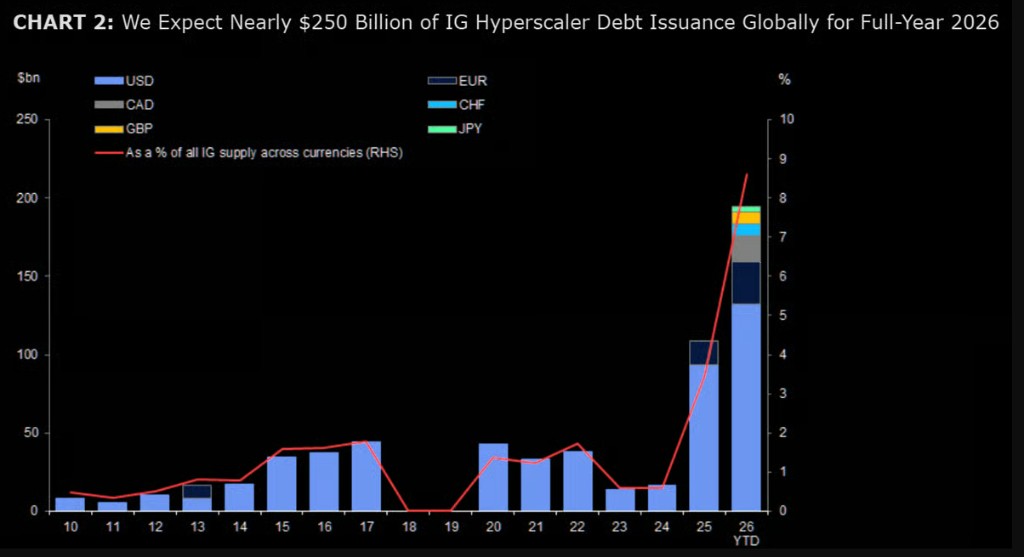
In terms of data, the scale of AI-related debt issuance has grown explosively. According to Goldman Sachs data, since the beginning of this year, AI-related companies have raised approximately $489 billion in global investment-grade, high-yield, and leveraged loan markets, far exceeding the total of $322 billion for the entire year of 2025. More broadly, the issuance volume of U.S. dollar investment-grade bonds has exceeded $1.5 trillion this year, and is expected to surpass the historical record set during the pandemic in 2026.
At the same time, sovereign deficits remain persistently high.
Privorotsky points out that although economic data has softened and short-end rates have consequently outperformed, hard constraints remain: massive sovereign deficits and potential annual AI capital expenditures exceeding $1 trillion jointly constitute continuous supply pressure on the bond market. In this context, even if economic data weakens, the Federal Reserve may be forced to raise interest rates in a weak data environment to re-anchor long-end interest rates and flatten the yield curve.
Valuation Under Pressure: Can Tech Stocks' "Immunity" Last?
Although the 10-year U.S. Treasury yield has risen from below 4% since late February to its current level, tech stocks have shown unusual resilience, with the divergence between the Nasdaq 100 Index and the 10-year yield expanding to a significantly notable degree.
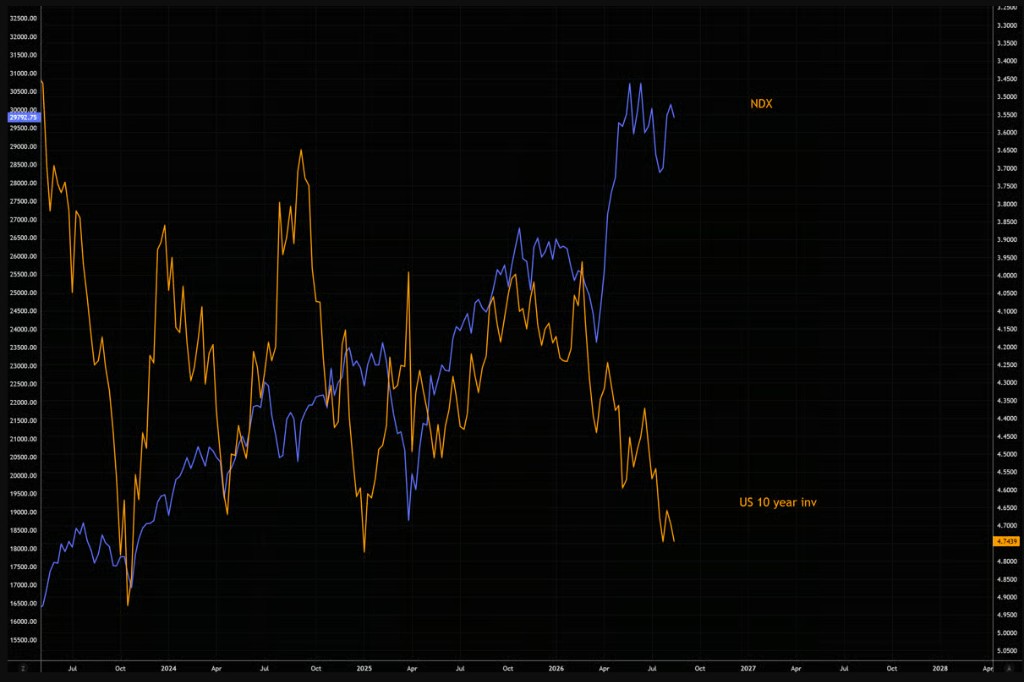
Privorotsky believes that this divergence will eventually be corrected through a compression of valuation multiples.
His logic is: if the market requires spending cuts in either the public or private sector, the adjustment is more likely to fall on the private sector, as governments rarely choose fiscal austerity proactively. Higher real interest rates plus huge demand from the public sector and AI capital mean that there will be a certain degree of "crowding-out effect" in other areas. This effect may already be reflected in the broader market de-rating—stock price performance has begun to lag behind the magnitude of earnings-per-share upgrades.
Goldman Sachs data also shows that when the increase in the 10-year yield exceeds two standard deviations, it often exerts a clear drag on the stock market.
The Real Risk Trigger
The Market Ear emphasizes that for the stock market, the speed of interest rate changes is more critical than the direction itself, at least in the short-to-medium term. Currently, the divergence between the MOVE Index (a measure of interest rate volatility) and the S&P 500 is quite evident, but interest rate volatility has not yet seen a true spike.
Analysts advise closely monitoring the movements of interest rate volatility—once this indicator breaks out, it will be an important signal for the repricing of equity risks.
Currently, the implied volatility of S&P 500 options is at its lowest level since January, and the cost of hedging stock risk through options remains relatively low. The Market Ear suggests that investors make good use of this window.