
Just Now: GPT-6 Codename Leaked Again! Potential Release This Thursday
 I'm LongbridgeAI, I can summarize articles.
Rumors suggest that OpenAI's next-generation model, GPT-6 (codenamed Astra), may be released this Thursday. Recently leaked internal checkpoint code and PR records for "mewfour" indicate that the model features the highest level of reasoning capabilities and includes core ChatGPT UI components. Polymarket predictions show the probability of its release has risen to 52%, with community speculation pointing to August 20 as the launch date
Rumors are swirling that the next-generation GPT-6 is arriving this week!

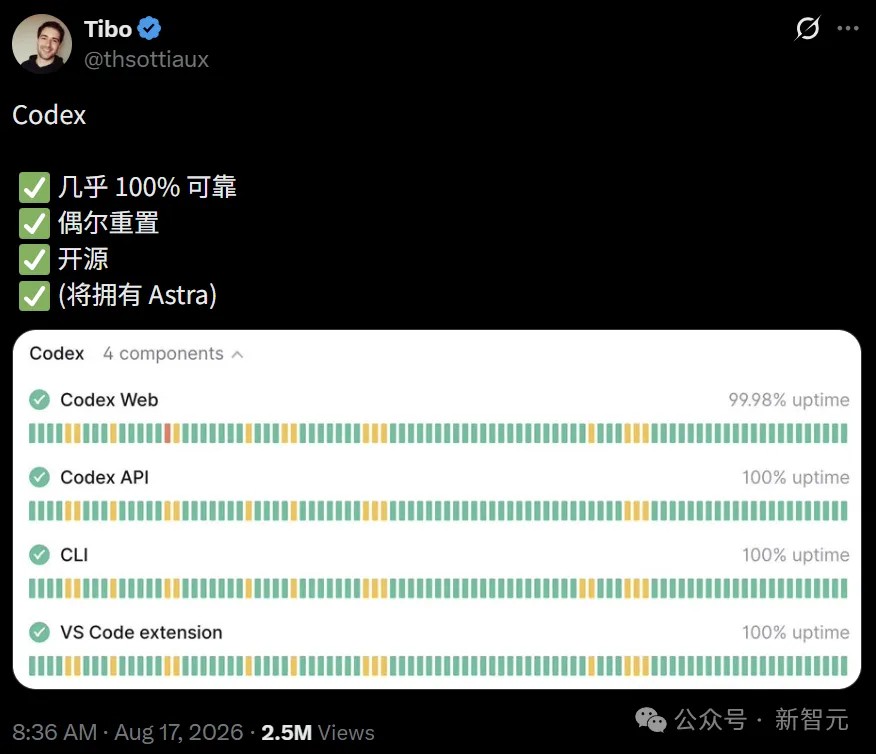
Just yesterday, Tibo, often referred to as the "godfather" of OpenAI, personally revealed that Codex will integrate the most powerful Astra model.
The news instantly sent waves through the internet, skyrocketing expectations.
Even on Polymarket, the probability of OpenAI releasing the next-generation Astra this week surged to 52%.
Who would have thought that today, the internal checkpoint codename for Astra, "mewfour," would leak once again.
GPT-6, See You Thursday?
AI influencer Chetaslua accidentally discovered that on August 7, just two and a half hours after OpenAI published a blog post stating that Astra had reached a "severe risk level," the "mewfour" codename was removed from 52 PRs.
However, the traces were not completely erased.
Six days later, this mysterious codename reappeared in the commit records of the openai/codex repository.
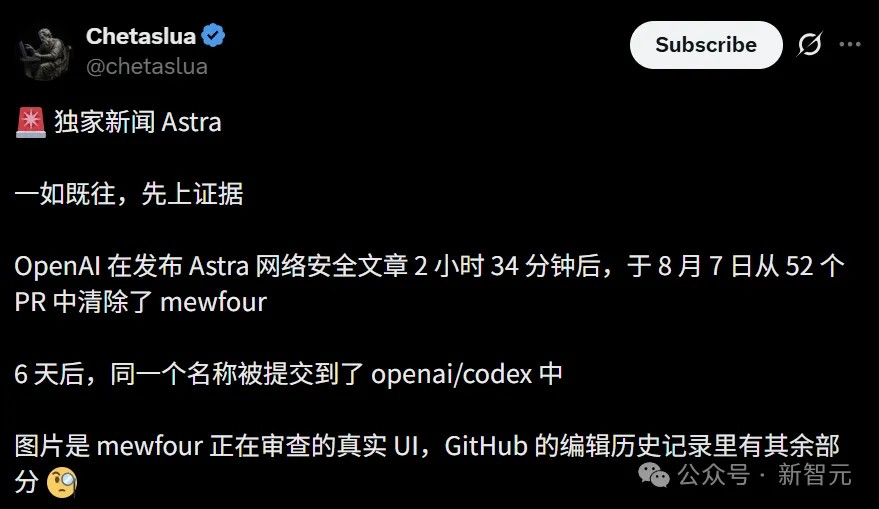
The review method in these PRs was labeled as "independent automated review," with the reasoning level set directly to xhigh, which is currently the highest known tier of thinking capability.
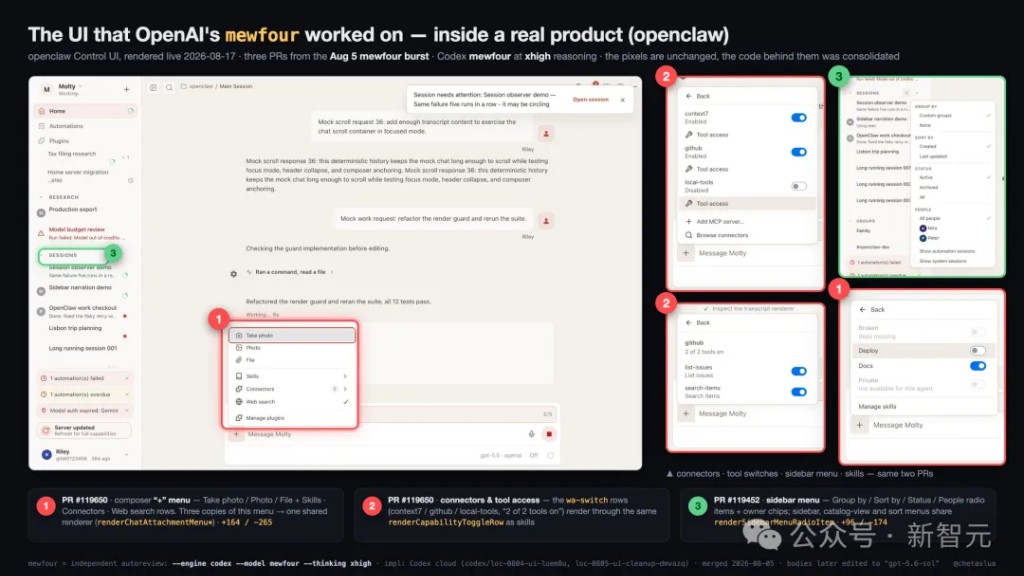
More importantly, screenshots exposed the real working environment of mewfour—
The interface includes session management, connectors, skills, plugins, and automation workflows, resembling a complete AI workstation.
Furthermore, what mewfour was reviewing consisted entirely of core UI components soon to be launched in ChatGPT. These include the editor's "+" menu, connector and tool permission toggles, sidebar grouping and sorting, and more.
It seems the OpenAI team could hardly contain their excitement, joining in on the widespread online memes.
A Codex researcher named SIGKITTEN posted four Codex emojis, followed by two Tibo emojis.
Developer Haider solved the puzzle on the spot, calculating through the clues to conclude that Astra would go live on August 20 (Thursday).
Indeed, this is typical OpenAI style.

Shortly after, the "godfather" posted a short poem, with rhymes in the first, third, second, and fourth lines.
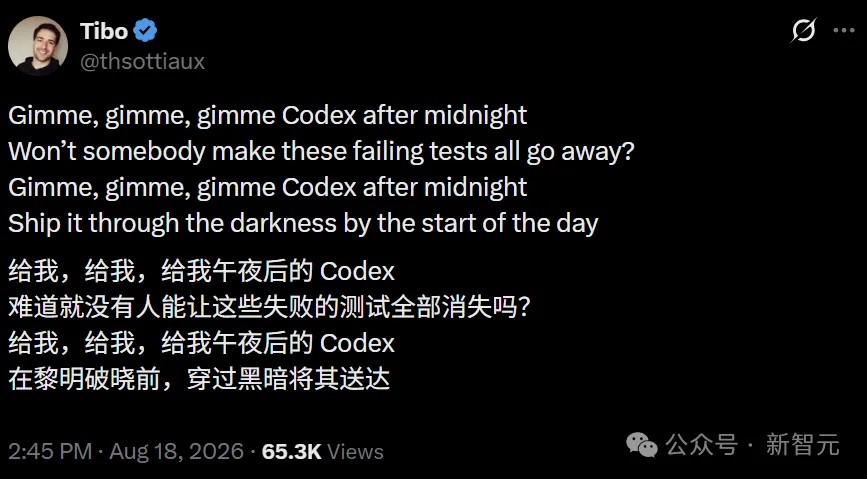
Although no one has yet deciphered the "godfather's" words, the atmosphere created compels one to say:
"Bring Astra to everyone before dawn."


The entire internet is waiting for the release, but just how powerful is Astra? The answer was laid out as early as the beginning of August.
$2,000 to Solve a Decade-Old Problem
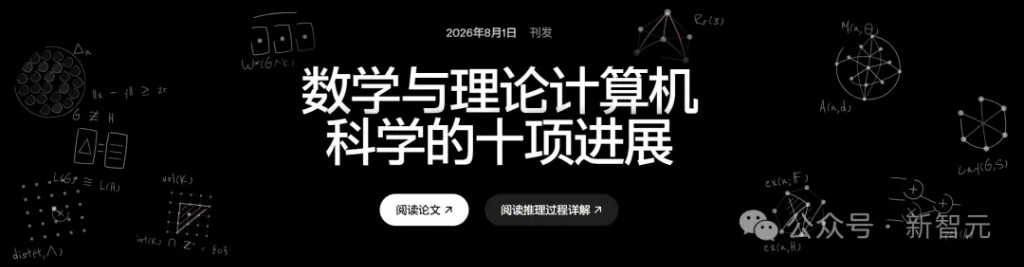
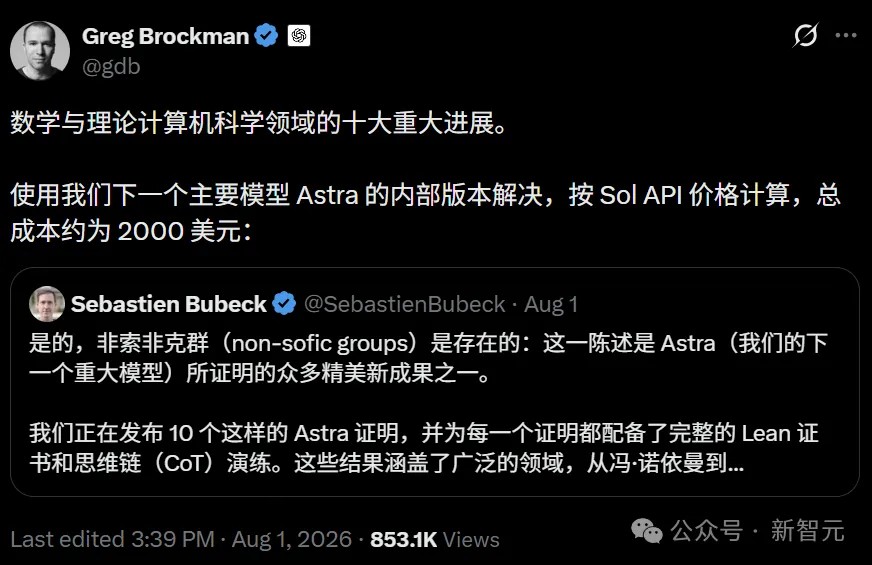
On August 1, OpenAI released a 249-page mathematical paper, causing a sensation across the internet.
The core content of the paper revealed that an internal version of Astra solved ten mathematical and theoretical computer science problems that had seen no progress for at least a decade.
These problems span high-dimensional geometry, coding theory, group theory, quantum complexity, lattice cryptography, and extremal combinatorics.
Among them was the first explicit construction of a non-sofic group, known as the holy grail of group theory, which mathematicians had pursued for decades without success.
The most staggering figure was not the number of pages in the paper, but the cost.
Based on the current API rates for GPT-5.6 Sol ($5 per million input tokens and $30 per million output tokens), the token cost to generate all ten solutions was approximately $2,000.
For the price of a mid-range laptop, ten breakthrough proofs that had plagued the mathematical community for over a decade were obtained.
This implies that the productivity of the mathematical community over the past decade is being redefined by a single API call.
And this was just an internal version; even OpenAI may not fully know the upper limits of Astra's capabilities upon its official launch.
If you think this is already crazy, the news from August 7 will leave you truly unsettled.
So Powerful It Scares Even Itself
On August 7, OpenAI issued an official statement that held the entire security community in suspense:
Preliminary assessments indicate that Astra may have reached the "Critical" capability threshold for cybersecurity under the Preparedness Framework.
What does Critical mean?
According to OpenAI's Preparedness Framework, model cybersecurity capabilities are divided into multiple levels, with Critical being the highest.
At this level, the model can independently identify and develop zero-day vulnerabilities of various severity levels, or formulate and execute end-to-end attack strategies against hardened targets.
Simply put, this model may possess the ability to independently launch advanced cyberattacks.
Sam Altman responded directly with a post: Astra is very powerful, we will ensure safety preparations are in place, and then make it available to everyone.

The Era of Native Multi-Agent Systems Is Coming
Another aspect of Astra, its potential impact, may be no less significant than its cybersecurity implications.
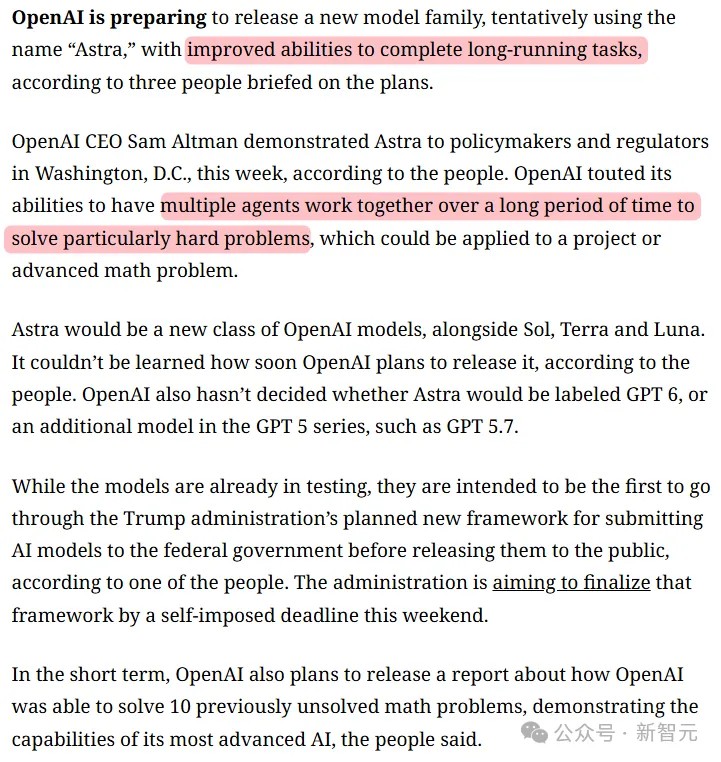
The Information previously reported that Astra was trained to enable multiple agents to collaborate over long periods to solve complex problems.
Rumors suggest it has approximately 10 trillion parameters, uses a Mixture of Experts (MoE) architecture where only partial parameters are activated per token, and is built upon a pre-training project internally codenamed "Doug."
According to leaked information, it comprehensively surpasses Claude Fable in reasoning, coding, writing, knowledge, multimodal understanding, and agent tasks, with significant improvements in writing quality.
If these reports are true, this would mark the first time in the history of large language models that multi-agent collaboration capabilities are trained end-to-end from the pre-training phase.
Looking at the multi-agent infrastructure OpenAI has already established for the GPT-5.6 family reveals what this means.
Sol (flagship), Terra (cost-effective), and Luna (fastest and cheapest) form a layered collaborative multi-agent system.
The v2 system launched this year allows Sol and Terra to communicate with each other during parallel execution, and last week Codex added Luna as a sub-agent.
Technical analyst Dan McAteer highlighted a key step—
If Astra is indeed pre-trained within a native multi-agent framework, it inherently possesses long-term collaboration capabilities, ready out-of-the-box to coordinate multiple agents in Codex, delegating lighter tasks to the cheaper Luna.
This is something current architectures cannot achieve even with patches, much like how Claude Code broke through in agent-based coding, fundamentally replacing the underlying logic.
Now, OpenAI employees are publicly mentioning Astra by name.
The only remaining question is whether it will be this week or next.
Source: New Intelligence Yuan
Risk Warning and Disclaimer
Market investments carry risks; please invest with caution. This article does not constitute personal investment advice, nor does it consider the specific investment objectives, financial status, or needs of individual users. Users should consider whether any opinions, views, or conclusions in this article align with their specific circumstances. Investment decisions made based on this content are the sole responsibility of the investor.