
The 'Holy Grail' of Cancer Treatment? Moderna's Melanoma mRNA Vaccine Succeeds in Phase 3 Trial, Surging 83% in Pre-Market Trading
 I'm LongbridgeAI, I can summarize articles.
On Wednesday, Moderna and MSD announced that their jointly developed personalized mRNA cancer vaccine achieved positive results in a large-scale Phase 3 clinical trial. This marks the first successful Phase 3 trial for mRNA technology in cancer treatment and represents a major breakthrough for personalized immunotherapy in the history of cancer treatment
The personalized mRNA cancer vaccine jointly developed by Moderna and MSD has succeeded in a large-scale Phase 3 clinical trial, becoming the first personalized cancer vaccine to demonstrate efficacy in a Phase 3 trial, regarded by the industry as a milestone breakthrough in the field of tumor immunotherapy.
According to the announcement released on Wednesday, the trial, named INTerpath-001, showed that the vaccine intismeran autogene, combined with MSD's immune drug Keytruda, can significantly reduce the risk of post-operative recurrence in high-risk melanoma patients and inhibit the spread of tumors to distant organs, outperforming the previously standard Keytruda monotherapy regimen.
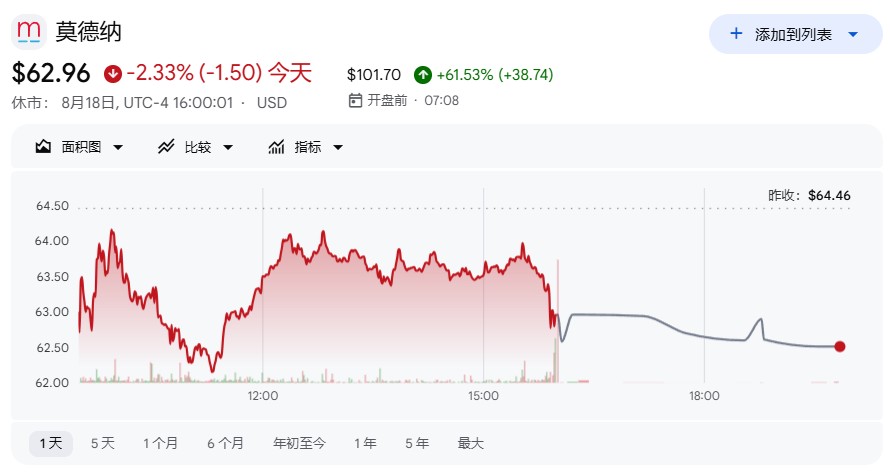
Following the news, Moderna's stock price soared more than 80% in pre-market U.S. trading. By 7:00 a.m. Eastern Time, the gain had narrowed to approximately 60%, with the stock price around $100. MSD's stock also rose by about 7%.
Moderna CEO Stéphane Bancel described the results as "an extraordinary milestone for mRNA science," stating that the two companies will engage with regulators regarding marketing authorization applications. The product could potentially be approved for market launch as early as 2027. Detailed data will be presented at an upcoming international medical conference.
Phase 3 Trial Achieves Primary and Key Secondary Endpoints
INTerpath-001 is a randomized, double-blind, placebo-controlled, and active-drug-controlled global Phase 3 clinical trial, enrolling a total of 1,137 high-risk melanoma patients (Stage IIB to IV) who had undergone complete surgical resection.
Participants were randomized in a 2:1 ratio. The treatment group received the mRNA vaccine combined with Keytruda for approximately 56 weeks, while the control group received Keytruda alone for about one year.
The trial achieved its primary endpoint of Recurrence-Free Survival (RFS) and the key secondary endpoint of Distant Metastasis-Free Survival (DMFS), with both endpoints reaching statistical significance and clinical relevance. The two companies stated that the safety profile of the combination therapy was consistent with previous study results, with no new safety signals observed.
Currently, the specific magnitude of improvement in Recurrence-Free Survival has not been disclosed. The trial will continue to assess other key secondary endpoints, such as Overall Survival (OS).
Georgina Long, Principal Investigator of the trial, Medical Director of the Melanoma Institute Australia, and Professor of Melanoma Oncology at the University of Sydney, stated: "intismeran combined with pembrolizumab has the potential to establish a new treatment paradigm in the adjuvant melanoma setting, helping patients remain cancer-free for longer periods."
Phase 3 Results Corroborate Previous Phase 2 Data
This Phase 3 success builds upon existing clinical evidence.
As previously reported by Bloomberg, the two companies disclosed five-year follow-up data from the KEYNOTE-942/mRNA-4157-P201 Phase 2 study earlier this year. The data showed that melanoma patients treated with the mRNA vaccine combined with Keytruda had a 49% lower risk of death or cancer recurrence within five years, and a 59% lower risk of distant metastasis or death, compared to those treated with Keytruda alone.
intismeran autogene utilizes the same mRNA technology platform as Moderna's COVID-19 vaccine, customized based on the specific genetic mutation "fingerprint" of each patient's tumor. Each course includes synthetic mRNA encoding up to 34 neoantigens. After injection, these are converted into protein sequences in the body, activating T cells to identify and attack residual cancer cells. The two companies have collaborated in this technological direction for over a decade.
Pipeline Coverage Across Multiple Cancer Types
The success of this melanoma Phase 3 trial is a core node in the broader clinical development plan of the two companies.
The INTerpath series of projects currently includes nine Phase 2 and Phase 3 clinical trials, covering multiple cancer types such as melanoma, non-small cell lung cancer, bladder cancer, and renal cell carcinoma, with melanoma research being the most advanced.
From a market perspective, Moderna's stock price had cumulatively risen 113% from the beginning of the year until Tuesday's close. Melanoma Phase 3 trial results have long been viewed as a critical node for testing the feasibility of this technological path. Notably, Moderna currently has a high short interest, with short positions accounting for approximately 13.5% of the float, equivalent to 49.8 million shares. The significant pre-market surge may trigger a short squeeze.
From "Holy Grail" to Clinical Reality
Therapeutic cancer vaccines have long been regarded as an elusive goal in the field of oncology.
Jane Healy, Head of Early Oncology Development at MSD, said in an interview with Bloomberg a few weeks before the trial results were announced, "People have been pursuing this direction in one way or another for over a century," pointing out that the potential advantage of such therapies lies in the promise of extending patient survival without significantly increasing additional side effects.
Data from the American Cancer Society shows that melanoma is the most serious type of skin cancer. It is estimated that there will be approximately 112,000 new cases in the United States in 2026, resulting in more than 8,500 deaths. Globally, there were more than 330,000 new cases in 2022, and the incidence rate has continued to rise over the past few decades.
Despite continuous advancements in treatment methods, patients still face a high risk of recurrence after surgical resection, with most recurrences manifesting as distant metastasis. There remains an urgent clinical need to reduce the risk of recurrence and improve long-term prognosis.