
Pre-market Drop of 7%! Walmart Q2 Comps Growth Hits Six-Year Low, Full-Year Profit Forecast Misses Expectations
 I'm LongbridgeAI, I can summarize articles.
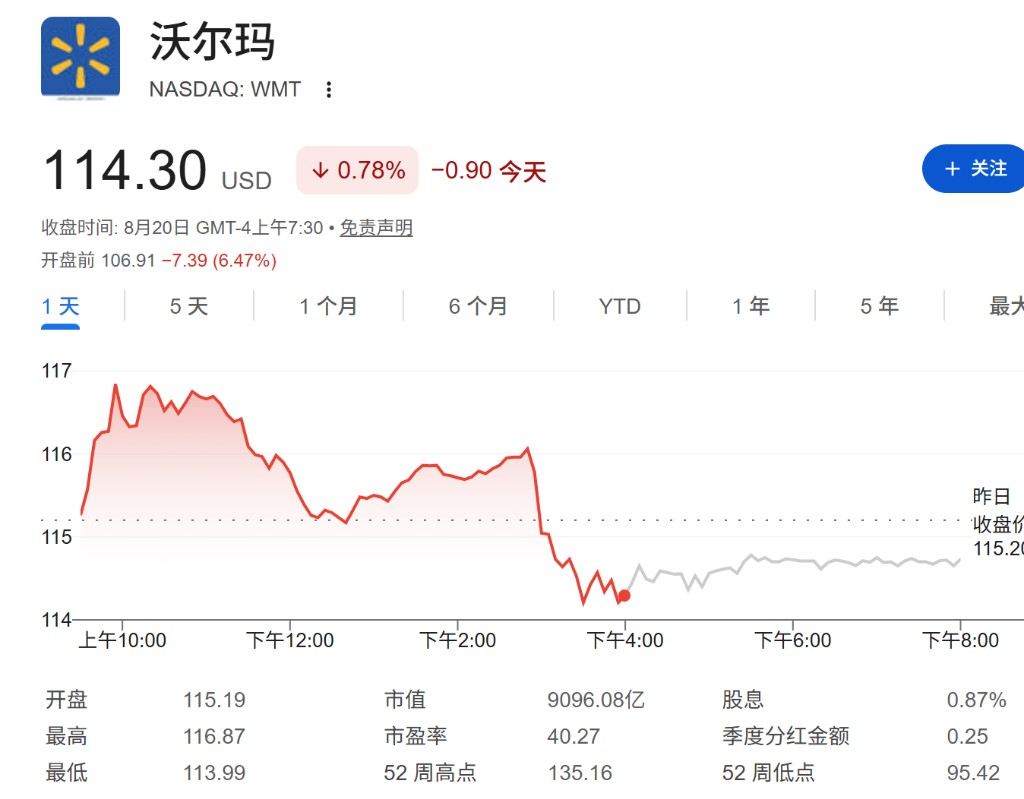
Walmart reported Q2 revenue of $187.94 billion and adjusted EPS of $0.81, both beating expectations, yet its US shares plunged over 7% in pre-market trading. The decline was primarily driven by US Comps growth slowing to 2.6% (a more than six-year low) and full-year EPS guidance falling short of expectations. Price cuts in pharmacy services and shrinking average transaction values weighed on performance, highlighting caution and weakness in US consumer spending amid high oil prices and a cooling labor market
Walmart’s second-quarter results were mixed—revenue and adjusted earnings per share both exceeded market expectations, but US Comps growth hit its lowest level in over six years, and the full-year profit forecast missed expectations, sparking concerns among investors about slowing growth momentum for the world’s largest retailer.
In pre-market trading on Thursday, Walmart announced its Q2 results, showing that Q2 revenue reached $187.94 billion, surpassing the estimated $186.87 billion. Adjusted earnings per share were $0.81, against an estimate of $0.74. Following the release, Walmart’s US shares plunged more than 7% in pre-market trading.
US Comps (excluding fuel) grew by only 2.6% year-over-year, missing even the lowest analyst expectation compiled by Bloomberg and marking the second consecutive quarter of decelerating growth. This was partly due to federal drug price negotiations pressuring pharmacy revenues.
Regarding the full-year outlook, Walmart set its adjusted EPS guidance range at $2.80 to $2.87, below the market estimate of $2.90. Meanwhile, the company raised its expectations for full-year sales and adjusted operating income, stating that it had begun receiving tariff refunds this quarter. Management committed to using these funds to lower product prices.
Pharmacy Business Drags Performance, Consumer Spending Per Transaction Shrinks
Walmart explicitly pointed out that the pharmacy business was one of the core factors weighing on performance this quarter. Federal government-led drug price negotiations led to lower selling prices for related products, dragging down overall sales.
At the same time, signals of divergence emerged on the consumer side. Average spending per shopping trip during the quarter (ended July 31) decreased compared to the same period last year, but the number of transactions remained relatively stable, while e-commerce sales continued to grow.
This combination of data reflects the complex situation facing US consumers: shopping frequency has not significantly contracted, but consumers are becoming increasingly cautious, preferring products with better value for money. According to Bloomberg, low-income households have significantly reduced spending under the pressure of high oil prices. The Consumer Confidence Index also declined for the first time in three months in August, and the labor market is showing signs of weakness.
Slowing Growth Raises Concerns as Economic Barometer
As the largest retailer in the US, Walmart has long been regarded as an important barometer of the US economy, and its performance is closely watched by investors. The drop in Comps growth to a six-year low may exacerbate market concerns about uneven economic signals and weakening consumer sentiment.
Walmart’s stock price had been under pressure for several months prior, partly due to market expectations of slowing growth in its US business. Earlier this year, the company warned that high oil prices could pressure profits. As of Wednesday’s close, Walmart’s stock had risen 2.6% year-to-date, but the sharp pre-market drop wiped out most of these gains.
In terms of competitive landscape, Target is gradually recovering thanks to its business transformation, while Kroger and Costco are actively lowering food prices to compete for market share. The competitive pressure facing Walmart cannot be ignored.
Continued Strategic Investment, Non-Retail Businesses Support Profits
Despite the disappointing quarterly performance, Walmart’s strategic layout has not stalled. Over the past few years, the retail giant headquartered in Bentonville, Arkansas, has continuously increased investment in store upgrades, merchandise structure optimization, and digital services, successfully attracting middle- and high-income consumer groups who prioritize convenience.
Under the leadership of CEO John Furner, Walmart has maintained its core positioning of "price advantage" while accelerating online delivery efficiency and deepening the application of artificial intelligence across various operational links.
The continuous expansion of non-retail business segments, such as advertising and third-party platforms, has provided additional support for profit growth, offsetting some of the growth pressure on the core retail business to a certain extent. However, maintaining growth momentum under the dual pressures of rising investor expectations and a tightening macro environment remains a core challenge for Walmart.