
Can Bessent's 'Operation Twist' Really Suppress Long-End Rates? Goldman Sachs: Fiscal Issues Are the Root Cause, and Term Premium May Persist in the Long Run
 I'm LongbridgeAI, I can summarize articles.
Goldman Sachs points out that the U.S. fiscal deficit, inflation uncertainty, massive debt issuance driven by AI, and market concerns about a rise in the equilibrium real interest rate are the driving forces behind the recent increase in U.S. long-end yields. Neither Treasury buybacks nor adjustments to issuance structure have any impact on these factors. Therefore, Goldman Sachs believes that this intervention is merely a temporary relief of pressure and cannot change the trend direction of long-end yields
The debate over controlling long-end U.S. Treasury yields is evolving into a tug-of-war between fiscal realities and policy tools.
U.S. Treasury Secretary Bessent recently announced a doubling of the buyback scale for Treasuries with maturities of more than 10 years, attempting to send a signal to the market to curb further rises in long-end yields by expanding long-term Treasury buybacks. Following the announcement, the 30-year U.S. Treasury yield fell by approximately 10 basis points on the day, and the yield curve exhibited a bull flattening trend.
However, Goldman Sachs' macro team holds clear reservations, believing that this intervention is merely a temporary relief of pressure and cannot change the trend direction of long-end yields.
Goldman Sachs macro strategist Vitali Meschoulam stated bluntly, "Operation Twist can affect the term premium, but it cannot eliminate it. Such operations can change the path, but rarely the destination."
The drivers of the current rise in long-end yields have shifted from technical factors to fiscal fundamentals. Once the market begins to price in sovereign financing dynamics, the effectiveness of yield suppression measures will become increasingly limited. This operation may bring a brief compression of 20 to 40 basis points and a phased flattening of the curve, but it cannot reverse the broader trend.
As of press time on Thursday, the 10-year U.S. Treasury yield rose by 3 basis points to 4.684%, basically returning to the level before Bessent announced the expansion of the buyback program on Wednesday.
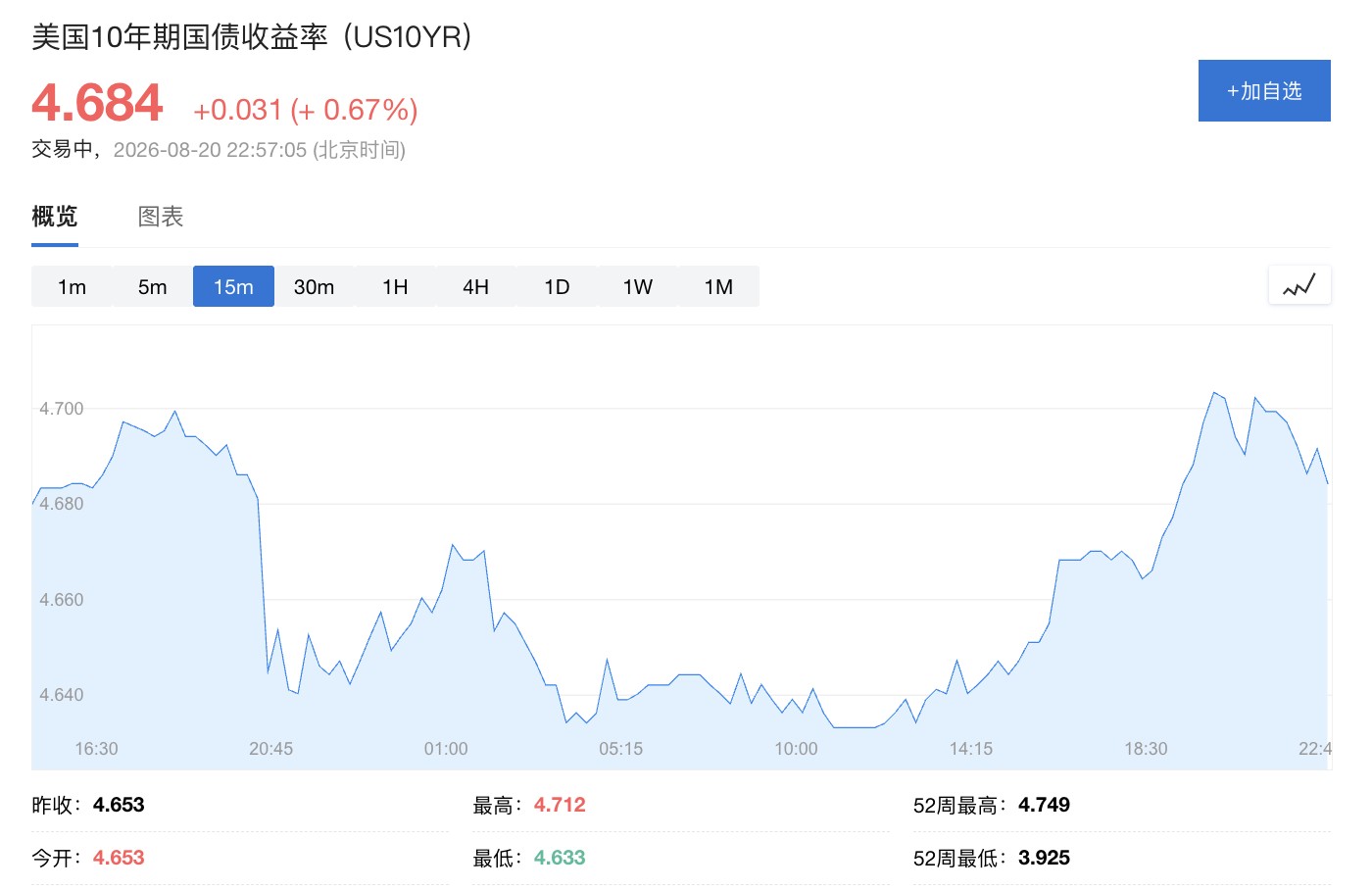
Bessent Sends a Signal, Market Cools Briefly
In terms of absolute scale, the magnitude of this buyback expansion is negligible. Technically, it could have been easily included in the previous U.S. Treasury Borrowing Advisory Committee (TBAC) refinancing announcement and does not constitute a substantive shift in policy mechanisms.
Bessent's true intention is to send a psychological signal to the market: policy makers are willing to intervene in the increasingly crowded steepener positions, introducing two-way risk to long-end rate trades that were previously seen as one-way bets.
The market's immediate reaction confirmed this judgment—the 30-year yield fell by about 10 basis points on the day, but the magnitude of the price change reflected more the market's positioning structure than a change in fundamentals.
Pressure can be channeled, but it is difficult to eliminate. Short-end rates are relatively fixed due to the Federal Reserve's policy anchor. After the long end was intervened upon, market pressure immediately shifted to the U.S. dollar, with the exchange rate coming under pressure becoming the most obvious market chain reaction following the announcement.
The Treasury's intervention was partly because the Federal Reserve's recent communication failed to effectively prevent the adverse tightening of long-end financial conditions. The friction between the Treasury's intent to control long-end rates and the Fed's balance sheet reduction process will be an important variable to watch closely leading up to the Jackson Hole meeting.
Historical Precedents: Policy Effectiveness Requires Going with the Flow
A common prerequisite for policy interventions to succeed is that the market already has a consensus on the direction of yield declines.
Both the original U.S. "Operation Twist" in 1961 and the Federal Reserve's Maturity Extension Program in 2011 achieved slight declines in long-end yields, with effects generally estimated at 10 to 20 basis points. However, at that time, inflation was mild and economic growth was weak, so the market itself was already inclined toward lower interest rate levels—policy intervention was pushing with the flow.
Japan's Yield Curve Control (YCC) is the most successful case of long-end suppression, but its conditions for success were extremely stringent: long-term absence of inflation, abundant domestic savings, and investors' general acceptance of the equilibrium yield level set by policy. Once inflation returned, the cost of maintaining the cap surged sharply and ultimately became unsustainable.
Australia's lesson is even more straightforward: the yield target operated smoothly until the market judged that the inflation and growth landscape had fundamentally changed. The central bank faced the dilemma of "infinite bond purchases or abandoning the target," and ultimately chose the latter.
Experience from emerging markets also confirms this pattern. Turkey temporarily suppressed yields through regulatory measures and forced domestic demand, but investors ultimately focused more on inflation, exchange rate stability, and policy credibility, causing the risk premium to inevitably re-emerge.
Brazil has repeatedly used liquidity measures to temporarily stabilize the long end, but the curve ultimately always returned to the true pricing of fiscal credibility, inflation expectations, and real interest rates.
From this, it can be inferred that investors can usually tolerate one of three things—weak economic growth, high inflation, or deteriorating fiscal conditions—but find it difficult to forgive the coexistence of all three.
Current Dilemma: Triple Pressure Overlap, Technical Tools Fail to Address Roots
This round of rising long-end yields is not caused by a technical imbalance between buying and selling, but is driven by three structural forces: the increase in duration supply brought about by the continuous expansion of the fiscal deficit, lingering inflation uncertainty, and market concerns about a structural upward shift in the equilibrium real interest rate compared to the post-financial crisis era.
Unlike in 2011, the current rise in long-end yields far exceeds the scope of market adjustments to expectations for the Federal Reserve's policy path. An increasing proportion of the adjustment is being realized through a rise in the term premium—and the term premium is inherently more difficult to suppress with policy tools.
In addition, there is a factor often overlooked by the market: the huge capital demand brought about by artificial intelligence infrastructure construction—capital expenditure on ultra-large data centers, investment in power infrastructure, and the broader trend of re-industrialization—are making capital itself scarcer, thereby pushing up its price.
Treasury buybacks and adjustments to issuance structure are insensitive to these three forces—while they can affect the amount of duration the market needs to digest, they cannot substantially change inflation expectations, the fiscal trajectory, or the level of the equilibrium real interest rate. This is the core distinction between "technical mitigation" and "structural resolution."
Goldman Sachs' conclusion is therefore clear: before there is a significant deterioration in growth, a decisive decline in inflation, or a tangible improvement in fiscal conditions, investors will continue to demand compensation for holding duration assets. The most accurate understanding of Bessent's operation this time might be: managing the market's perception of duration risk, rather than eliminating the root cause of the risk itself.