
Morgan Stanley visits Fremont: Tesla intentionally does not increase Model Y, Robotaxi bets placed on Cybercab
 I'm LongbridgeAI, I can summarize articles.
JP Morgan analysts pointed out after visiting Tesla's Fremont factory that Tesla intends to control the addition of Model Y to the Robotaxi fleet, instead betting on the scaling of Cybercab. Management is confident in the near-term development of Cybercab, believing that a dedicated platform is the key to capacity. FSD V15 is seen as the main gateway for the rollout of autonomous driving, with the expected acceleration window for fleet expansion from the end of 2026 to early 2027. Morgan Stanley maintains a target price of $475 for Tesla
JP Morgan analysts visited Tesla's Fremont factory in California and met with the investor relations team, writing a key sentence in the minutes: the company "intends to control the continued addition of Model Y to the Robotaxi fleet," as management is confident about the near-term scaling of Cybercab. FSD V15 is defined as a performance leap comparable to V13 and V14, and is the main gateway for the large-scale rollout of unsupervised autonomous driving. Morgan Stanley maintains a target price of $475. This on-site minutes did not revise sales figures but transformed two long-term narratives—Robotaxi and Optimus—from slogans into verifiable timelines.
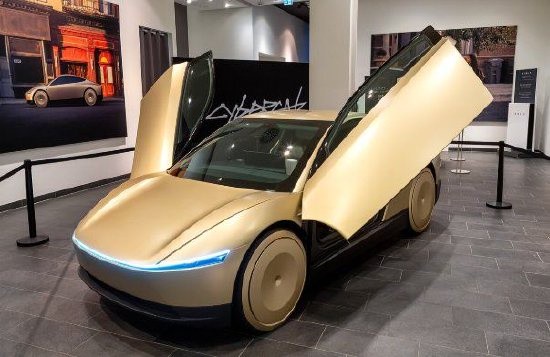
Current models are just a transition; dedicated platforms are the capacity switch
The core of the minutes is not "Robotaxi has stopped," but that the fleet composition needs to change. Existing services are still primarily based on modified Model Y; management clearly does not want to convert more current models to avoid occupying already tight retail capacity and to prevent making the capacity curve too steep before dedicated vehicles arrive. Morgan Stanley's interpretation is that confidence in near-term scaling has shifted from "modifying another batch of Ys" to "Cybercab can ramp up as planned."
This is generally consistent with the statements made during the Q2 conference call, but this time it explicitly stated "deliberately slowing down." For the trading market, the implication is twofold: short-term Robotaxi mileage and urban coverage may seem slow; once the Cybercab small-scale test fleet is validated, capacity elasticity will be greater than continuing to dismantle Model Y. A more complete note cited by Wall Street Journal indicates that the acceleration window for fleet expansion is set for late 2026 to early 2027, with the catalyst locked in as the FSD V15 to be launched within the year.
Cybercab is positioned as the first form of the platform, not the only form. Management again mentioned the Obovan demonstration at the event on October 10, stating that there will be other models based on the same architecture in the future. The manufacturing side emphasizes the "unboxed" process: large subassemblies are pre-installed in parallel, with final integration advancing alongside validation and capacity expansion.
FSD V15: Seven core technologies, 40% already tested in the fleet
Software is the harder part of this minutes. Tesla refers to V15 as a step-change, with magnitude comparable to V13 and V14—at that time, accompanied by an increase in parameter volume, an expanded context window, and a decrease in latency of about 20%. V15 includes seven core technologies, of which about 40% have already been tested in the Robotaxi fleet, with initial feedback being positive. The company also emphasizes that when new features are introduced, existing driving capabilities must be safeguarded against regression. V15 is seen as a major threshold for expanding unsupervised FSD from pilot to scale The hardware division has also been clarified. The existing AI/HW4 stack has been reiterated as sufficient to run V15 and support unsupervised FSD; the next generation AI4.5 is reserved for scaling up the Robotaxi model and extending context length—computing power is expected to be about 10% higher in FLOPS, and memory is expected to double. In other words, mass production expansion is not tied to new chips, but the long-term fleet density will consume more computing and storage. This follows the same logic as "first validating software with existing cars, then using dedicated vehicles to increase utilization."
European regulations are listed separately. The notes indicate that Tesla is pursuing a dual track: after multiple delays in EU-level approvals, the current expectation is set for October; simultaneously, collaboration with member countries like the Netherlands aims to replicate the established framework in other markets. European FSD driving data has exceeded 65 million kilometers, with collision events decreasing by about five times, which has been used as regulatory communication material. The one-time buyout of FSD will cease in the US and Canada by February 2026, with the global subscription switch completed in August.
Cost Accounting: Reducing from $0.60/mile to $0.30/mile
Using current vehicles for Robotaxi can only partially realize the economic benefits of autonomous driving. The notes provide a comparison: the total cost of ownership for personal use of Model Y/3 is about $0.60–$0.70 per mile; after increasing Robotaxi utilization to 4–5 times personal use, it can drop to $0.50–$0.60; the long-term goal for dedicated platforms is $0.30. This explains why management prefers to add fewer Y models now: each additional modification to an existing vehicle incurs a higher per-vehicle cost to fill short-term mileage, while delaying full production of dedicated production lines.
Therefore, "deliberately not adding Y" should not be interpreted as weak demand, but rather as a prioritization of capacity and software. The software gate is V15, the hardware gate is the Cybercab ramp-up, and the regulatory gate is in various states in the US and the EU. If these three lines do not synchronize, the fleet numbers will appear flat. When the three lines overlap, the curve will bend.
Optimus: Mass production imminent, external sales as early as the second half of 2027
The same visit covered humanoid robots. The third-generation design of Optimus has been finalized, and the supply chain is largely locked in; after the dismantling of the original Model S/X production line in Fremont, a robot line is being installed. Mass production (SoP) is set for the coming months; the official unveiling of the third generation will be close to mass production to protect competitive details. External commercial sales are expected to begin as early as the second half of 2027. The capabilities, costs, and scalability of the fourth generation will depend on data from the third generation.
Commercialization is broken down into three steps: entering the "Optimus Academy" in the second half of 2026 to collect real-world data; then moving into Tesla's own factories to avoid third-party compliance friction; and only then selling to external customers. The internal priority scenarios are repetitive and high-risk positions such as stamping and white body assembly, while final assembly is pushed further back due to dexterity requirements. The long-term production capacity is still projected at about 1 million units in Fremont and about 10 million units in the Texas Gigafactory—that is a plan, not a shipment guidance for 2026 Market: Target price $475, stock price still realizing previous gains
After a visit, Morgan Stanley maintains a target price of $475, with the overnight stock price around $351. IBD mentioned that another seller gave a bearish contrast to Robotaxi, and Tesla retraced some of this week's gains in Thursday morning trading. This is typical: the minutes confirm the path but do not provide new quarterly numbers; bulls see confidence in Cybercab and V15, while bears see "deliberately not adding vehicles" meaning that the recent mileage growth may be below expectations.
Three interpretations can be drawn regarding positions. First, the Robotaxi narrative has shifted from "modifying existing cars for urban use" to "waiting for dedicated vehicles + V15," with the validation window being from Q4 2026 to Q1 2027. Second, HW4 has been officially endorsed again, reducing concerns that "a chip replacement is necessary for unsupervised driving," but AI4.5 indicates that subsequent models will continue to consume memory. Third, Optimus's external revenue is still expected after the second half of 2027, contributing almost nothing to the profit statement in the near term, yet occupying Fremont's space and supply chain attention.
The risks are equally clear. If V15 shows a significant setback, the EU's October points are delayed again, or Cybercab ramps up slower than the "near-term confidence" statements, the market will quickly rewrite "deliberately not adding Y" to "dedicated vehicles are not ready yet." Conversely, once unsupervised mileage and dedicated vehicles roll out simultaneously, discussions about the $475 target price will shift from sentiment to utilization arithmetic. The value of these minutes is to put the timeline on paper rather than to buy the valuation all at once