
Treasury Yields Become the 'Elephant in the Room,' Yet Stock Market Investors Turn a Blind Eye
 I'm LongbridgeAI, I can summarize articles.
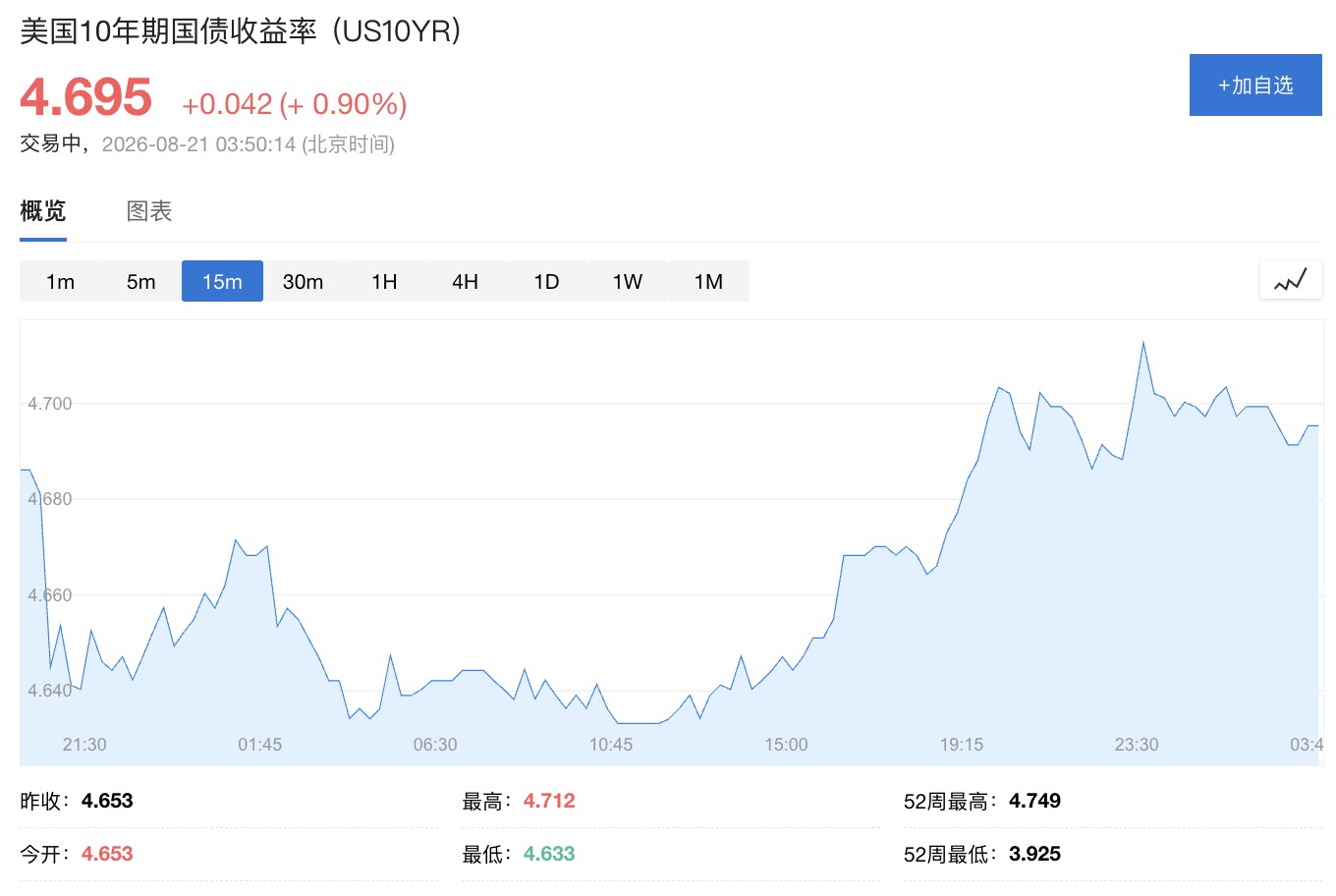
A Bank of America survey shows that institutional investors have allocated 56% of their portfolios to equities, the highest level since November 2021. Among them, "disorderly rise in bond yields" is regarded as the second-largest threat to the stock market, trailing only concerns about an AI bubble. Analysts state that current U.S. Treasury yields remain within an acceptable range, with the 10-Year Treasury Yield at 5% being a key threshold
Global bond yields continue to climb, but stock market investors seem to be choosing to ignore them. Wall Street strategists generally believe that yields are not yet high enough to end the stock market bull run—though they also acknowledge that there is a clear tipping point for this judgment.
The latest Global Fund Manager Survey by Bank of America reveals that responding institutional investors have allocated 56% of their portfolios to equities, the highest level since November 2021.
Meanwhile, the same survey indicates that "disorderly rise in bond yields" is viewed as the second-biggest threat to the stock market, second only to concerns about an AI bubble; another 25% of respondents listed a new wave of inflation rebound as the top risk.
On Wednesday, the U.S. Treasury unexpectedly announced an increase in the scale of long-term Treasury buybacks, providing the market with a brief respite—the 10-Year Treasury Yield fell by 6 basis points to 4.65%, while the 30-year yield dropped by 9 basis points to 5.19%. However, yields rebounded on Thursday.
Equity Positions Hit Three-Year High, Coexistence of Risk Awareness and Risk Appetite
Despite the "disorderly rise in bond yields" ranking high on the risk list, the actual actions of institutional investors contradict these concerns. The Bank of America survey shows that fund managers' current equity allocation ratio has reached 56%, a peak in nearly three years.
JC O'Hara, Chief Technical Strategist at Roth Capital Partners, stated that although the stock market is operating against a backdrop of rising yields, it remains near historical highs, and investors "should be bullish, or at least maintain a positive attitude."
He pointed out that improved earnings expectations, a favorable economic outlook, and reduced market focus on the Middle East situation have jointly driven a recovery in risk appetite, and the S&P 500 Index often achieves strong forward-looking returns during phases of improving risk appetite.
Tyler Richey, editor of Sevens Report Technicals, holds a relatively cautious stance. In an interview, he stated that rising yields are the "elephant in the room," posing a potential threat to a stock market that has already fallen into volatility after hitting record highs.
Yield Curve Shape May Be More Worth Watching Than Absolute Levels
Some strategists have shifted their analytical focus from the absolute level of yields to the shape of the yield curve. Ed Clissold, Chief U.S. Strategist at Ned Davis Research, pointed out on Tuesday that the stock market is currently in the "sweet spot" of the yield curve.
Currently, the 10-Year Treasury Yield is about 49 basis points higher than the 2-year yield. Clissold defines a "moderately positive sloping yield curve," where the 10-year yield exceeds the 2-year yield by no more than 150 basis points, as the range where the S&P 500 performs most stably and yields the highest returns.
According to NDR's historical data tracing back to 1976, under this pattern, the S&P 500's average annualized return is approximately 11%.
5% Is the Widely Recognized Psychological Threshold
Even among the current bulls in the stock market, there is widespread acknowledgment that if yields continue to rise, they will eventually exert substantial pressure on the market.
Liz Ann Sonders, Chief Investment Strategist at Charles Schwab Center for Financial Research, stated:
"Current levels are still within an acceptable range, but I believe that if (the 10-Year Treasury Yield) moves closer to 5%, it could cause severe market turbulence similar to what happened in 2023."
From late July to late October 2023, the 10-Year Treasury Yield briefly touched 5%, during which period the S&P 500 Index cumulatively fell by 10%.
Matt Maley, Chief Market Strategist at Miller Tabak + Co., put it more concisely in a phone interview: "Bond yields are starting to rise, and the stock market is choosing to ignore them—until it can no longer do so."