
POP MART: The Tide Has Receded, but It Is Not Naked Swimming
 I'm LongbridgeAI, I can summarize articles.
POP MART's H1 revenue of RMB 17.17 billion and net profit of RMB 5.04 billion both missed expectations, causing the stock price to drop more than 8% during trading. However, dissecting the root causes of the "poor" performance reveals that the RMB 720 million foreign exchange loss and the waning traffic for LABUBU are external variables. With domestic growth at +47.3%, member repurchase rates at historical highs, a RMB 5 billion buyback program, and Wang Ning actively admitting to "missing targets," it is the growth rate that has faltered, not the fundamental business
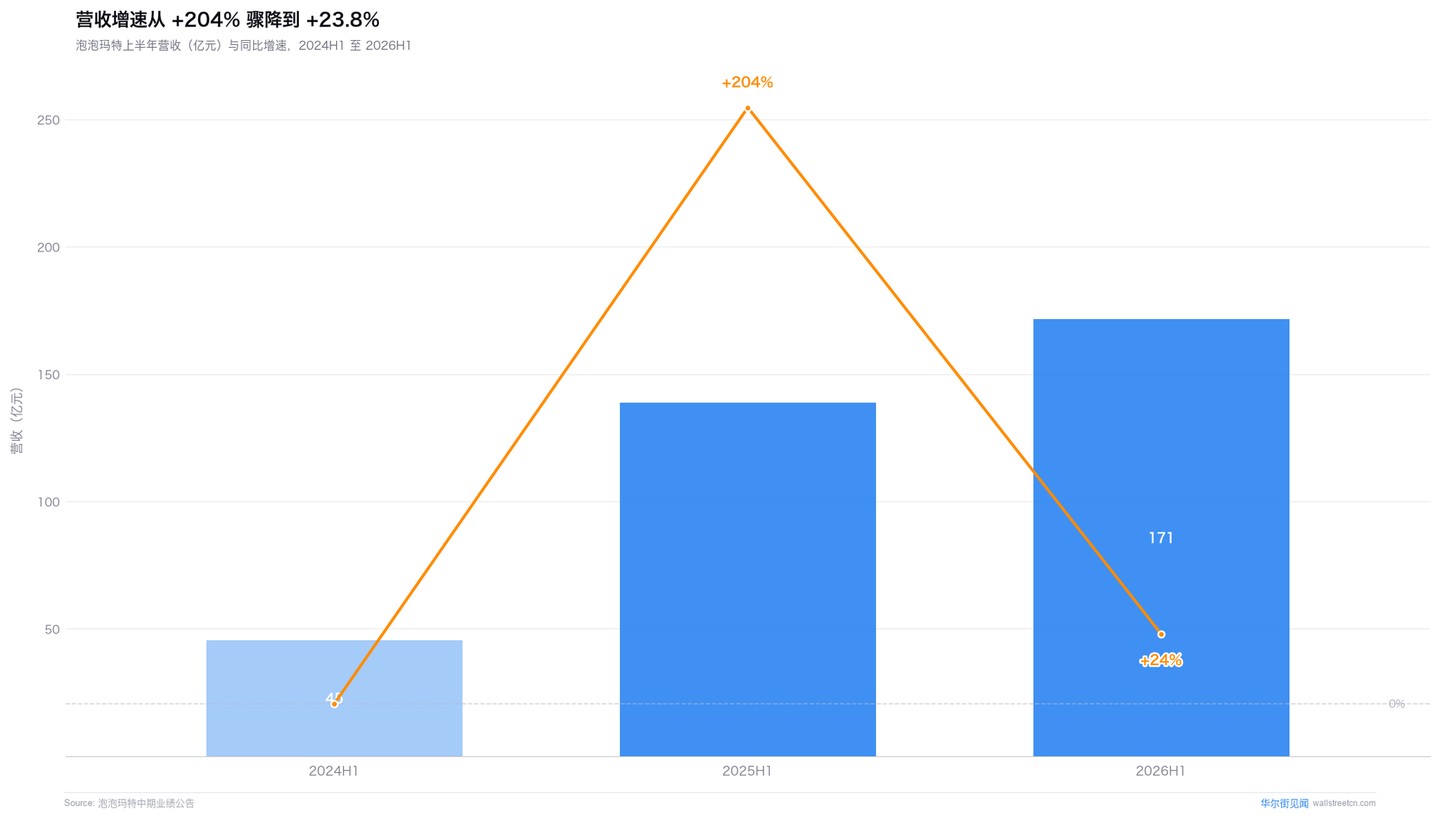
During early trading on August 21, POP MART's Hong Kong-listed shares fell more than 8%, hitting a five-month low. The market's vote, cast with its feet, seemed indisputable: revenue of RMB 17.17 billion and net profit of RMB 5.04 billion both missed expectations, with growth slowing from 204% a year ago to 23.8%.
However, if we break down and recalculate these figures, the conclusion may be entirely opposite. Is the market really voting for a deteriorating company? In this "poor" financial report, the worst parts are precisely those not attributable to operations.
The Numbers Are Indeed Ugly, with Growth Dropping from 204% to 23.8%
Let us first acknowledge the poor performance. H1 revenue was RMB 17.17 billion, a year-on-year increase of 23.8%, about RMB 2.8 billion less than market estimates; net profit was RMB 5.04 billion, a year-on-year increase of 8.9%, RMB 1.6 billion less than estimated. The adjusted net profit margin (excluding one-off items) fell from 33.9% to 30.0%, and the gross margin dipped slightly from 70.3% to 69.7%.
A year ago, the company delivered an interim report with revenue growth of +204.4% and net profit growth of +396.5%, making it the most dazzling growth stock in the Hong Kong market. Now, with growth shifting gears and profits decelerating, market panic is not without basis.
But if we decompose the causes of the "poor" performance, the answer may be read in reverse. The two major factors dragging down performance are exchange rates and traffic, neither of which points to product strength or channel capabilities themselves.
Half of the Poor Performance Is Due to Exchange Rates, Half to Waning Traffic
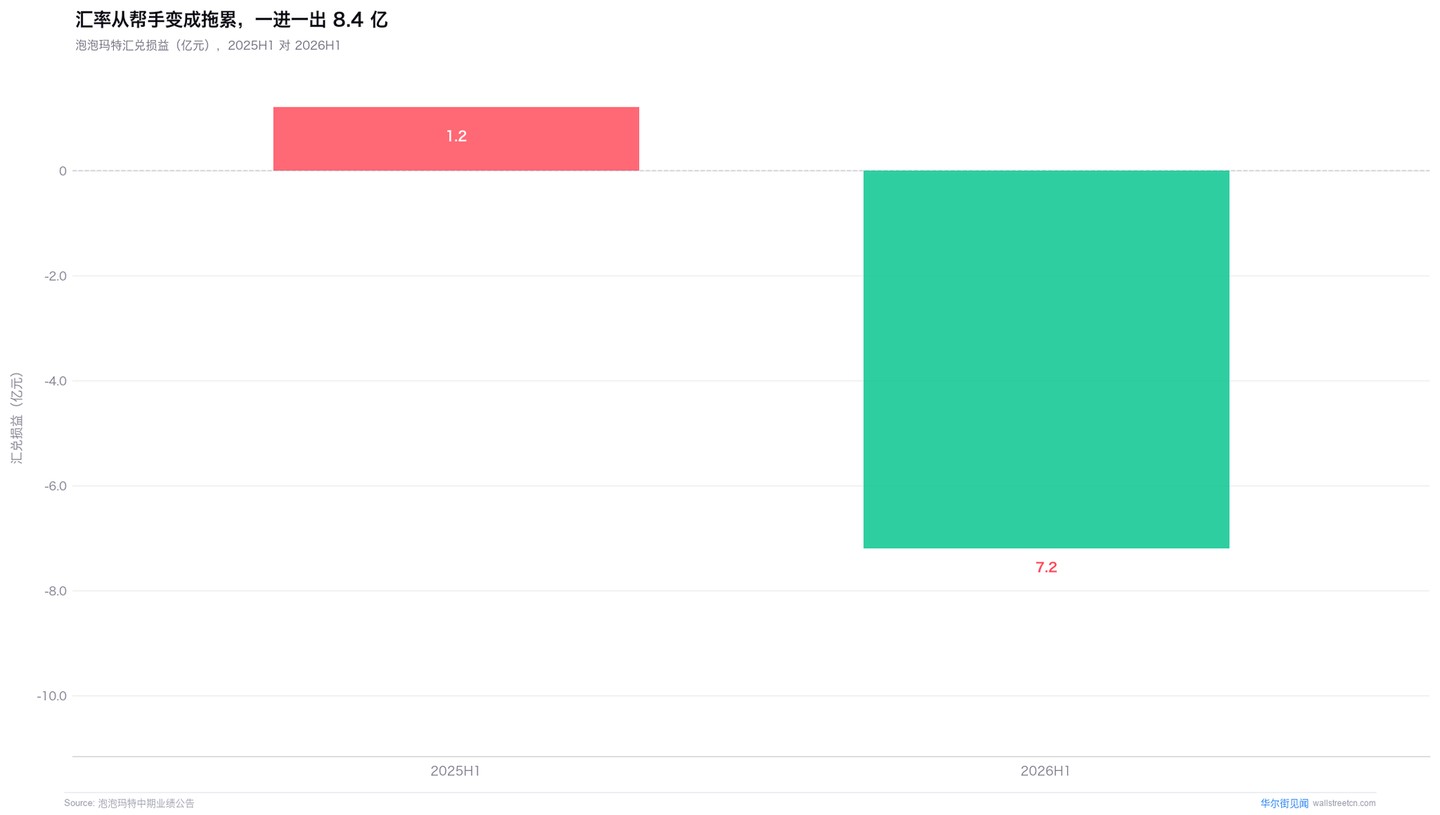
First, look at exchange rates. The company recorded a foreign exchange loss of RMB 720 million in the first half of the year, compared to a foreign exchange gain of RMB 120 million in the same period last year, a swing of RMB 840 million. On the statement, net profit was only about RMB 400 million higher than the same period last year, but if we add back the foreign exchange factor, the real incremental profit is close to RMB 1.3 billion, corresponding to a growth rate jumping from 8.9% to over 25%.
Next, look at overseas online channels. Asia-Pacific online revenue decreased by 39.8% year-on-year, with a 62.1% drop on the Shopee platform; Americas online revenue decreased by 45.6% year-on-year, with a 44.6% drop on the self-developed App and official website. The company attributed the reasons in its financial report to the "fading of external traffic dividends" and the "return of core IP popularity to normal levels." In plain language, the online frenzy stirred up by LABUBU has subsided.
Exchange rates are external variables, and waning traffic is a cyclical phenomenon; neither reflects the company's inherent product strength or channel capabilities.
However, overseas operations have not cooled off; they have simply shifted battlegrounds. Retail stores in the Americas expanded from 41 to 86, and in Europe from 18 to 45, with offline overseas revenue growing by 19.5% and 49.8%, respectively. After the traffic dividend fades, the company is switching its growth engine from online harvesting to offline intensive cultivation. Store openings take time to yield results, so they cannot immediately fill the gap left by online declines in the short term.
The Operational Fundamentals Are More Stable Than the Financial Statements Suggest
Squeezing out the moisture from foreign exchange and traffic reveals the true quality of operations. The gross margin of 69.7% dropped by only 0.6 percentage points under the dual pressure of rising raw material costs and a declining proportion of high-margin overseas business, remaining stable around 70%. This demonstrates top-tier pricing power in the consumer industry.
Expense growth also has its logic. Selling and distribution expenses increased by 23.1% year-on-year, with rental expenses up 43.3% and employee compensation up 45.7%. The number of sales staff increased from 6,219 to 9,734, staffing the overseas store network that doubled in size over six months. Opening stores burns cash, but the accounts should be viewed with a longer-term perspective.
One point that must be stated honestly is that the profit side included RMB 240 million in government subsidies (RMB 37.81 million in the same period last year). This is not money earned from operations and should not be mistaken for resilience.
Resilience One: Domestic Engine and IP Succession
True resilience comes first from the domestic fundamentals. Revenue in the China region was RMB 12.2 billion, a year-on-year increase of 47.3%, shouldering almost all the incremental growth. Moreover, the number of stores only increased net from 445 to 455, meaning growth relied on single-store efficiency rather than expansion.
At the IP level, revenue from THE MONSTERS, where LABUBU belongs, was RMB 4.45 billion, a year-on-year decrease of 7.5%, but Starry People took over the baton with RMB 2.65 billion in revenue, a growth rate of +580.6%. Six IPs exceeded RMB 1 billion, and 11 IPs exceeded RMB 100 million. CRYBABY, DIMOO, and SKULLPANDA all achieved positive growth. POP MART is no longer a company relying on a single IP.
A more valuable signal lies in membership. Mainland China members increased from 72.58 million to 82.44 million, adding nearly 10 million in half a year. Member-contributed sales accounted for 92.9% of China region revenue, with a repurchase rate of 51.6%. The repurchase rate is at a historical high, indicating that users are not just buying into temporary hits but are continuously repurchasing within the IP ecosystem.
Resilience Two: Balance Sheet and RMB 5 Billion Buyback
The second layer of resilience lies on the balance sheet. As of the end of June, cash and cash equivalents totaled RMB 12.44 billion, with no bank borrowings. The debt-to-asset ratio continued to fall from 29.4% to 24.9%. After distributing RMB 3.15 billion in dividends and spending approximately RMB 1.55 billion on buybacks in the first half, the cash position remains robust.
This is also the confidence behind Wang Ning's announcement of a Buyback Program of no less than RMB 2 billion and no more than RMB 5 billion during the earnings call, marking the first time the company has announced a buyback plan during such an event. In the first half of the year, the company cumulatively repurchased and cancelled 11.22 million shares, costing approximately HKD 1.74 billion, with a repurchase price range of HKD 140.9 to HKD 194.9 per share.
Admitting to growth deceleration while using real money to buy back its own stock is a vote of confidence by management. It is worth noting that the board decided not to distribute an interim dividend, redirecting the dividend budget to buybacks. For shareholders, this is still a return, just in a different form.
Resilience Three: Wang Ning's Candor and Morgan Stanley's Resilience Thesis
The third layer of resilience is hidden in management's attitude. During the earnings conference call, Wang Ning rarely spoke so plainly, stating that pressures in the second half would be greater than in the first half, and that it is highly likely the company will miss the 20% growth target set at the beginning of the year. While this sounds like bad news, from another perspective, a company that dares to actively lower expectations and not make excuses is more trustworthy than one that stubbornly holds onto targets and eventually suffers a shock.
Investment banks' judgments confirm this. Morgan Stanley analyst Dustin Wei's team lowered POP MART's target price from HKD 214 to HKD 203 and simultaneously lowered H2 sales expectations by 7%. However, the report emphasized that the resilience of POP MART's core operating profit margin far exceeded expectations, benefiting from improved domestic margins and the flexibility of overseas cost structures.
Morgan Stanley also predicted that Q4 sales would benefit from positive seasonal factors and continued store expansion. In other words, the investment bank cut "growth rates" but acknowledged "earning power." The stock price dropped more than 8% at the open, hitting a five-month low. The market is valuing POP MART using a logic of growth gear-shifting, but the evidence of earnings quality actually stands on the side of the bulls.
In this semi-annual report, POP MART's worst figures can almost entirely be attributed to external variables. Foreign exchange losses are due to currency fluctuations, and the online retreat is a traffic cycle. The domestic engine, IP succession, member stickiness, and cash on hand are the cards the company holds itself. Three uncertainties remain: whether the 201 days of inventory can be successfully cleared, whether overseas offline channels can fill the online gap, and whether Wang Ning's statement about "missing targets" is excessive caution or foresight. The bottom cards have been revealed; the fourth quarter will show the true outcome.