
US August Composite PMI Preliminary Reading Beats Expectations, Rising to Over Four-Year High as Strong Services Expansion Offsets Manufacturing Weakness
 I'm LongbridgeAI, I can summarize articles.
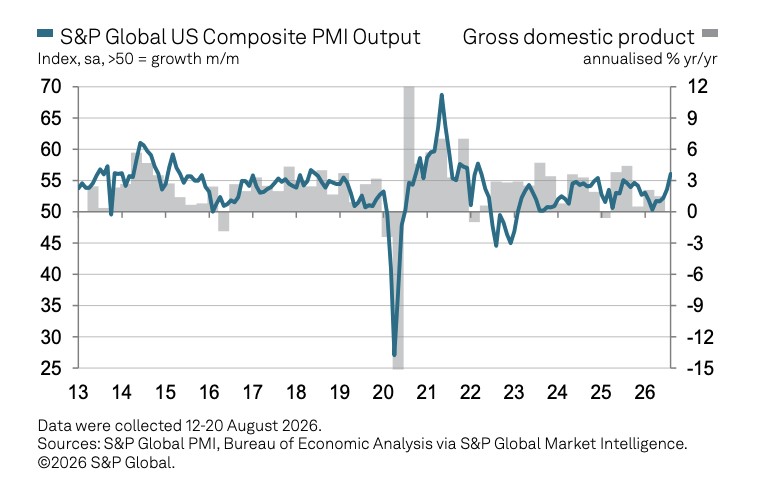
The US Composite PMI rose to 56.0 in August, hitting a new high since April 2022. Strong expansion in the services sector is driving the annualized GDP growth rate for the third quarter toward nearly 3.0%, marking a shift in economic growth momentum from manufacturing to services. The job market has shown significant improvement, corporate confidence has strengthened, and price pressures have eased somewhat. However, manufacturing has cooled due to constraints such as supply chain delays and tariffs, while energy prices remain a potential inflation risk
US business activity accelerated significantly in August, with the Composite PMI rising to its highest level in over four years. Strong expansion in the services sector has become the main support for economic growth, and the job market has simultaneously warmed up. Meanwhile, corporate price pressures have eased, indicating that inflationary pressures have not further intensified even as economic growth accelerates.
Preliminary data released by S&P Global on August 21 showed that the US August Composite PMI Output Index rose to 56.0, a significant increase from July's 54.5, marking the highest level since April 2022. The Services Business Activity Index rose from 54.6 to 56.8, the highest since December 2024; the Manufacturing PMI fell from 53.9 to 53.2, and the Manufacturing Output Index dropped further to 51.9, a 13-month low.
Chris Williamson, Chief Business Economist at S&P Global, stated that the latest survey suggests the annualized GDP growth rate for the US third quarter could approach 3.0%, significantly higher than the 1.5% recorded in the second quarter. This indicates that the momentum of US economic growth is shifting from manufacturing to services.
Notably, the job market has also shown significant improvement. The Composite Employment Index recorded its largest single-month increase this year, with the scale of new job creation hitting its highest growth since January 2025; meanwhile, companies' expectations for output over the next 12 months rose to their highest level since last November.
Services Take the Lead as Economic Growth Momentum Shifts
The services sector was the core driver accelerating US economic activity in August.
The Services Business Activity Index rose to 56.8, with the growth rate of new business orders improving synchronously. Backlogs grew at the fastest pace since May 2022, indicating that demand remains robust while corporate capacity still faces certain constraints.
In contrast, manufacturing sentiment has cooled. The Manufacturing PMI fell to 53.2, the lowest since March this year; the growth rate of manufacturing output slowed for the third consecutive month, dropping to a 13-month low, and the growth rate of new orders also fell to its lowest since March this year.
Williamson pointed out that the momentum of US economic growth has clearly shifted from manufacturing to services between the second and third quarters, and the sustainability of economic expansion will depend more heavily on areas such as consumer spending and financial services.
Supply Chain Disruptions Limit Manufacturing Growth
Behind the manufacturing slowdown, supply chain pressure remains a significant constraint.
In August, the degree of supplier delivery delays reached one of the most severe levels in the past four years, with businesses mainly affected by shipping delays, tariffs, and insufficient supplier inventories. Supply chain bottlenecks have also led to a continuous increase in manufacturing backlogs, with the growth rate of backlogs reaching its fastest range since 2022 since the outbreak of the Middle East conflict.
Meanwhile, companies' previous behavior of increasing inventories to cope with supply risks has begun to cool down. Manufacturers' purchase volumes saw their first decline this year in August, indicating that companies are reducing purchasing efforts after a period of concentrated stockpiling.
Williamson stated that supply chain delays have significantly limited the actual output of some companies, and the situation in the Middle East remains an important risk faced by businesses, particularly potentially impacting them through supply chain and energy price channels.
Job Market Warms Up as Corporate Confidence Improves Simultaneously
The job market was another highlight in the August data.
The Composite Employment Index recorded its largest single-month increase this year, and the second-largest increase in the past four years. Services sector employment growth reached its fastest level since early 2025, and manufacturing employment also rebounded.
Corporate confidence has also improved significantly. Companies' expectations for output over the next 12 months rose for the third consecutive month, reaching the highest level since last November. Increasing backlogs, improved customer inquiries, and companies' own expansion plans have all driven businesses to turn more optimistic about future prospects.
Williamson believes that the alleviation of the negative economic impact of tariffs and the uncertainty caused by the Middle East conflict are important reasons for the improvement in employer confidence.
Inflationary Pressures Cool, But Energy Remains a Risk
As economic activity accelerated significantly, price pressures eased.
In August, the increase in companies' composite input costs fell to its lowest since February this year, while the increase in composite selling prices dropped to its lowest since last November. The rate of increase in services selling prices hit a ten-month low, and the rate of increase in manufacturing selling prices also fell to a six-month low.
The increase in manufacturing input costs narrowed for the third consecutive month, and services input price inflation also fell significantly after touching a 14-month high in July. Companies stated that energy prices, supply chain disruptions, and tariffs remain the main sources of current price pressures.
However, inflation has not completely escaped risk. Williamson pointed out that the average cost increase so far in the third quarter is still slightly higher than the overall level of the second quarter, and if energy prices rise again, inflationary pressures could resurface.