
From Near-Exit to a $44 Billion Market Cap Surge: Moderna’s Decade-Long Bet on Cancer Vaccines
 I'm LongbridgeAI, I can summarize articles.
After the decline in demand for COVID-19 vaccines, Moderna faced growth challenges, and the commercial prospects of its mRNA technology were called into question. Now, the company's cancer vaccine, which it has backed for over a decade, has achieved a key breakthrough: the personalized mRNA melanoma vaccine, jointly developed with Merck, reduces the risk of recurrence or death in patients by 44%. If subsequent trials continue to validate its efficacy, Moderna may unlock new growth opportunities
Moderna is betting on cancer vaccines in an attempt to open up a second growth curve for the company.
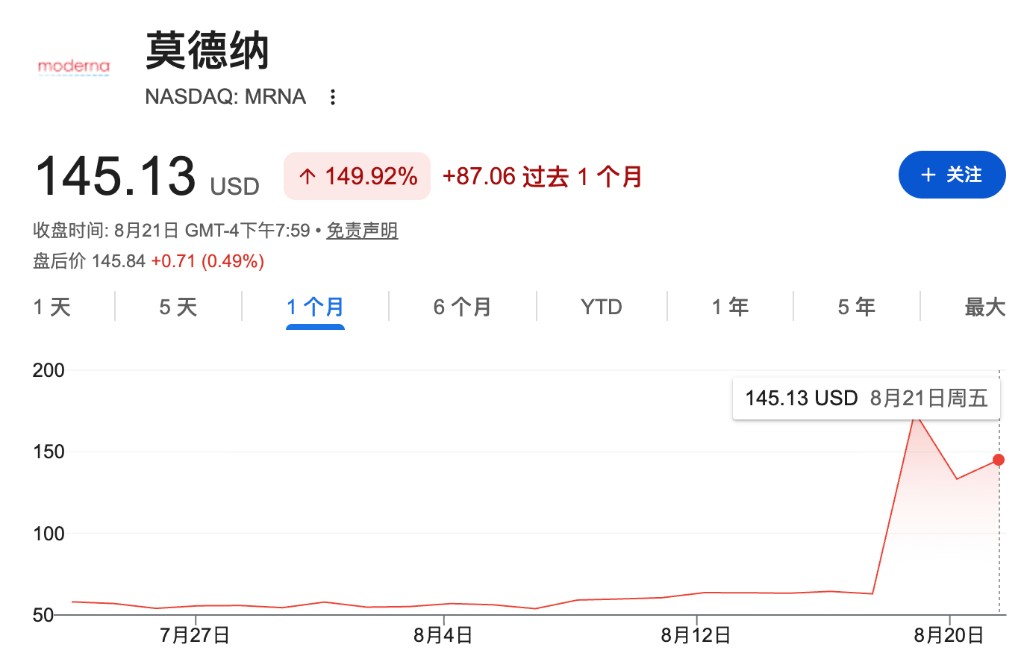
On August 19, Moderna announced key clinical results for the personalized mRNA melanoma vaccine co-developed with Merck. Data showed that, compared to using Keytruda alone, this therapy reduces the risk of recurrence or death in high-risk melanoma patients by 44%. Following the announcement, Moderna’s stock surged, and the company’s market capitalization increased by approximately $44 billion at one point.
Two days later, an in-depth report by The Wall Street Journal on August 21 recreated the scene on the day the results were announced: 4,500 employees at Moderna’s headquarters temporarily gathered in the company cafeteria, waiting for management to announce the results of more than a decade of work. CEO Stéphane Bancel even spoke while holding cue cards; there were hugs, tears, and champagne was opened.
For Moderna, this is not just a clinical breakthrough, but a pivotal moment for a long-term bet that has finally come to fruition.
COVID-19 vaccines generated about $36 billion in sales for Moderna in just a few years, providing ample cash for the company to continue investing in high-risk projects such as cancer therapies. However, as the pandemic dividends faded, the company experienced a sharp drop in sales, layoffs, cuts to R&D projects, and a significant plunge in its stock price. The market began to question what would drive growth for Moderna in the post-pandemic era.
Now, Moderna has finally received a substantial answer.
The report pointed out that the company’s gamble is far from over. Whether the efficacy can be sustained, whether personalized vaccines can be produced at scale, whether costs will be acceptable to the market, and whether the technology can be replicated for more types of cancer will determine whether this breakthrough is merely a short-term rebound or if Moderna has truly opened up a second growth curve.
A Decade-Long Cancer Gamble
The Wall Street Journal reviewed that Moderna began researching mRNA cancer therapies early on, but the company did not focus on the oncology field in its initial stages. The reason is easy to understand: cancer vaccines had previously undergone numerous failed attempts, with long development cycles, high costs, and very limited success rates.
It was not until 2013, when hedge fund manager Patrick Degorce decided to invest $500,000 in Moderna’s oncology project after his wife passed away from lung cancer, that the company further advanced in this direction.
What truly changed the fate of the project was the partnership reached with Merck in 2016. At that time, Merck invested $200 million, and both parties began exploring the effects of combining mRNA cancer vaccines with Keytruda. For Moderna, which was still in its early stages, this funding and the combination with mature cancer immunotherapy provided important support for the continued advancement of the project.
The subsequent COVID-19 pandemic unexpectedly provided ample ammunition for this long-term bet.
Moderna’s COVID-19 vaccine generated about $36 billion in sales in the first two years of the pandemic, and a large amount of cash was subsequently invested in new businesses such as oncology. In a sense, without the huge cash flow brought by the COVID-19 vaccine, it might have been difficult for Moderna to persist with this high-risk cancer bet until today.
mRNA Moves from “Vaccination” to “Cancer Treatment”
The biggest difference between this cancer vaccine and traditional vaccines is that it does not use the same formula for all patients, but is customized based on the tumor characteristics of each patient.
According to The Wall Street Journal, doctors first sequence the patient’s tumor to identify mutations unique to the cancer cells, then use algorithms to select targets worth attacking, with up to 34 targets selectable. Subsequently, this information is encoded into mRNA and delivered into the human body via lipid nanoparticles.
Simply put, it attempts to provide the immune system with a “identification list” targeting specific tumors, helping T cells find and attack cancer cells more precisely.
This is also where the technology truly deserves attention: if this personalized model can be validated in more types of cancer, the commercial value of mRNA could expand beyond its previous heavy reliance on COVID-19 vaccines to the larger tumor treatment market.
The Market Had Lost Faith in Moderna
Just before this set of data was released, the market’s attitude toward Moderna was actually quite pessimistic. As demand for COVID-19 vaccines dropped rapidly, the company faced revenue pressure and had to continuously lay off staff and cut costs. Doubts about the commercial prospects of mRNA technology also grew.
Citing market data, The Wall Street Journal reported that earlier this year, the short interest in Moderna’s stock reached around 20%. The core issue behind this was clear: Without COVID-19 vaccines, how can Moderna make money?
Therefore, it is understandable that the market quickly re-priced Moderna after it announced positive data for its cancer vaccine. If the mRNA platform can replicate similar success in the field of cancer treatment, Moderna will have the opportunity to prove that it is not just a vaccine company that rose briefly due to pandemic dividends, but a biotechnology company with continuous R&D capabilities and commercialization potential.
However, the scientific community remains cautious. The report cited the view of Drew Weissman, a pioneer of mRNA technology and Nobel laureate, pointing out that current data is still insufficient to answer key questions such as how long the efficacy will last. In other words, while a 44% reduction in the risk of recurrence or death is undoubtedly an important signal, more clinical data is needed to prove that this technology can truly change cancer treatment.
The Real Test Comes After Approval
Even if clinical results continue to improve, Moderna still faces another more realistic question: Can this vaccine become a good business?
Personalized treatment means that each patient may need a vaccine redesigned based on their own tumor mutations. Compared to traditional drugs that can be mass-produced, this model is naturally more complex, implying higher manufacturing and supply chain costs.
The Wall Street Journal cited expert opinions stating that such personalized therapies may face high treatment costs in the future. This means that the challenges Moderna faces in the next stage are not just “whether it can treat,” but also whether it can achieve scaled production, whether insurance will cover it, and whether patients can afford it.
Currently, Moderna and Merck plan to release further relevant clinical data and promote the entry of such therapies into areas such as lung cancer, kidney cancer, and pancreatic cancer, beyond melanoma. If subsequent trials can continue to validate efficacy, then Moderna’s decade-long gamble may finally be reaching a key stage of realization.
For a company that once soared thanks to COVID-19 vaccines and then fell into a trough as the pandemic receded, what is truly worth paying attention to is not how much the stock price rose in a single day, but whether it can prove through cancer vaccines that: The story of mRNA may have just begun.