
 I'm LongbridgeAI, I can summarize articles.
The anonymous model Ox Alpha, nicknamed "Niu Lai," has been released for free, scoring 80% in coding tests to beat GPT-5.6 and Claude. The AI community launched a 24-hour "fingerprint tracking" effort, with five pieces of evidence pointing to Z.AI's GLM-5.3, though the computing power does not match. With its identity remaining a mystery, the truth may be revealed after Z.AI open-sources its latest large model on August 28
An unnamed model is plunging the entire AI developer community into a guessing game.
An anonymous AI model named Ox Alpha quietly appeared on the OpenRouter platform, offering free access and strong performance, which quickly sparked heated discussion among developers. Chinese netizens, noting that "Ox" translates to "Niu" (cow/bull) in Chinese, gave it a down-to-earth nickname: the "Niu Lai" large model.
Free + Powerful, Developers Flock In
Late on the night of August 20 US Eastern Time (early morning on August 21 Beijing Time), Ox Alpha was listed low-key on OpenRouter as a "stealth model," provided by an anonymous third party.
The configuration is quite luxurious: a 1 million token context window, support for multimodal input including text, images, and video, full support for tool calls, and forced reasoning activation. The price is even more outrageous—completely free.
According to Bloomberg, during its first week of free access, usage of Ox Alpha was "nearly unlimited." An official announcement from the AI coding tool OpenCode stated that its provider possesses daily computing power of 100 trillion (100T) tokens—approximately 100 times Visa's total AI token usage for an entire month.
Stripe CEO Patrick Collison tested it personally and wrote directly on X: "Very impressive."
Coding Test: Surpassing GPT-5.6 and Claude
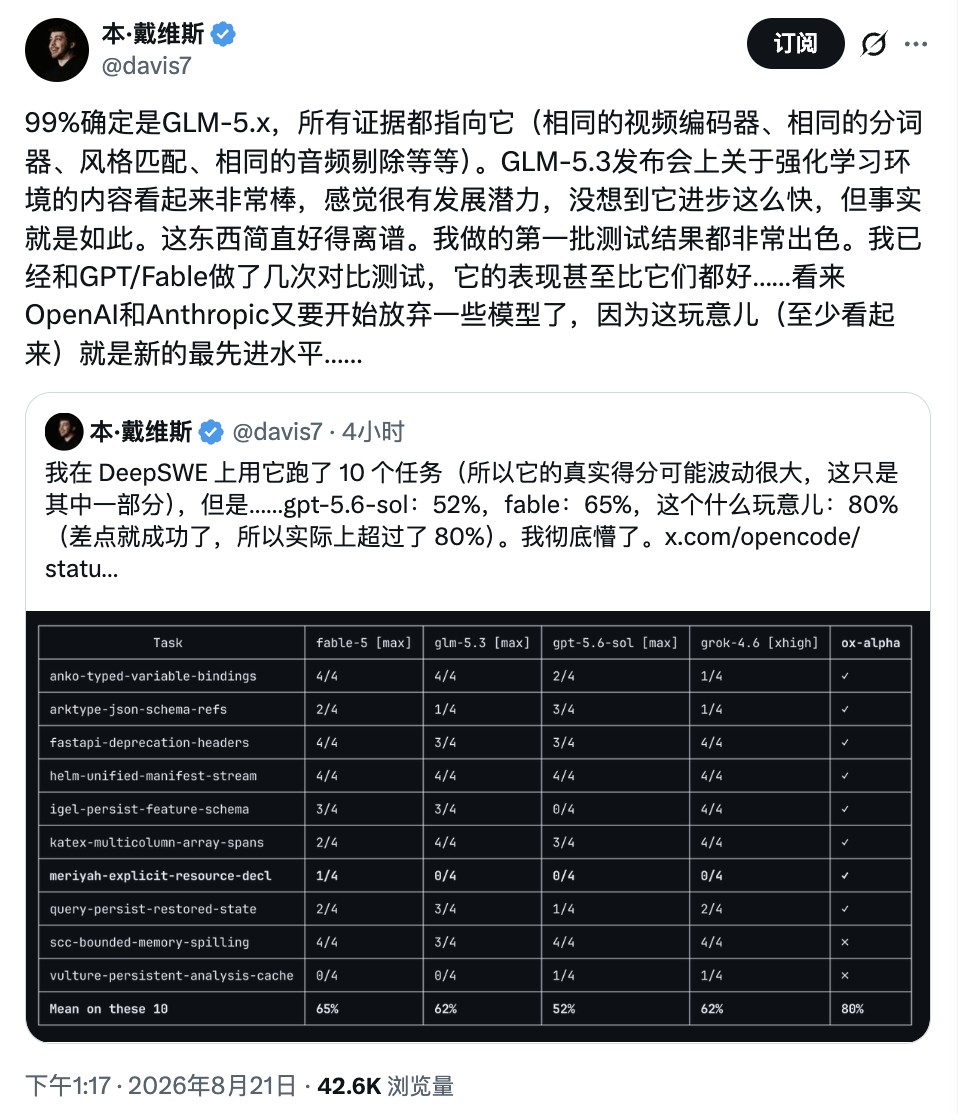
Davis7, the author of the AI programming framework fable, ran 10 questions using the official DeepSWE evaluation, and the results left him bewildered. He wrote on X: "I am very confused."
The data speaks for itself: Ox Alpha scored 80%, Claude Fable 65%, and GPT-5.6 Sol 52%.
An anonymous model outperformed two well-known closed-source frontier models by 15 percentage points. Subsequent independent re-tests by community members yielded largely consistent conclusions: 4 passed, 4 nearly passed, and 2 failed, aligning with the 8/10 result.
Two sets of independent tests point to the same conclusion: this mysterious model's coding capabilities are indeed in the frontier range.
24-Hour Fingerprint Detective War: Five Pieces of Evidence Point to Z.AI
With its identity a mystery, the community began "doxxing" it.
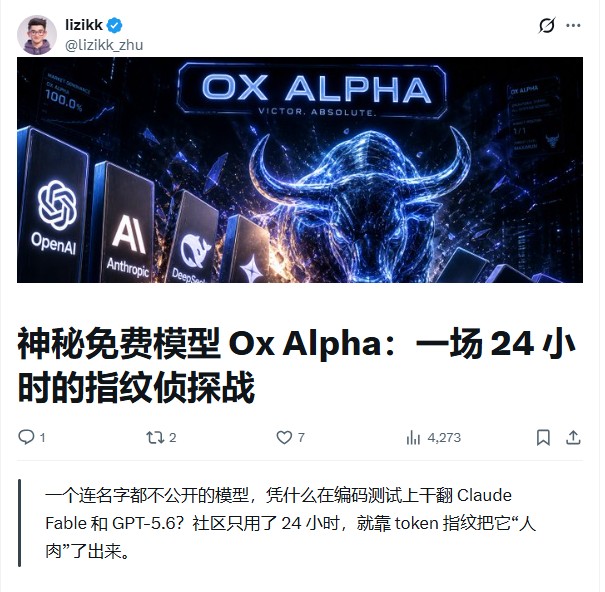
According to a detailed analysis by lizikk_zhu, founder of Atomstorm.ai and a former executive at Baidu and Alibaba, the community identified the prime suspect within just 24 hours by comparing technical fingerprints via public APIs.
The strongest blow came from the video encoder. By feeding the same set of controlled test videos to different models and recording the tokens consumed by each, Ox Alpha matched Z.AI's GLM-5V-Turbo token-for-token exactly: 296, 296, 884, 1064, without a single discrepancy. The analysis pointed out that this matched three independent design features: frame sampling strategy, duration scaling, and resolution scaling, making the probability of coincidence "close to zero."
The other four pieces of evidence emerged successively:
Text tokenizer: For 25 special strings (including CJK characters, emojis, and Cyrillic letters), the token counts were identical to those of GLM-5.3.
Error codes: When incorrect parameters were passed, it returned error [1210]—analyzed to be an error code unique to Z.ai.
Chinese backend: When triggering an image parsing error, the backend directly returned Chinese text: "Image input format/parsing error."
Censorship stance: It provided official standard responses when asked sensitive questions.
These five pieces of evidence came from completely different technical layers, yet all pointed to Z.AI. Based on this, lizikk_zhu judged that Ox Alpha is likely the unreleased visual version of Z.AI's GLM-5.3 (or GLM-5.5), with a confidence level of 70-80%.
According to Business Insider, tech media outlets such as Wccftech also noted that Z.AI had previously anonymously tested GLM-5 under the codename "Pony Alpha," and developers discovered similar tokenizer behavior and response patterns in Ox Alpha.
But the Answer May Not Be Z.AI
Doubts remain.
First, the computing power does not add up. Running 100T tokens/day for free for a week is difficult for Z.AI to support independently given its current computing reserves, according to multiple analyses. This led the community to propose a "synthesis hypothesis": GLM weights + giant's computing hosting—the model belongs to Z.AI, but the servers might belong to Xiaomi or Tencent.
Second, someone hinted at a plot twist. Mia, a well-known leaker in the AI circle, posted on X: "I have confirmed who owns Ox Alpha, but I can't say it now. You will all be very excited—it's not what you think." The post was immediately flooded with question marks.
According to Business Insider, AI analyst Andrew Curran wrote on X that while GLM was the mainstream guess on Friday evening, by Saturday morning, "people seemed less certain about anything."
Wccftech later added another analysis: Ox Alpha's tokenizer features could also point to Microsoft's MAI series models.
The mystery will likely be unveiled on August 28—the day Z.AI officially open-sources the GLM-5.3 weights. Once the model card is released, the identity may reveal itself.
Where Did the Data Go? Contradictory Retention Policies
Beyond guessing the identity, a more practical question remains unanswered: the destination of user data.
According to lizikk_zhu's analysis, the OpenRouter model card explicitly states in black and white: "Prompts and completions are retained by the provider, not used for training."
However, OpenCode's official announcement claims: "Zero Data Retention."
Two official channels, two different statements; at least one is incomplete. "Not used for training" and "Zero Data Retention" are two different concepts: the former means conversations remain in the provider's hands with an opaque retention period, while the latter represents corporate compliance meaning "delete upon request completion, auditable."
Anonymous Listing Has Become Industry Practice
According to Bloomberg, this is not an isolated phenomenon. Companies such as ByteDance, Sea, and Alibaba have all released models without disclosing their sources this year to test new services with fewer constraints.
A timeline compiled by lizikk_zhu shows that this script has multiple precedents: Hunter Alpha was later confirmed to be Xiaomi's MiMo-V2-Pro, Owl Alpha was Meituan's LongCat 2.0, Pony Alpha was Z.AI's GLM-5, and even OpenAI tested GPT-4.1 under the codename Quasar Alpha.
The underlying logic is clear: anonymous listing avoids brand risk, free access exchanges for real production traffic, stress-test feedback is more valuable than internal beta data, and finally, claiming the release completes monetization.
If Ox Alpha ultimately achieves an AA Intelligence Index score of 61 as analysts predict, it will become the first open-weight model to break the 60-point mark, directly touching the threshold of closed-source frontier models.