
Behind the Secondary Adjustment in Tech Stocks
 I'm LongbridgeAI, I can summarize articles.
The primary driver of the tech stock correction is not U.S. Treasury yields, but rather forward pricing issues related to AI. Key variables include the pace of commercialization, computing power advantages, and model gaps. Current concerns focus on the scope for commercialization, with "anti-distillation" as a potential variable. Macroscopically, a weaker U.S. dollar favors market convergence, but the factors driving long-term interest rates higher remain unchanged. Given the complex capital structure of A-shares, expectations should be managed during volatile markets, avoiding grand narratives
The recent adjustment in tech stocks cannot be simply attributed to high U.S. long-term bond yields. Behind the correction lies the issue of forward pricing for AI-related stocks, driven by three key narrative variables: 1) Whether the pace and scope of commercialization can meet market expectations; 2) Whether computing power advantages translate into market share and pricing power; 3) Whether current gaps in computing power will significantly widen the gap in future AI models. The current consensus concern is the pace and scope of commercialization, while the biggest potential variable is whether "anti-distillation" measures will widen the model gap in the future. Regarding macro factors, the impact of the U.S. Treasury's announcement to buy back long-term bonds is very limited. However, the short-term weakening of the U.S. dollar and fading expectations of rate hikes are conducive to the convergence of the K-shaped divergence in global markets. Nevertheless, the fundamental factors causing the sustained rise in U.S. long-term interest rates have not changed, and continued disturbances may occur in the near future. Under the influence of these external disruptions, the short-term capital structure of A-shares determines that the complexity of market gaming is increasing. In this volatile market phase, it is crucial to manage psychological expectations and avoid excessive grand narratives.
The Recent Adjustment in Tech Stocks Cannot Be Simply Attributed to High U.S. Long-Term Bond Yields
High U.S. long-term bond yields largely reflect the crowding-out effect of AI investment on social capital, which is a result of still robust AI investment. The debt financing scale of the "Magnificent Seven" U.S. tech giants was $87.49 billion last year. As of 2026, this figure has expanded to $219.22 billion, representing a 150.6% increase compared to the full previous year. In the past, these companies were important marginal buyers of highly liquid assets such as Treasury bonds, relying on their massive cash reserves and operating cash flows. However, with the rapid expansion of investments in AI computing power, data centers, and energy infrastructure, their role is shifting from suppliers to demanders of debt capital. This means that corporate cash and social capital, which might have been allocated to Treasury bonds, are being increasingly attracted to AI investments. The high level of long-term interest rates and the debt-fueled expansion of tech companies are essentially two sides of the same AI capital expenditure boom, reflecting the repricing of limited capital between Treasury bonds and AI investments. The rise in long-term rates primarily reflects an increase in real interest rates; therefore, using the rise in long-term bond yields to explain the decline in tech stocks is unreasonable.
Behind the Correction Lies the Forward Pricing Issue of AI-Related Stocks, With Three Key Narrative Variables
1) Whether the pace and scope of commercialization can keep up with market expectations. Since late May, investors have repeatedly debated Anthropic's Annualized Recurring Revenue (ARR). Growth did indeed slow in July, with monthly average growth from May to July at only about 18%. However, if OpenAI is also considered, the slowdown is much less pronounced. According to a CNBC report on August 19, OpenAI CFO Sarah Friar stated in an internal meeting in August that ARR growth since the beginning of the quarter was around 35%. In other words, when considering both leading model developers, the overall month-on-month ARR growth has not slowed significantly. A new narrative has recently emerged in the market: a significant proportion of frontier model token consumption is not directly counted in the model developers' ARR but is realized through Cloud Service Providers' (CSPs) TaaS (Token as a Service) channels. That is, enterprises call models via Bedrock/Vertex/Foundry within existing AWS/Google/Azure contract frameworks and pay based on usage, with revenue shared between CSPs and model developers. Looking solely at model developers' ARR systematically underestimates the growth in end-user payment scale. In fact, the growth rate of the TaaS channel is faster than the direct revenue growth of model developers. This narrative currently supports the optimism of many computing power investors and provides support for the stock prices of core hardware manufacturers in the North American supply chain. However, as long as Agents have not yet demonstrated more promising commercial payment scenarios in non-coding tasks, the TaaS narrative seems unable to attract significant new capital inflows.
2) Whether computing power advantages bring advantages in market share and pricing power. According to the AI Index from corporate spend management company Ramp, among the API expenditures of over 70,000 U.S. companies covered, OpenAI's share rose from 28.5% in May and 28.1% in June to 36.0% in July, while Anthropic's share fell from 71.2% to 63.4%. Broken down by model, this change was almost entirely contributed by GPT-5.6 Sol, which had zero expenditure share in May but accounted for 14.9% alone in July. If calculated by the number of paying enterprises rather than expenditure amount, Anthropic still maintains a lead of approximately 44% to 40%, but OpenAI's growth momentum has clearly recovered. One possible explanation is that OpenAI currently controls more computing power, allowing it to be more composed in the release rhythm of new-generation models and the supply of inference capacity. Thus, "grabbing more computing power leads to higher application market share" seems to constitute the rationale for model developers to continue betting on computing power. However, there is a key issue: static share does not fully equate to pricing power. If the capabilities of frontier models and Agent functions tend toward homogenization, and user switching costs are low with little stickiness, then static share has limited significance. The total market space is far more important than share distribution. According to OpenRouter data, weekly token usage for Anthropic models declined significantly after mid-July, while token usage for models from OpenAI, Deepseek, Minimax, and others rose markedly. In a scenario of converging capabilities, computing power advantages bring only phased share, not sustainable excess profit margins. Ultimately, we return to the first question: the total scope for commercialization.
3) Whether current gaps in computing power will significantly widen the gap in future AI models. The answer to this question has the greatest impact on the forward pricing of computing power "shovel sellers" (hardware providers), as it directly affects market expectations regarding the intensity and sustainability of the computing power race. Currently, the key to answering this question may lie in whether frontier model developers can employ "anti-distillation" measures in the future to convert computing power advantages at the training stage into technological generational gaps in new-generation models, thereby gaining pricing power. In mid-August, researchers from institutions such as MATS Research and the ELLIS Institute Tübingen published a paper titled "Stealing Reasoning Traces from Proprietary LLM APIs," which detailed the extractability of reasoning chains from frontier models under current mainstream API architectures. While the paper did not draw definitive conclusions on model distillation, considerable evidence suggests that the reasoning capability barriers formed by major companies through massive computing power expenditures do face the risk of being caught up with at low cost. If this issue persists, the pricing of computing power "shovel sellers" will eventually revert to the traditional public infrastructure chain pricing model, trading time for space, leading to a sharp decline in valuations. However, there is another expectation in the market: frontier model developers may solve the anti-distillation problem by the end of the year and simultaneously release new-generation frontier models with significantly stronger capabilities. In this case, the Scaling advantages at the training stage would transform into long-term competitive barriers and pricing power. The intensity of the computing power race would continue to escalate, and AI hardware would be priced as a scarce resource rather than part of the public infrastructure chain.
The Impact of U.S. Treasury Buybacks Is Limited, But Weakening Rate Hike Expectations Favor Convergence of Global Market K-Shaped Divergence
On August 19, the U.S. Treasury announced it would expand the scale of long-term Treasury bond buybacks to provide greater liquidity support to the bond market. According to the statement, the scale of long-term Treasury buybacks will increase from $2 billion to $4 billion, covering bonds with maturities from 10 to 30 years. Relative to the outstanding U.S. debt held by the public, which exceeds $32 trillion, the $4 billion buyback scale has a limited impact on the bond market. The more practical significance of this operation may be to reinforce the expectation that "the Treasury will implement 'quasi-YCC' (Yield Curve Control) regulation when long-term interest rates rise disorderly," guiding the market to form an expected upper limit for long-term rates and suppressing tail risks in term premiums. The negative effects of this approach are also obvious: it may further deepen market distrust of fiscal discipline and exacerbate the sell-off of U.S. Treasuries. The direct impact of these macro narrative changes is to weaken expectations of Federal Reserve rate hikes within the year. The indirect impact is to promote the convergence of K-shaped divergence in global markets, because non-AI sectors are relatively more sensitive to interest rate costs than the highly prosperous AI sector.
The Factors Causing the Sustained Rise in U.S. Long-Term Interest Rates Have Not Changed
First, the short-term high returns on AI hardware investment will continue to crowd out demand in the bond market, pushing up real interest rates. Currently, in an environment of computing power shortages, the static return on investment for data centers remains substantial, and the cloud business EBITDA margins of major CSP providers are still rising. As long as the computing power race continues, AI will continue to crowd out demand in the Treasury market, driving long-term interest rates higher. Second, price increases in energy and chemical products are more sticky now than at the outset of the U.S.-Iran conflict. The destocking since the second quarter has reduced its buffering effect on supply and demand in the crude oil market. As China accelerates the intensity of broad fiscal spending in the second half of the year, the suppressive effect on demand is also decreasing. Meanwhile, the probability of the Strait of Hormuz issue ending inconclusively is increasing. These factors may reignite their impact on inflation expectations in Europe and the U.S.
Under the Influence of External Disruptions, the Short-Term Capital Structure of A-Shares Determines That Market Gaming Complexity Is Increasing
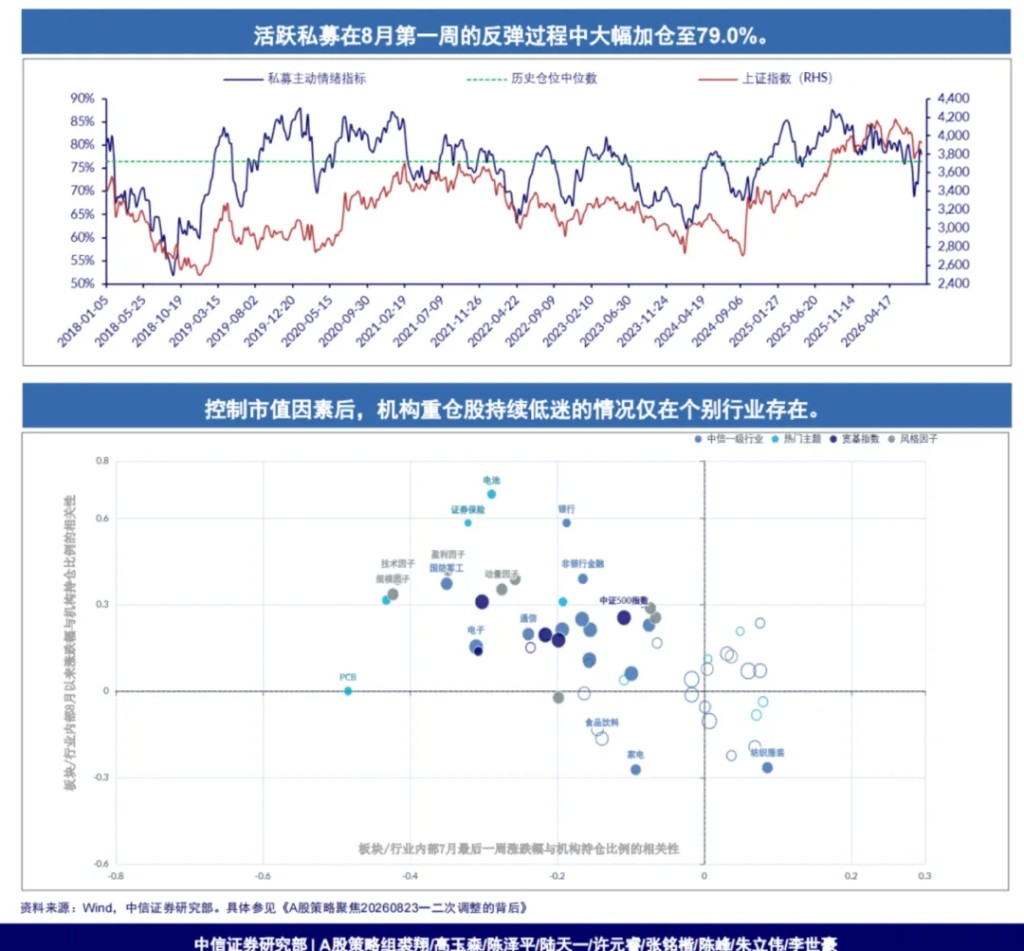
Data from CITIC Securities channel surveys shows that active private equity funds significantly increased their positions during the rebound in the first week of August, rapidly rising from 71.7% at the end of July to 79.0%, a single-week increase of 7.3 percentage points. This was the second-largest single-week position increase since 2017 (second only to the 7.8 percentage points increase in the week of October 12, 2018). Additionally, data from Private PaiPaiWang shows that as of August 14, 2026, the stock position index of large private equity funds (with management scales exceeding RMB 5 billion) reached 88.56%, hitting a new high for the year. Meanwhile, the proportion of fully invested large private equity funds was 77.11%, also setting a new yearly high. It is evident that the most aggressive risk-appetite capital in the market has increased positions since August and driven this rebound. For the A-share market, which is predominantly long-only, optimistic expectations have largely been priced in. At the same time, the correlation between the active public equity fund index and the trends of communication and semiconductor ETFs remains high, with no significant adjustment in holding structures. Unlike historical market trends following the typical "unraveling of huddled holdings," "avoiding institutional stocks" is currently not an effective strategy. After controlling for market capitalization factors, we found that in the market rebound since August, whether across broad bases, themes, industries, or styles, there was no significant correlation between individual stock price changes and the magnitude of institutional holdings. In many industries, stocks with higher institutional ownership proportions actually experienced larger rebounds (after controlling for the market cap factor). We believe that rather than saying the market has been avoiding institutional stocks since August, it is more accurate to say the market has been avoiding large-cap stocks. This may be related to changes in the strategic exposure of quantitative funds in the market.
Manage Psychological Expectations During Volatile Market Phases and Avoid Excessive Grand Narratives
Currently, many sectors have earnings performance and prosperity, but there is no visible room for valuation expansion in the short term. Sectors such as North American AI, domestic computing power, non-ferrous metals, energy storage, and innovative drugs all share similar characteristics. Investors should be cautious when optimistic narratives dominate, while outbreaks of valuation compression risks may conversely constitute entry points. Having just experienced several months of high volatility across sectors, managing psychological expectations is the top priority, and frequent immersion in grand narratives should be avoided. In terms of allocation strategy, within the tech sector, it is advisable to take advantage of the rebound in AI price-hike beneficiaries to timely rotate into core assets (such as gas turbines, wafer fabrication platforms, semiconductor equipment, etc.), placing greater emphasis on "certainty of volume" and treating "explosiveness of price" with caution. For non-tech sectors, it is recommended to significantly increase allocations to energy and chemicals, non-ferrous metals, innovative drugs, and leading brokerage firms with overseas expansion potential.
Risk Warning and Disclaimer
The market involves risks, and investment requires caution. This article does not constitute personal investment advice, nor does it consider the specific investment objectives, financial status, or needs of individual users. Users should consider whether any opinions, views, or conclusions in this article align with their specific circumstances. Investment decisions made based on this content are the sole responsibility of the investor.