
 I'm LongbridgeAI, I can summarize articles.
Nagoya University in Japan and Fujifilm Holdings have jointly developed a novel lipid nanoparticle, FL0445, achieving efficient delivery of capped circular RNA (Cap-cirRNA) for the first time. This vector boosts mRNA activity tenfold with minimal inflammation, combining high translation efficiency with long-term stability. In GLP-1 mouse experiments, it significantly improved glucose control and extended drug efficacy, marking a breakthrough for next-generation long-acting mRNA therapies and reduced injection frequency
Researchers from Nagoya University in Japan and Fujifilm Holdings have collaboratively developed a novel lipid nanoparticle (LNP) that efficiently delivers capped circular RNA (Cap-cirRNA) into animals for the first time. This achievement results in a tenfold increase in activity with minimal inflammation, opening new doors for next-generation long-acting mRNA therapies. The related paper was published in the latest issue of the journal Cell Biomaterials.
A key step in mRNA vaccines is using LNPs to deliver fragile mRNA strands into cells. However, traditional LNPs are designed for linear mRNA and are less effective against the more rigid structure of circular RNA. Circular RNA lacks start and end points, making it resistant to degradation by intracellular enzymes. Ribosomes can continuously work on the circle, theoretically allowing for prolonged protein expression. However, it has a drawback: its translation initiation efficiency is lower than that of capped linear mRNA.
The Nagoya University team solved this problem by preparing capped circular RNA, which combines the advantages of both: the high translation efficiency of linear mRNA and the long-term stability of circular RNA.
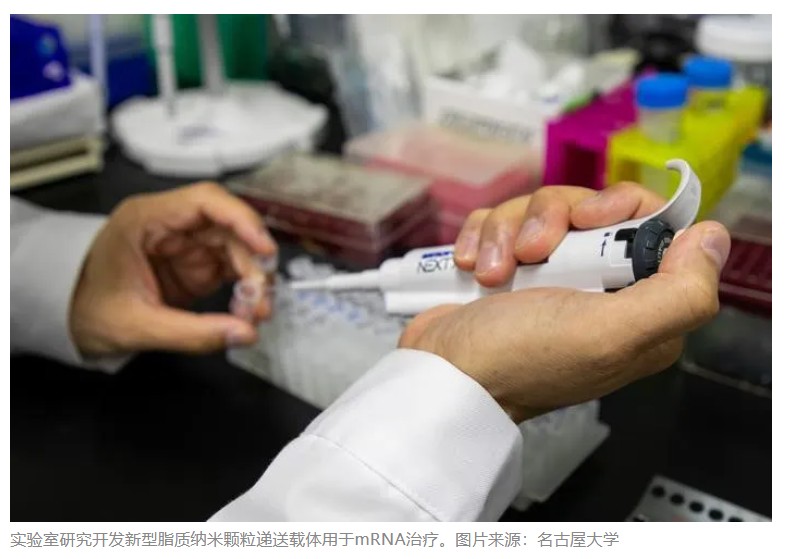
With better "cargo," a suitable "delivery vehicle" is also needed. The FL0445-LNP provided by Fujifilm fills this gap. Its biggest difference from traditional LNPs lies in the structure of its internal lipids: traditional LNPs use straight-chain lipids, while FL0445-LNP uses branched lipids. This creates more flexible internal space, enabling it to carry different types of nucleic acids, whether light small fragments or heavy circular structures. Experiments showed that delivering mRNA using FL0445-LNP resulted in activity ten times higher than traditional LNPs, with very mild inflammatory responses.
To verify the actual effectiveness of this combination, the team selected GLP-1, a peptide hormone widely used in clinical practice. GLP-1 is the core component of currently best-selling weight-loss drugs and typically requires repeated injections. The team used FL0445-LNP to deliver linear mRNA and Cap-cirRNA encoding GLP-1 into obese mice, respectively. The results showed that mice in the Cap-cirRNA group produced more durable GLP-1, and their glucose control capabilities significantly improved. This indicates that combining circular RNA with the new carrier could allow patients to maintain therapeutic effects for longer periods with a single dose, greatly reducing the number of injections.
The greatest significance of this technology is that it serves as a universal delivery platform capable of carrying different types of RNA. In the future, it holds promise for use in cancer vaccines, genome editing, and replacement therapies for genetic diseases caused by protein deficiencies. Of course, there is still a long way to go from animal experiments to clinical application. This study proves a key link: it is feasible to safely and effectively deliver more durable circular RNA into cells.
[Editor's Pick]
This achievement brings welcome new progress to the development of next-generation long-acting RNA drugs. The biggest shortcoming of traditional mRNA drugs is their short duration of efficacy, often requiring repeated injections for patients. Circular RNA possesses a closed ring structure, theoretically offering potential for long-term expression. However, its translation efficiency is low, and there has long been a lack of efficient and safe "delivery vehicles" to introduce it into the body. This study takes a "two-pronged approach," innovatively designing capped circular RNA to effectively compensate for its low translation efficiency, while simultaneously developing a novel "delivery vehicle" to successfully solve the "delivery" challenge. This means scientists have taken a key step toward ultimately realizing RNA therapies that are "effective for a long time with a single dose."
Risk Warning and Disclaimer
The market involves risks, and investment should be approached with caution. This article does not constitute personal investment advice, nor does it consider the specific investment goals, financial status, or needs of individual users. Users should consider whether any opinions, views, or conclusions in this article align with their specific circumstances. Investment decisions made based on this content are the sole responsibility of the investor.