
BofA: If Republicans Lose the Senate in Midterms, US Stocks Could Drop Over 10%; Texas Race to Decide "AI Policy"
 I'm LongbridgeAI, I can summarize articles.
BofA strategist Hartnett warns that the market is overly optimistic about the midterm elections. If Democrats win the Senate and Republicans lose in Texas, US stocks could fall more than 10% by year-end. The Texas race is seen as a "referendum" on AI infrastructure policy; a reversal in results would simultaneously pressure expectations for deregulation trades and AI capital expenditure policies
BofA strategist Hartnett believes the market is overly optimistic in its pricing of the midterm elections. Once Democrats take control of the Senate, US stocks face a correction risk of over 10%.
Current market pricing is built on an assumption: a moderate midterm election result, with continued deregulation and AI-friendly policies. On August 23, Hartnett pointed out in his latest research report that this assumption may be wrong.
He stated that if Democrats win the Senate, two core market narratives will be hit simultaneously: first, financial deregulation, and second, political support for AI capital expenditure. Combined, he expects US stocks to correct by more than 10% before year-end, accompanied by a weaker US dollar and lower bond yields.
Political Fundamentals Are Deteriorating
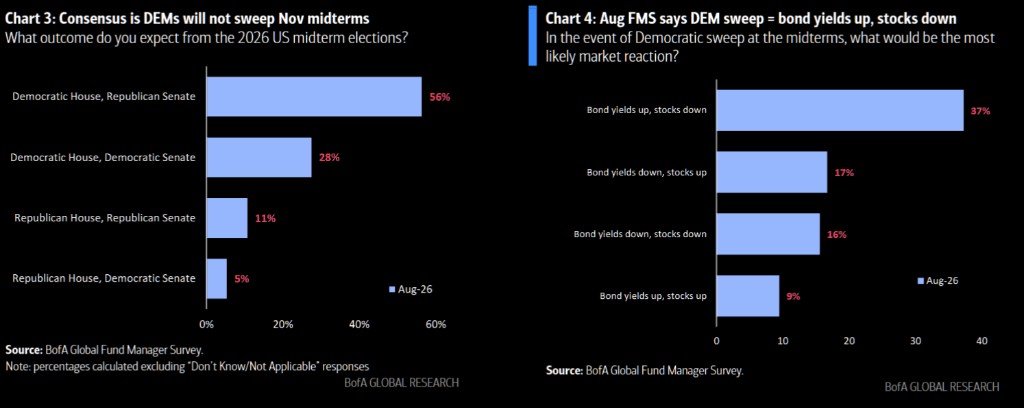
According to BofA data, Trump's current overall approval rating is 39%, with economic approval at just 36%, and inflation approval even lower at 30%, all significantly below "pre-Iran War levels."
This means the Republican base for the November election is not solid. Hartnett's hedging logic is built precisely on this political reality, which the market has overlooked.
Texas Race: A "Referendum" on AI Policy
Hartnett specifically highlighted the special significance of the Texas gubernatorial election.
He believes this election is evolving into a referendum on the "power costs and affordability" of AI infrastructure. The massive expansion of AI data centers has brought huge power consumption and infrastructure pressure, triggering a political backlash in Texas.
If Democrats pull off an upset victory in Texas, the market will have to reassess: Can AI capital expenditure still receive unconditional political support?
This is not just a political signal, but a direct blow to the market's pricing logic for ultra-large-scale AI investments.
Two Hedging Paths: Financials and Semiconductors
Hartnett provided specific hedging tools.
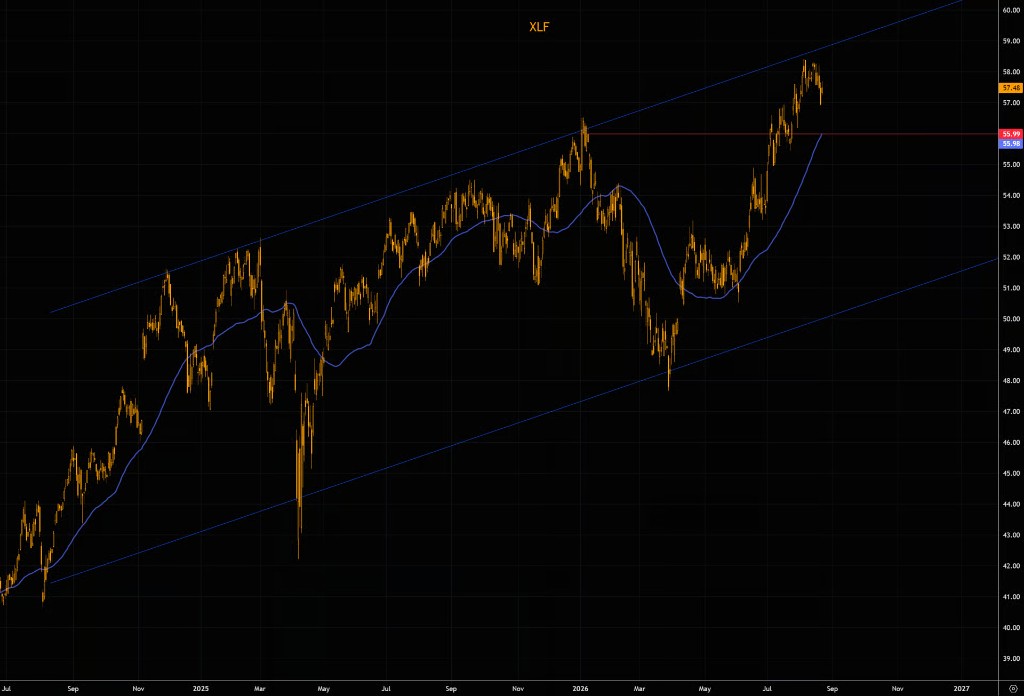
Financial Stocks (XLF): XLF is currently still within an upward trend channel, with key support near $56, where the 50-day moving average also converges. Hartnett suggests expressing a bearish view through put spread options expiring in November—specifically, the Nov 56/52 put spread, with a maximum payout ratio of approximately 4 times.
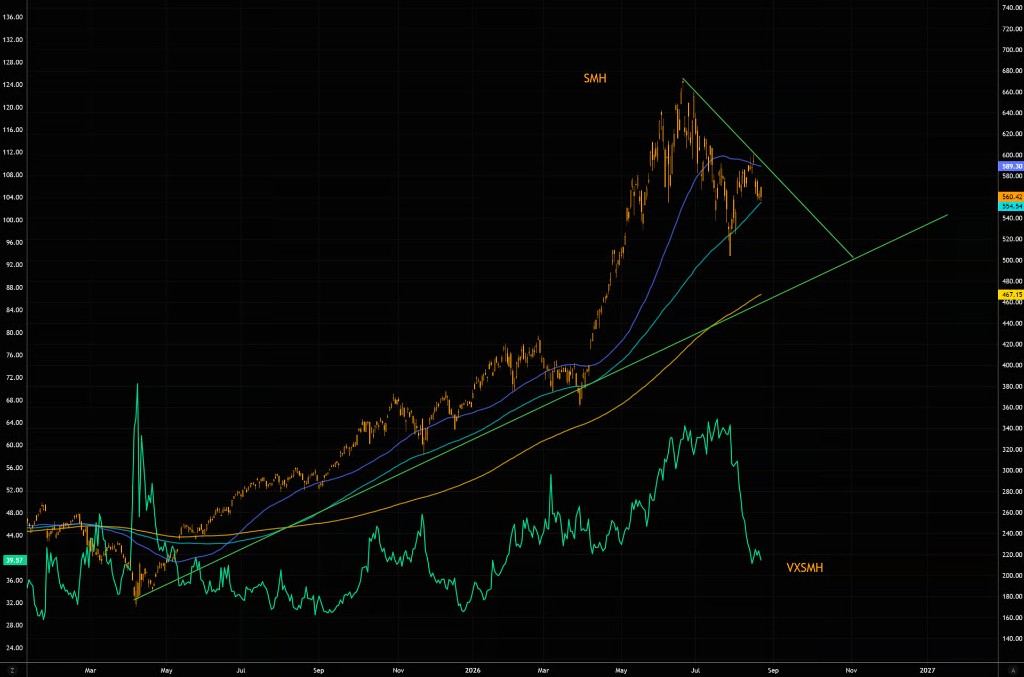
Semiconductor ETF (SMH): The semiconductor sector lost momentum at the end of June and has continued to underperform the broader market. The most recent rebound was again blocked at the 50-day moving average and the short-term downward trend line, with long-term support still near the 200-day moving average, quite far from current prices.
The key point is that semiconductor volatility has dropped significantly in recent weeks, making hedging costs more attractive. Hartnett recommends hedging this risk through SMH downside option structures.
Capital Flows Are Already Confirming This
Flow data provides corroborating evidence.
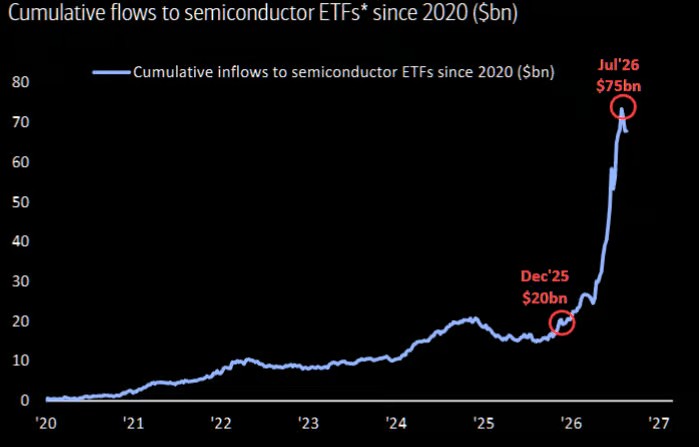
According to BofA data, semiconductor ETFs have seen cumulative outflows of about $6 billion over the past three weeks. Hartnett pointed out that this may not necessarily be hedging behavior specifically targeted at the midterm elections, "but capital flows are moving in the direction of a bearish scenario."
Hartnett also proposed a second logical path, with different catalysts but the same conclusion.
He believes that quantitative easing (QE) was the starting point of the great bull market of the past 20 years and also spawned the Wall Street narrative of "too big to fail." After 20 years of unconventional monetary stimulus, the market generally expects current policy efforts to "fix fixed income" to succeed.
However, if Treasury Secretary Bessent fails to push the 30-year Treasury yield below 5%, Hartnett believes policy failure will drive the US dollar weaker and trigger a market shift: shorting risk assets, shorting leverage—especially ultra-large-scale AI operators and private credit—and shorting cyclical sectors such as financials.
"Different catalysts, same hedge: financials and AI," Hartnett summarized.