
Earnings Preview | Under the torrent of Token reasoning, NVIDIA's performance faces the challenge of cyclical financing inquiries! The market expects Rubin to ignite the "$6 trillion" narrative
 I'm LongbridgeAI, I can summarize articles.
NVIDIA is about to release its second-quarter financial report, and the market is highly focused on whether its performance will exceed expectations and the guidance for the third quarter. If the performance is strong, it is expected to drive the stock price up and increase the valuation to about 35 times the price-to-earnings ratio, potentially setting a new historical market capitalization high. As a core beneficiary of AI computing power, NVIDIA's performance is crucial for driving the S&P 500 index and the market of the "seven tech giants."
The moment that global AI computing power theme investors have been focusing on is about to arrive. Since the launch of ChatGPT by OpenAI, which has swept the globe, and the unprecedented investment boom in artificial intelligence, Wall Street institutional investors and global retail investors have been eagerly awaiting this moment every quarter: the announcement of the second-quarter earnings report by the world's most important stock—NVIDIA (NVDA.US), the "superpower of AI chips."
Other major tech companies, including Microsoft, Google, Amazon, Tesla, have already released their earnings about a month ago, and NVIDIA will finally disclose its detailed financial performance for the second quarter and its outlook for future quarters.
The so-called "Magnificent Seven" (Mag 7), which occupy a significant weight (over 40%) in the S&P 500 and Nasdaq 100 indices, includes NVIDIA, Apple, Microsoft, Google, Tesla, Amazon, and Facebook's parent company Meta Platforms. They are the core driving force behind the S&P 500 index's record highs and are viewed by top Wall Street investment institutions as the most capable combination to bring substantial returns to investors against the backdrop of the largest technological transformation since the internet era.
The "AI super bull market," which has seen the S&P 500 index rise by over $30 trillion in the past three years, is largely driven by the giants considered to be the best beneficiaries of the AI boom—the largest tech giants in the world (the seven major tech giants in the U.S. stock market). It is also significantly propelled by chip companies that have greatly benefited from the massive investment in AI computing power infrastructure globally (such as SK Hynix, Samsung Electronics, Micron, TSMC, and Broadcom), the three major storage product giants (SanDisk, Western Digital, and Seagate), and power system suppliers (such as Constellation Energy).
According to the observation of Zhitong Finance APP, as NVIDIA's earnings report is about to be released, global chip stocks, especially semiconductor stocks closely related to the AI computing power theme, have struggled to maintain their price rebound since August after a significant drop in July. The market is once again concerned about whether global enterprises can achieve strong returns from the unprecedented scale of AI investments. Therefore, investors are eager to know whether the enterprise demand for NVIDIA's next-generation AI computing cluster—Vera-Rubin—will show stronger performance than the Blackwell architecture under the expanding trend of AI application demand, and how NVIDIA's management, including Jensen Huang, views the future revenue prospects of B-end and C-end AI applications.
The strong growth data related to the cloud computing businesses of Microsoft, Amazon, and Google has helped alleviate some of the investors' concerns; however, the increasing AI computing power infrastructure spending by Google and Meta has also made investors uneasy.
NVIDIA's upcoming second-quarter earnings for the fiscal year 2027 has upgraded from a "chip leader's earnings report" to a system-level stress test for the global AI capital expenditure cycle Wall Street expects revenue of approximately $92 billion and adjusted earnings per share of $2.09, with data center business revenue projected to reach an astonishing $85.4 billion, a year-on-year increase of 107%; however, Wall Street financial giant Jefferies has raised the "real bullish threshold" to $95 billion for the second fiscal quarter and about $108 billion for the next fiscal quarter. The options market accounts for about 6%-7% of bidirectional volatility, corresponding to a market value change of over $320 billion, and NVIDIA's stock still fell the day after four consecutive strong earnings reports and outlooks that exceeded expectations, indicating that simply beating market consensus is no longer sufficient to drive a new round of strong growth in the AI computing power industry chain.
$92 Billion "Computing Power Test"! NVIDIA's Earnings Report Becomes the Total Switch for AI Trading
According to analysts' consensus expectations compiled by institutions, NVIDIA is expected to achieve adjusted earnings per share (EPS) of $2.09 in the second quarter, with revenue of approximately $92 billion. This means total revenue is expected to jump 96% year-on-year and continue to accelerate in growth trajectory against a high base on a quarter-on-quarter basis.
NVIDIA updated its financial performance reporting framework last quarter, breaking down data center business revenue into revenue data from hyperscalers such as Google, Microsoft, and Amazon, as well as revenue data from AI cloud, industrial, and enterprise-type customers (i.e., ACIE). The company's revenue data from personal computers, gaming consoles, workstations, robotics, and automotive businesses is now included in NVIDIA's edge computing business segment.
According to Wall Street institutions' consensus expectations, NVIDIA's data center business revenue in the second fiscal quarter is expected to exceed $85.4 billion, indicating a significant year-on-year growth of 107%. Revenue from hyperscalers is expected to reach $43.5 billion, while ACIE business sales are expected to reach $41.7 billion.
Most of NVIDIA's revenue continues to come from hyperscalers such as Amazon, Google, and Microsoft. However, these global cloud computing leaders are all developing their own AI chips and server CPUs to reduce their reliance on NVIDIA's computing power infrastructure, and they have even begun to focus on selling AI computing clusters built around their self-developed chips to large third-party customers, which may pose a relatively unfavorable long-term factor for NVIDIA in the future.
NVIDIA is also continuing to sign cooperation agreements with many technology and financial companies in the AI ecosystem.
Earlier this month, this AI chip leader announced that it is collaborating with BlackRock, Blackstone, KKR, Apollo, Brookfield, and Goldman Sachs to establish a $500 billion capital pool, which will promote the securitization of large-scale NVIDIA AI GPU assets.
NVIDIA recently also stated that it will support SB Energy and OpenAI in building a massive 8-gigawatt data center in Ohio, with an investment amount of up to $150 billion.
NVIDIA is jointly establishing a $500 billion capital pool with BlackRock, Blackstone, KKR, Apollo, Brookfield, and Goldman Sachs, and supporting SB Energy and OpenAI in building an 8-gigawatt data center with an investment of up to $150 billion All of this means that NVIDIA's long-standing growth model around GPUs is evolving from simply selling GPUs to a full-stack AI ecosystem that includes "AI chips + high-performance network infrastructure + an AI developer ecosystem around CUDA and NVIDIA's open-source large models + long-term capital."
In particular, NVIDIA seems to be increasingly focused on reducing customers' upfront AI computing capital pressure through GPU securitization and project financing, attempting to transform large orders for AI chips or AI computing clusters into financeable and leaseable long-term computing assets. However, this will also bind NVIDIA more deeply to customer utilization rates, AI application monetization, and debt repayment capabilities; if revenue growth from AI inference cannot cover the high computing costs, the ecological financing commitments and GPU residual values may become new channels for risk transmission.
Is a $5 trillion market cap far from NVIDIA's endpoint? High growth and high expectations collide positively
NVIDIA currently has a market cap of approximately $5.25 trillion, significantly higher than the second-ranked Apple, which is around $4.5 trillion. However, some analysts bullish on NVIDIA's stock price outlook believe that the gap between the two will rapidly widen, and this will all begin after NVIDIA announces its second-quarter results on August 26, Eastern Time.
The expectations facing NVIDIA ahead of its earnings report this year have not been that high. For 2024 and 2025, prior to the second-quarter earnings report, NVIDIA's expected price-to-earnings ratio was about 35 times. For most of this year, it has been around 24 times, which is quite a cost-effective expected price-to-earnings ratio.
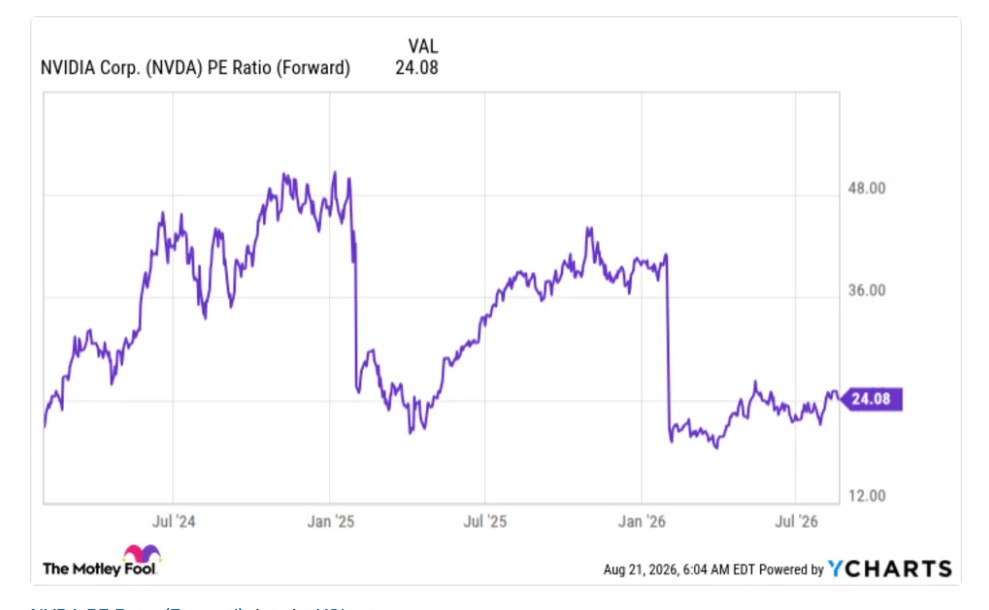
With a market cap of $5.25 trillion, NVIDIA only needs to rise about 14% to break through $6 trillion; if the expected price-to-earnings ratio rises to a relatively optimistic 35 times, the theoretical upside is about 46%, corresponding to a market cap of approximately $7.65 trillion. This judgment is supported by the ongoing expansion of AI construction, the continued doubling of data center revenues, and NVIDIA's system-level advantages in GPUs, high-performance Ethernet networks, and AI application software developer ecosystems. However, Amazon, Google, and Microsoft are accelerating the deployment of self-developed ASIC/XPU, and the return on investment in artificial intelligence has also become a key focus of market scrutiny. Therefore, this earnings report could either serve as a starting gun for a renewed acceleration in AI trading or mark a milestone shift in valuation from "almost unlimited computing demand" to "sustainable cash flow growth verification for the entire AI ecosystem."
If NVIDIA's performance and future outlook significantly exceed market expectations, especially demonstrating that the demand for Vera-Rubin far exceeds market consensus expectations—such as the possibility that Vera-Rubin orders may exceed $1 trillion over the next two years, and the expected price-to-earnings ratio could rise to a relatively optimistic 35x—NVIDIA's stock price will see a substantial increase, pushing its market cap to surpass $6 trillion by the end of 2026 Based on NVIDIA's current market capitalization of $5.25 trillion, a 46% increase in stock price would actually raise the company's market value to $7.65 trillion—far exceeding the level anticipated by Wall Street analysts covering NVIDIA stock. NVIDIA only needs to rise 14% to reach $6 trillion, so some analysts believe that it is a fairly reliable judgment for NVIDIA to reach $6 trillion shortly after the earnings report is released. This makes it a highly attractive stock at present; even if its valuation does not return to normal levels, 2027 is still expected to be an outstanding year for the stock, as its valuation entering 2027 will be at a relatively low level considering its still strong performance growth rate.
If NVIDIA reports a quarterly performance that far exceeds expectations and provides strong guidance for the third quarter, this could ignite a surge in stock price, pushing NVIDIA back to the valuation level it typically occupies during this time of year—around 35 times the expected price-to-earnings ratio. If NVIDIA can achieve this, its market value will rise to heights never before reached by any company.
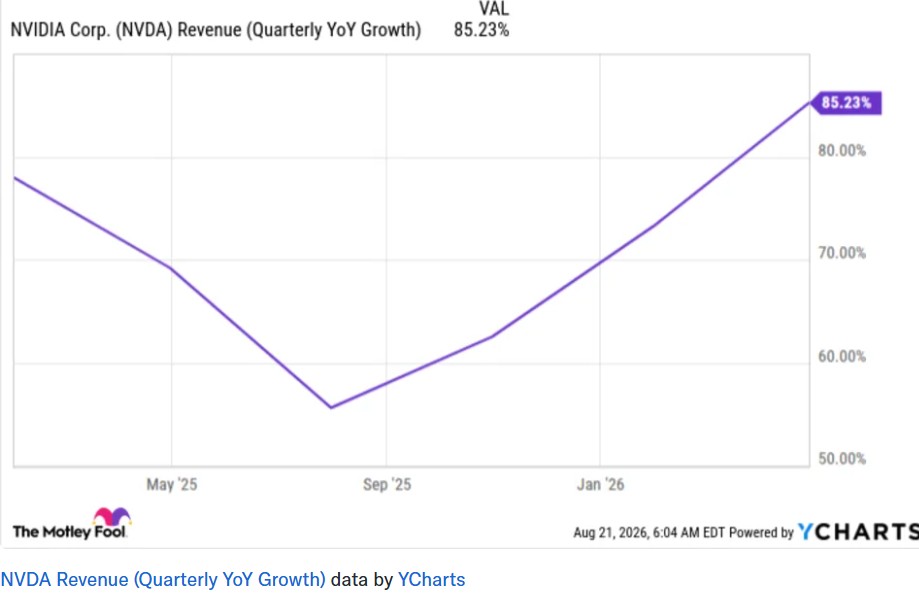
For NVIDIA, exceeding expectations has become the norm. In the fourth quarter of fiscal year 2026, NVIDIA's management expected revenue of $65 billion, but the actual revenue was $68 billion. In the first quarter of fiscal year 2027, management provided revenue guidance of $78 billion, but NVIDIA actually generated $82 billion in revenue. Such a level of outperformance has become an established expectation in the market; with NVIDIA's management expecting second-quarter revenue to reach $91 billion, most investors anticipate that actual revenue will be at least $92 billion. However, Wall Street institutions like Jefferies have already given expectations of $95 billion or even higher. For these more stringent investors, NVIDIA's revenue in the second quarter of last year was $46.7 billion, which means that its revenue for the second quarter of fiscal year 2027 needs to reach $93.4 billion to achieve a year-on-year doubling.
Rubin is about to take over from Blackwell, will NVIDIA's earnings report ring in a new round of "main rising wave" for AI computing power themes?
Using the closing price of $214.72 on August 21, approximately 24.22 billion shares outstanding, and a market capitalization of $5.20 trillion as a unified standard, 59 Wall Street analysts have given NVIDIA a consensus rating of "strong buy," with an average 12-month target price of $304.73, implying a potential upside of about 41.92%; corresponding to a market value of approximately $7.38 trillion, which means a potential increase of about $2.18 trillion. The highest target price is $500 given by Baird analyst Tristan Gerra, implying a potential stock price increase of about 132.9%, corresponding to a market value of approximately $12.11 trillion, which means a potential increase of about $6.91 trillion compared to the current value. The above market value estimates assume that the total share capital remains basically unchanged Gerra maintains an "outperform" rating with a target price of $500, based on the core logic that NVIDIA is upgrading from a GPU supplier to a full-stack AI platform with CUDA, NVLink, AI Enterprise, and rack-level systems: the company continues to gain market share in the hyperscale cloud computing and inference market, with Vera Rubin's penetration speed in frontier model companies potentially exceeding that of Blackwell; the independent Vera CPU is expected to open up approximately $200 billion in new markets due to its performance advantages, while agent AI is driving global AI infrastructure annual spending from over $1 trillion in 2027 to $3 trillion to $4 trillion by 2030, which will continuously strengthen NVIDIA's pricing power, AI application development ecosystem-related revenue, and free cash flow growth.
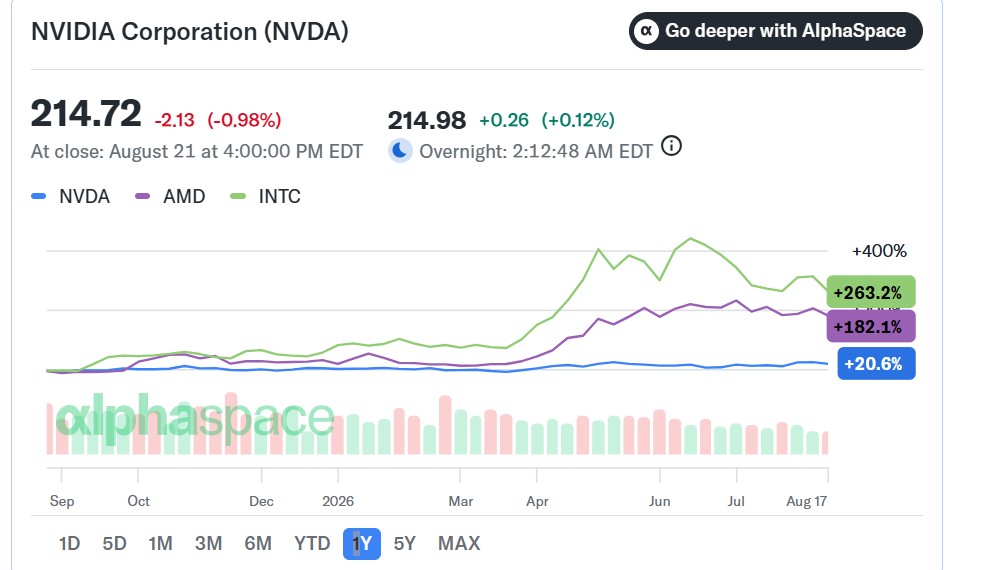
For NVIDIA's upcoming earnings and future outlook, the market is primarily focused on the "quality" of demand growth, rather than just the "scale of growth," which is why NVIDIA's performance has remained strong in recent quarters, yet its stock price continues to weaken. Analysts expect that hyperscale cloud vendors and AI cloud, industrial, and enterprise customers (ACIE) will contribute $43.5 billion and $41.7 billion, respectively. If ACIE continues to grow rapidly, it would mean that NVIDIA is reducing its dependence on a few customers like Microsoft, Amazon, and Google, with demand expanding from training clusters to inference, enterprise agents, sovereign AI, and industrial AI; conversely, if growth still mainly comes from capital expenditures by hyperscale cloud giants, the market will be more concerned about the dilution of shares caused by large U.S. tech companies developing their own ASIC/XPU. Therefore, the most critical operational signals in the earnings report will focus on whether the customer structure continues to diversify, whether GPU utilization remains high, and whether token revenue and cloud business growth can prove that computing power procurement is generating real cash flow, rather than just accumulating idle capacity.
The second decisive focus is the transition from Blackwell to Vera Rubin products. Rubin continues the Oberon NVL72 rack form factor, reusing the established power supply, liquid cooling, cabinet, and manufacturing systems of GB200/GB300; if the assembly time for computing trays is reduced from about 2 hours to 5 minutes, it means that NVIDIA is transforming complex AI server projects into modular, scalable delivery "AI factories." Jefferies expects that VR/R200 will account for about 12% of GPU revenue in the third quarter of fiscal year 2027, exceed 40% in the fourth quarter, and become the dominant product in the first quarter of fiscal year 2028; the Vera CPU will unify CPU, GPU, network, and CUDA software into a rack-level platform through LPDDR5X and NVLink consistency interconnect. If management confirms that Rubin will achieve mass production on schedule and significantly accelerate starting in the first quarter of next year, the market valuation anchor may shift from "when will Blackwell peak" to "Rubin opens the next growth curve." The third new narrative is "open model sowing demand + supply chain locking supply." Nemotron, Cosmos, GR00T, Alpamayo, NeMo, and Agent Toolkit may not directly contribute significant model revenue, but they can guide developer workloads to CUDA, TensorRT, NIM, DGX, and RTX platforms. In particular, small language models (SLM) are suitable for agent tool calls, enterprise-specific tasks, and edge-side inference, which can help NVIDIA upgrade from "selling GPUs" to defining the Token production environment. Meanwhile, NVIDIA locks in advanced packaging CoWoS-L, HBM, optical components, land, and electricity through long-term agreements, essentially controlling the most scarce input factors for AI factories, making it difficult for competitors to rely on chip design alone, as they may be constrained by packaging yield, memory, and delivery cycles. NVIDIA initiated the Nemotron alliance and collaborated with multiple AI laboratories to develop open models, further strengthening this hardware-software flywheel.
The rise in storage prices constitutes a "double-edged sword" for financial reports. Current media reports indicate that the entire server set equipped with NVIDIA chips may see price increases of over 15% due to rising storage costs such as HBM and DRAM, rather than a uniform 15% price increase for NVIDIA GPUs; the price increase covers the Grace Blackwell and Vera Rubin systems to be delivered early next year. On one hand, this proves that AI memory, advanced packaging, and overall machine capacity remain extremely tight, highlighting the bargaining power of bottleneck suppliers such as SK Hynix, Micron, Samsung, and TSMC; on the other hand, it will raise the total cost of ownership (TCO) per megawatt data center, compressing profits for server foundries and enhancing the motivation for cloud vendors to use self-developed ASICs to undertake mature inference tasks. As a result, the market will closely examine whether NVIDIA can fully pass on costs, maintain a mid-range gross margin of 70%, and continue to offset server price increases for customers through performance/watt and per Token cost reductions.
NVIDIA provides approximately $105 billion in credit support for the OpenAI—SB Energy project and participates in a $500 billion GPU financing pool, which can alleviate customers' capital constraints in a high-interest-rate environment, but also gives it the dual identity of equipment supplier, investor, and credit supporter. If the financial report simultaneously delivers nearly $95 billion in revenue, with next quarter guidance around $108 billion, confirming Rubin's acceleration, stable gross margins, and no significant delays in power and packaging delivery, while clearly defining leasing, power payment, and residual value guarantee responsibilities, then the AI computing power theme trading hotspot is likely to not only revolve around NVIDIA GPU computing clusters but may also further accelerate diffusion to HBM/DRAM/NAND, CoWoS/3D advanced packaging, MLCC/ABF substrates, data center CPUs, high-performance network infrastructure, optical interconnects, liquid cooling, and data center power chain infrastructure across the entire AI computing power industry chain, forming a new round of industry chain-level "main rising wave" super market.
If NVIDIA's performance and quarterly outlook only slightly exceed expectations, with next quarter guidance close to $102 billion—$104 billion, or if financing obligations, gross margins, and Rubin's mass production timetable are vague, then it is more likely to see "the financial report is good, but the stock price does not rise," leading to high-level fluctuations In other words, the new round of main upward trend in the AI computing power industry chain does not depend on whether NVIDIA can continue to grow, but rather on whether it can prove that future growth comes from profitable token demand, rather than relying on GPU orders generated by its own credit cycle