
 I'm LongbridgeAI, I can summarize articles.
The financing round was led by IDG Capital, with strategic follow-on investments from Tencent and Alibaba. Meanwhile, the company reported a Q2 net loss of RMB 1.34 billion, and its Q3 guidance fell short of market expectations, causing its U.S.-listed shares to drop more than 8%. Management has positioned robotics and Robotaxi as the core engines for its transformation into a physical AI technology company, setting a clear target for driverless passenger operations by 2027, while capital markets remain cautious about the transformation prospects
In XPENG-W's Q2 financial report, the robotics business set a new record for China's embodied intelligence industry with over $900 million in its first round of financing, yet the company's overall net loss widened nearly 1.8 times year-over-year.
Data disclosed on August 24 revealed that XPeng's robotics subsidiary completed its first round of financing exceeding $900 million, achieving a post-money valuation of over $6.3 billion (approximately RMB 43 billion), setting a new record for single-round private equity financing in China's embodied intelligence sector.
This round was led by IDG Capital, with participation from Gaorong Ventures, and received support from two strategic investors, TENCENT and Alibaba.
Contrasting with this valuation record, XPeng's Q2 net loss reached RMB 1.34 billion, widening nearly 1.8 times year-over-year. Q3 delivery and revenue guidance also significantly missed market expectations, leading to a drop of over 8% in the company's U.S.-listed stock price after the earnings release.
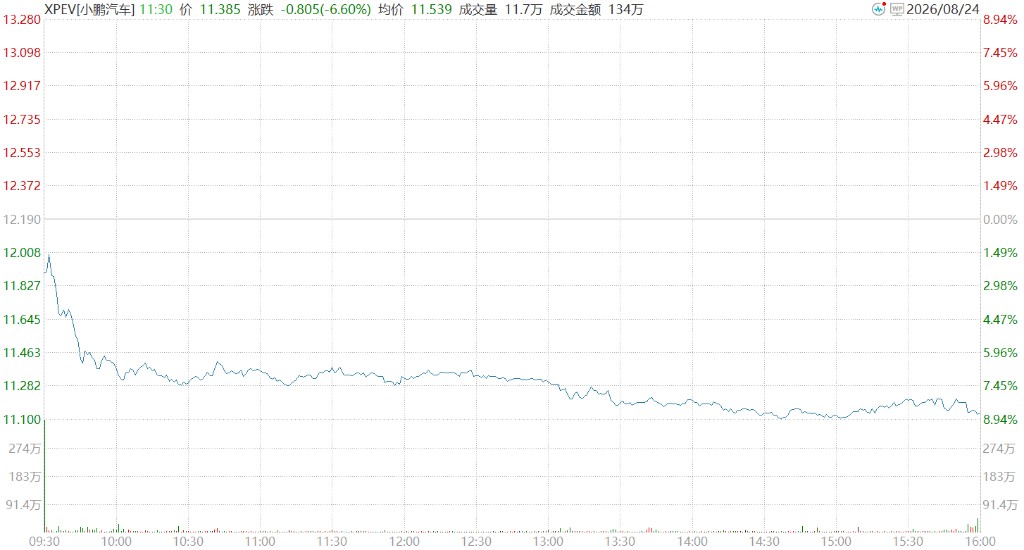
Management has positioned robotics and Robotaxi as the core engines for transforming into a physical AI technology company, providing for the first time a clear timeline for driverless passenger operations by 2027. Capital markets remain cautious about whether this transformation can offset pressure on the core business.
Robotics Financing Breaks Records with Star-Studded Investor Lineup
The first round of financing for XPeng's robotics business was the most significant highlight of this earnings report. The financing amount of over $900 million and the post-money valuation of over $6.3 billion (approximately RMB 43 billion) set a new record for single-round private equity financing in China's embodied intelligence industry.
Led by IDG Capital, with participation from Gaorong Ventures, and supported by strategic investors TENCENT and Alibaba, XPeng's robotics subsidiary, Dogotix Inc., has signed share purchase agreements. The group will continue to maintain controlling interest in the robotics business.
Regarding the commercialization path, He Xiaopeng, Chairman of XPeng Group, revealed that the XPeng IRON humanoid robot will enter mass production by the end of 2026, initially deploying in company stores and industrial parks. It will officially be sold to retail and service industry customers in 2027, achieving scaled deliveries domestically and internationally, with monthly production capacity adjustable to thousands of units based on market demand.
IRON adopts a recurring revenue model of "hardware sales + AI software upgrades." Management expects its lifetime revenue and gross profit contribution to exceed the current per-vehicle levels of the automotive business.
To accelerate global technology expansion, XPeng recently established a group-level key Business Development (BD) team to coordinate the commercial expansion of the Turing AI chip, the second-generation VLA model, and robotics technology.
Robotaxi Completes Internal Testing, Aiming for Driverless Operations by 2027
In the autonomous driving sector, XPeng's Robotaxi is shifting from R&D testing to demonstration operations.
The financial report disclosed that factory-installed mass-produced Robotaxis equipped with the second-generation VLA system architecture have completed over 2,000 internal test orders in Guangzhou, successfully running through the entire process of manned demonstration operations, and completing the development of the cloud-based takeover platform.
The company plans to achieve driverless passenger operations by 2027. Subsequently, it will collaborate with domestic and international mobility platforms to expand operational scale in core global cities, generating revenue through vehicle sales, technical services, and operational revenue sharing.
To support the implementation of its physical AI strategy, XPeng continues to increase R&D investment. Q2 R&D expenses reached RMB 2.91 billion, primarily used for new model development and AI technology iteration.
According to previous disclosures by management, R&D investment related to physical AI is expected to further increase to RMB 7 billion in 2026.
Overseas Sales and Orders Both Increase, Core Business Supports AI Investment
The transition to physical AI relies on cash flow support from the core automotive business.
In Q2, XPeng's overseas sales exceeded 20,000 units for the first time, an 81% year-over-year increase, with overseas business revenue accounting for over 25% of total revenue in the first half of the year. According to plans, the MONA L03 will start overseas deliveries in Q4, driving quarterly overseas sales to exceed 40,000 units. In the medium to long term, the company plans to launch several extended-range electric vehicle (EREV) models in 2027 to expand its overseas market share.
In the domestic market, total car deliveries in Q2 reached 103,000 units. Entering Q3, new locked-in orders increased by over 50% quarter-over-quarter, hitting a historic high.
Addressing production bottlenecks, XPeng has initiated double-shift production for the MONA L03 and is working with the supply chain to boost capacity. With the launch of the large five-seater flagship G9L in September and the deployment of the MONA L05 in Q4, the company expects a significant increase in Q4 sales, aiming for a monthly target of 60,000 units.
Core Business Under Pressure: Net Loss Widens, Guidance Misses Expectations
The other side of the transformation narrative is the pressure on the core business. XPeng's total revenue in Q2 was RMB 19.74 billion, an 8% year-over-year increase and a 51.5% quarter-over-quarter increase. Gross margin was 20.7%, up 3.4 percentage points year-over-year, remaining above 20% for two consecutive quarters.
However, the net loss was RMB 1.34 billion, widening nearly 1.8 times compared to RMB 480 million in the same period last year, while narrowing by 25.1% quarter-over-quarter. The non-GAAP net loss was RMB 1.24 billion.
Of greater concern is the forward guidance: The company expects Q3 revenue to be between RMB 21.7 billion and RMB 23.4 billion, with deliveries between 115,000 and 121,000 units, significantly lower than the market estimates of RMB 27.26 billion and 147,000 units.
Brian Gu, Vice Chairman and Co-President of XPeng Group, stated that amid industry cost pressures, the company maintains stable operations through premiumization and international expansion. Over the next year, it will accelerate the mass production and commercialization of physical AI technologies to create a positive business cycle.