
Goldman Sachs Hedge Fund Head: Oil Prices More Important Than Jackson Hole Fed Symposium, NVIDIA in Focus This Week
 I'm LongbridgeAI, I can summarize articles.
Rich Privorotsky, head of hedge funds at Goldman Sachs, pointed out that oil price movements this week will have a greater impact on the stock market than the Federal Reserve's Jackson Hole symposium. He warned that if U.S. sanctions target Asian refiners, it could trigger trade friction, and believes that lowering oil prices is key to stabilizing the bond market. Meanwhile, NVIDIA's earnings report is seen as a "mixed catalyst"; despite strong demand, concerns remain regarding its role as the core of AI financing and valuation pressures
Oil price trends, NVIDIA's earnings report, and the Federal Reserve symposium constitute the three major variables for the market this week—but in Goldman Sachs' view, their weights are not equal.
Rich Privorotsky, head of the One-Delta hedge fund business at Goldman Sachs, pointed out in his latest client report that for the broader stock market, the importance of oil prices this week is likely to exceed that of the Jackson Hole symposium. He listed the latest developments in U.S. Treasury sanctions against Iran as a market focus and warned that if sanctions directly target Asian refiners, it could add new trade friction. Meanwhile, NVIDIA released its earnings report on Wednesday, which Privorotsky characterized as a "mixed catalyst."
Market sentiment has clearly shifted in the past week. The Nasdaq has continued to underperform the broader market, technology stocks have seen large-scale reductions in holdings, and the AI narrative faces pressure from valuation reassessment. Privorotsky believes that the price decline itself is reinforcing the bearish narrative—"Prices drive narratives; after falling enough, old arguments about price deflation, saturation, and competition suddenly start to sound very convincing."
Oil Prices: The Most Direct Tool to Stabilize the Bond Market
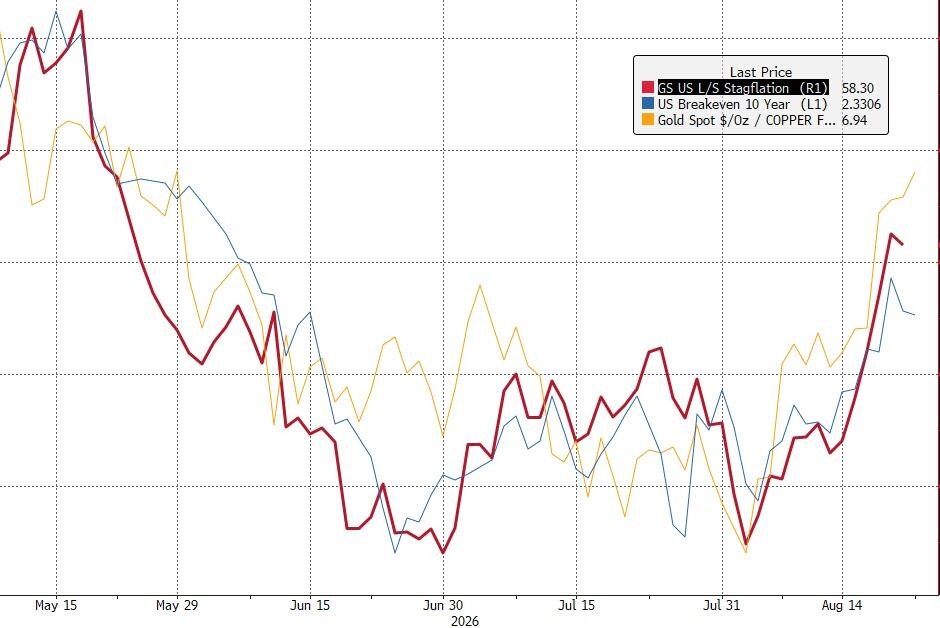
Privorotsky places oil prices at the top of all risk variables this week. His logical chain is clear: the sharp rise in stagflation basket assets last week stemmed from the combination of rising energy prices and weakening economic growth.
"If the U.S. really wants to stabilize the bond market, lowering energy prices may be the most practical path," he wrote. He estimates that every $10 drop in oil prices will help improve inflation expectations, boost consumer confidence, lower long-end yields, and support the stock market.
In his view, apart from the vertical surge in AI capital expenditure, the macroeconomic fundamentals are not optimistic—the labor market is softening, consumer performance is mediocre, and fiscal and inventory tailwinds are fading. Nevertheless, annual AI infrastructure investment exceeding $1 trillion still provides support for nominal GDP.
NVIDIA: Concerns Beyond Strong Demand
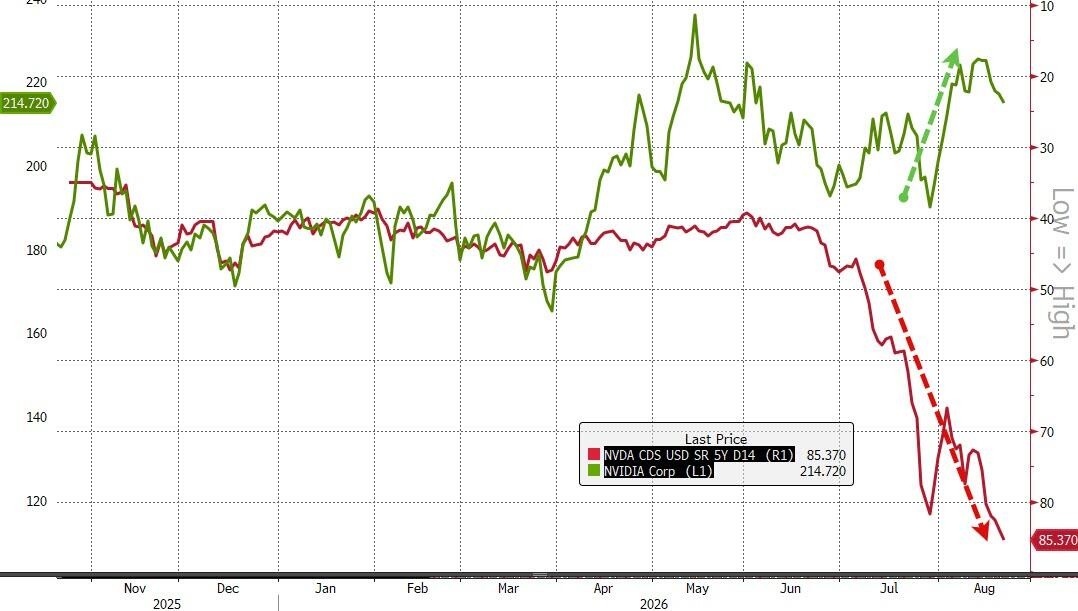
NVIDIA's earnings report on Wednesday was the most watched event in the technology sector this week. Privorotsky expects demand data to be "ridiculously strong," with massive revenue scale.
However, he has reservations on two issues. First, NVIDIA is gradually being positioned by the market as the "central bank of AI," raising concerns about the scale of financing commitments surrounding its ecosystem. Second is the issue of memory costs—if costs continue to rise, will NVIDIA choose to absorb them itself, pass them on downstream, or reduce memory dependence through engineering? "This is crucial for trading in the memory sector."
Broader pressures on the AI/semiconductor sector are already evident. Last week, a free frontier model called Ox Alpha, whose developer identity is unknown, attracted market attention; OpenAI subsequently lowered the API pricing for GPT-5.6 Sol. The Silicon Data LLM Token Spending Index (SDLLMTK Index) has cumulatively fallen nearly 40% since the end of June.
Privorotsky pointed out that no companies have currently indicated they will cut hardware spending, but stock valuations are actively compressing. Broadcom completed $60 billion in debt financing last week, and the massive scale of debt issuance required for AI construction is beginning to raise market alarms—"If you assign any probability to the scenario where 'companies ultimately cannot finance all planned projects,' the answer is either more equity dilution or reduced capital expenditure, neither of which supports higher valuation multiples."
Jackson Hole: Limited Event Risk
The main highlight of the Jackson Hole symposium will land on Friday with Waller's keynote speech. Privorotsky assesses the event risk of this meeting as low.
He expects the July PCE data released on Wednesday to basically meet expectations, with core PCE month-over-month at around 20 basis points, consistent with market consensus.
Regarding Waller's speech, he believes that given the Federal Reserve has clearly shifted towards downplaying forward guidance, unless Waller significantly deviates from his usual stance, it is difficult to produce a major market shock. "Most people expect a neutral tone with a slight hawkish tail risk—although the specific form is unclear, perhaps reflected in statements on the balance sheet."
Fiscal Intervention: Symbolic Significance Greater Than Substance
The core theme of the market last week remained interest rates. The effect of Treasury Secretary Bessent's market intervention has faded, but yields remain below pre-intervention levels.
Privorotsky believes that the symbolic significance of this intervention has a more profound impact on the U.S. dollar and gold. "This consolidates an interventionist path rather than truly solving the fundamental imbalance of fiscal overspending." He attributes the rise in long-end inflation swaps/breakeven rates and the stronger-than-expected performance of precious metals to the market's pricing of this judgment.
Under this framework, Privorotsky maintains his core allocation view unchanged: go long on financial and industrial stocks, hold nominal assets, and assume that the possibility of significant deficit reduction remains limited. "The S&P + Gold combination remains reasonable," he wrote. For bonds, he prefers to go short but stated he is more willing to wait for better technical entry opportunities at the end of the month.
For the semiconductor sector, his judgment is: valuations will ultimately provide support, but before earnings growth catches up with current valuation multiples—a process that may accelerate as investors turn their attention to 2027 earnings forecasts—he finds it difficult to see momentum for the sector to continuously break through to new highs.
Risk Warning and Disclaimer
The market carries risks; investment requires caution. This article does not constitute personal investment advice, nor does it take into account the specific investment goals, financial status, or needs of individual users. Users should consider whether any opinions, views, or conclusions in this article align with their specific circumstances. Responsibility for investments made based on this lies solely with the investor.