
 I'm LongbridgeAI, I can summarize articles.
Robinhood Chain faces a narrative-reality misalignment, where stock token infrastructure is driven by meme trading and speculative activity. As of August 2026, it holds $720M DeFi TVL and $1.32B daily DEX volume. Pons dominates the launchpad landscape with ~80% market share, while projects like microduck link memes to real-world assets like NVIDIA tokens.
Written by: KarenZ, Foresight News
Robinhood built a highway for tokenized stocks. However, after the road opened, the first to rush in weren't investors prepared to hold Nvidia and Apple long-term, but rather the on-chain speculative market formed around Memes, launchpads, and NFTs.
This seemingly deviates from the initial vision, but it is precisely the starting point for understanding the current state of Robinhood Chain.
Robinhood Chain is currently in a phase of narrative and reality misalignment: while its core selling point is stock tokens, early activity was primarily driven by Meme token issuance, short-term trading, and trading bots; officially described as financial infrastructure serving AI agents, the initial revenue generators are launchpads, trading terminals, and liquidity protocols.
Robinhood Chain is currently in a phase of narrative and reality misalignment: it uses stock tokens as its core selling point, but early activity was mainly driven by Meme token issuance, short-term trading, and trading bots; officially described as financial infrastructure serving AI agents, the initial revenue generators are launchpads, trading terminals, and liquidity protocols.
... This article will analyze the current state of Robinhood Chain's ecosystem development from aspects such as overall data performance, launch platform landscape, competition among trading terminals, the connection between Memes and stock tokens, the evolution of NFTs from collectibles to programmable financial certificates, on-chain lending, and the agency economy. How is Robinhood Chain's overall data performance? According to DefiLlama data, as of August 31, 2026, Robinhood Chain's DeFi TVL was approximately $720 million. The total market capitalization of on-chain stablecoins was approximately $775 million, of which USDG accounted for approximately 57.6%, followed by Ethena USDe ($324 million, approximately 42%).
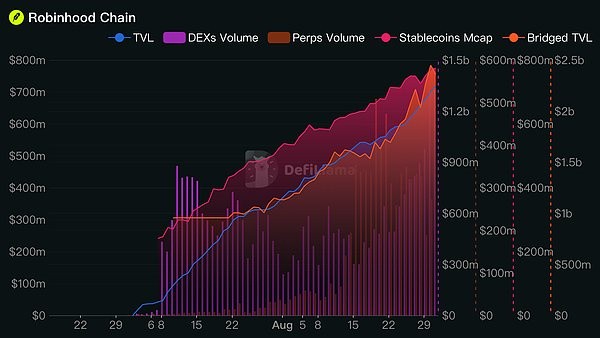
Source: DefiLlama
According to DefiLlama's broad statistical definition, the active market capitalization of on-chain RWA is approximately $151 million, but this figure includes other real-world assets and cannot be directly equated to the circulating market capitalization of stock tokens.
In terms of trading, Robinhood Chain's rolling 24-hour DEX trading volume was approximately $1.32 billion during the data verification period, exceeding the on-chain DeFi TVL, reflecting relatively active capital turnover. During the same period, the 24-hour trading volume of on-chain perpetual contracts was approximately $270 million.
Furthermore, Robinhood Chain's Bridged TVL is approximately $2.242 billion, representing the scale of assets that have entered the network through cross-chain bridges, but this does not mean that all of these funds are currently remaining in DeFi protocols. This data indicates that both the scale of funds and trading activity on Robinhood Chain are increasing: the growth in stablecoins and TVL reflects the continuous inflow of funds, while the trading volume being significantly higher than TVL indicates that these funds are frequently used for trading after entering the chain, resulting in a high turnover rate. Launchpad Wars: Pons Secures the Throne The early launchpad landscape of Robinhood Chain underwent rapid changes. Looking at the share of launchpad token trading volume, Noxa almost dominated all related trading volume in the early stages of the mainnet launch, then suddenly ceased operations; Pons quickly took over the market. Despite a period of dispersed traffic in early August, Pons' trading volume share rebounded to nearly 80% by the end of the month. Pons' scale is already quite impressive. As of August 31, its cumulative issuance was approximately 389,000 tokens. In addition to the platform token PONS, Pons also has 10 projects with a market capitalization exceeding $5 million, including 6 exceeding $10 million and 4 in the $5 million to $10 million range. These include pure memes as well as liquidity management, index, social, and lending products. Delta (DELTA, market capitalization $29.3 million): A liquidity management project on the Robinhood Chain, focusing on LP staking, yield reinvestment, and transaction fee acquisition. Thinking Cat (HMM, market capitalization $24.78 million): A community meme based on the "Thinking Cat," currently lacking a defined protocol function. microduck (market capitalization $17.78 million): A meme that forms a trading pair with NVDA stock tokens, connecting community trading activity with the NVIDIA asset narrative. microduck originates from the real-world open-source robot "Microduck" released by Hugging Face on August 27th. Copper Inu (COPPERINU, market cap $12.87 million): Copper Inu originated from a January 2026 tweet by Cobie: "Trading real copper doesn't have to worry about waking up in the middle of the night to find 'Copper Inu' has stolen all the market attention from copper, because a new commodity doesn't pop up every few seconds on Pump.fun." The recent Robinhood token surge was primarily driven by crypto KOL Him. YOLO ($11.18 million): A pure meme with "all or nothing" as its core cultural symbol. Golden Goose ($11.11 million): A community meme themed around "the goose that lays golden eggs" and paired with GLD (a tokenized gold ETF on the Robinhood Chain). Down to Finance (DTF, $6.88 million): A decentralized portfolio platform that allows users to package a basket of assets or strategies into a single token and plans to distribute a portion of protocol fees to DTF stakers. clan.tech (CLAN, $6.24 million): A social trading product built on Fomo Clans, where users can purchase community keys, enter private chats, and participate in the distribution of trading revenue. Motion (MOTION, $6.12 million): Positioned as a TipFi and social graph within the Robinhood Chain, it builds user relationship networks through identity, interaction, and token rewards. Longbow (BOW, $6.15 million): A lending project based on Morpho Blue, allowing users to borrow USDG by staking stock tokens, RWA, crypto assets, and some ecosystem tokens. Of the 10 projects mentioned above, 6 are from Pons V2. Compared to earlier versions, Pons V2 allows projects to use ETH, USDG, and even stock tokens like NVDA and TSLA as pricing assets; after the token completes its binding curve, liquidity enters Uniswap v4 and is permanently locked. This means Pons is no longer just a Robinhood Chain version of Pump.fun. It is attempting to connect meme issuance, stock tokens, and Uniswap liquidity within the same mechanism. Pons has also generated a relatively substantial cash flow. As of the latest DefiLlama data as of August 31, 2026, Pons has generated approximately $46.06 million in user fees, of which approximately $10.14 million was recorded as protocol revenue, and approximately $3.61 million was used to buy back and burn PONS. In the past 30 days, Pons generated approximately $26.53 million in fees, $5.2 million in protocol revenue, and $1.62 million in buybacks and burns; in the past 7 days, these figures were approximately $16.778 million, $2.985 million, and $494,000, respectively. If we mechanically annualize the data from the past 30 days, Pons' annualized fees would be approximately $323 million, annualized protocol revenue approximately $63.3 million, and annualized buybacks and burns approximately $19.7 million. Roughly calculated based on DefiLlama's then-current circulating market capitalization of approximately $270 million for Pons, the annualized buyback amount is equivalent to approximately 7.3% of the market capitalization. However, this percentage should not be interpreted as the yield on holding the token. Buybacks and burns do not directly pay cash to holders, and Pons has only been online for a short time, with a recent significant increase in both issuance volume and trading activity. Whether the current revenue can be sustained remains to be seen. Trading Bot Wars: Trading Terminals Compete for Order Flow In Robinhood Chain, trading bots are not peripheral tools, but important producers of trading volume and number of transactions. According to Adam Tehc's Dune dashboard data as of August 29, GMGN accounted for approximately 41.2% of trading terminal trading volume, and FOMO accounted for approximately 30%, totaling approximately 71.2%. This means that competition within Robinhood Chain isn't just about liquidity among DEXs, but also about user order flow among trading terminals. Whoever can discover new coins faster and complete buy, copy trading, and profit-taking more smoothly will have a greater chance of controlling the trading entry point. The connection between Meme and stock tokens is the most distinctive experiment of Robinhood. Issuing Meme separately isn't new. The truly distinctive innovation of Robinhood Chain is connecting Meme and stock tokens at the asset and fee levels. Currently, there are roughly three models. The first type directly uses stock tokens as the pricing asset for the meme. For example, Artificial Inu (AI) on Long and microduck on Pons V2 both revolve around the NVDA narrative. When users buy and sell these memes, the stock tokens are placed in liquidity pools, thus generating additional trading volume and lock-up demand. The second type purchases stock tokens through transaction taxes and distributes them to holders. The Index charges approximately 3% of each INDEX token transaction to purchase a portfolio of 18 stock tokens, including NVDA, AAPL, and MSFT, and distributes them to eligible INDEX holders according to project rules. This type of product resembles an index, but it is not the same as a traditional redeemable index fund. Its funding comes from token transaction taxes, and its value depends on the continuous trading of INDEX itself; if trading volume decreases, the cash flow from purchasing stock tokens will also decrease. The third method is to put stock tokens into NFTs or token-linked accounts. Compared to the first two models, this design also attempts to redefine the function of NFTs themselves. NFTs: From Collectibles to Programmable Financial Certificates Representative NFTs on Robinhood Chain no longer focus solely on images and scarcity, but rather on using NFTs as programmable financial interfaces. The total supply of StoneBrokers is 4444, and each NFT has an ERC-6551 token-linked account. At minting time, stock tokens are placed in this account, which can continue to receive and manage assets thereafter. In other words, users are not just trading an image, but a combination of "image, account, and assets within the account." The current floor price for StonkBrokers is 7.31 ETH. Quotrons combines ERC-404 tokens with NFT terminals: each tradable QUOTRON corresponds to one terminal. Holders can choose to maintain their liquidity or burn QUOTRON, irreversibly "hardwire"ing the terminal into the rewards system. Each regular terminal corresponds to one of ten stock tokens, including NVDA, AAPL, TSLA, and SPY. The protocol charges a 3% base transaction fee, of which 2% is periodically converted into the corresponding stock token and distributed to connected terminals. The remainder is used to buy back and burn StonkBrokers, increase locked liquidity, and pay creator fees. As of this writing, the floor price for Quotrons is approximately 3.15 ETH. The yet-to-be-released The Standard Reserve uses a narrative of "central bank, branch permission" to organize NFTs and a token system. It's important to note that as of the end of August, it was still primarily in the white paper and pre-launch phase. From this perspective, the common direction of Robinhood Chain NFTs is to encapsulate assets, revenue rights, access rights, community identity, and interaction rules within the same on-chain credential. Whether this model is more valuable than traditional PFPs ultimately depends not on the complexity of the mechanism, but on its ability to attract real users and whether there are sufficient assets, revenue, and usage demand behind it. Lending needs to be broken down into two layers: USDG foundation and ecosystem experiment. If all projects on Robinhood Chain with terms like "lending," "revenue," or "equity collateral" are grouped together, it's easy to overestimate the maturity of equity token financialization. The true foundation of TVL consists of Robinhood Earn, Morpho, and Steakhouse. Robinhood Earn allows users to deposit USDG into the Morpho Vault, curated by Steakhouse, with an estimated annualized yield of approximately 7% displayed on the page. As of the time of this review, Morpho's TVL on the Robinhood Chain is approximately $480 million, making it the largest component of the chain's total TVL. There is significant overlap between Steakhouse and Morpho data, as Steakhouse is the curator of the Morpho Vault; the two figures cannot be simply added together. More importantly, this large-scale lending currently primarily revolves around assets like USDG, rather than using stock tokens like NVDA and TSLA as collateral. While the Robinhood Chain already has a USD lending platform, "stock token lending" remains experimental. According to Arrow Finance, its mainnet will launch on August 31st, supporting 16 collateral markets covering stablecoins, WETH, tokenized stocks, and indices. Longbow, based on Morpho, creates an isolated lending market that allows users to borrow USDG using assets such as stock tokens, PONS, and INDEX. The problem is that Longbow's TVL is only $130,000, while the BOW token's market capitalization has reached $6.15 million as of this writing. This doesn't mean the project has no value, but it illustrates that its token price primarily reflects future expectations rather than the current scale of funds and revenue.
Agent Economy and x402: The Endgame is Big, But It's Still Early
Compared to the plethora of on-chain agent tokens, Robinhood's more noteworthy aspect is its comprehensive product system built around agent trading, account authorization, and payment capabilities.
Robinhood has launched a standalone Agentic Trading account, allowing authorized agents to execute transactions within a limited account; it has also launched the Agentic Credit Card, which creates independent virtual cards for agents through Banking MCP, setting monthly limits, transaction policies, and manual approval conditions.
Robinhood also defines the Robinhood Chain as an "AI-native" blockchain, providing the foundational environment for agents to trade, exchange, lend, and use tokenized assets on-chain.
Robinhood defines the Robinhood Chain as an "AI-native" blockchain, providing a foundational environment for agents to trade, exchange, lend, and use tokenized assets on-chain.
According to Virtuals' latest weekly report, more than a month after its launch, proxy-related assets issued by Virtuals have contributed over 1% of the DEX trading volume on Robinhood Chain. It can be seen that compared to Memes, launchers, and trading bots, the actual activity of the proxy economy and x402 on Robinhood Chain is still relatively early. However, proxy accounts, machine payments, and automated asset management are also development directions that Robinhood hopes to promote in the long term. In summary, if we must summarize the current stage of Robinhood Chain, it is more like an on-chain financial network initiated by Robinhood's distribution capabilities, differentiated by stock tokens, but currently primarily driven by Memes, launchers, and trading tools. In summary, Robinhood Chain currently exhibits four relatively clear characteristics: First, Robinhood's brand, user entry points, and product integration capabilities can quickly translate into on-chain funds and trading activity. Second, while stock tokens offer differentiation, they are not yet the primary source of ecosystem activity. Currently, Memes, launchpads, and trading terminals are more active, with stock tokens primarily serving as pricing assets, liquidity components, and product narratives. Third, what's truly noteworthy about Robinhood Chain isn't simply putting stocks on-chain, but rather the new combinations surrounding stock tokens, including pairing stock tokens with Memes, on-chain indices, collateralized lending, and NFTs that integrate assets, rewards, and usage rights. Whether these experiments can generate sustained demand is more important than simply increasing the number of stock tokens. Meanwhile, many projects hastily launch tokens shortly after creating their social media accounts, lacking sufficient verification of operational records, contract security, and team backgrounds, making participation risky. Fourth, the current data still carries a significant early-stage sentiment premium. However, real user retention, protocol revenue sustainability, and the actual usage scale of the stock tokens still require further verification. The next stage for Robinhood Chain is not to continue proving the market's willingness to trade, but to prove that this trading activity can translate into demand for holding, lending, payments, and asset management. Robinhood Chain has completed its initial traffic launch, but has not yet completed the transformation from trading activity to financial demand. Its future success depends on how much capital, users, and real business remain after the initial hype fades.