
 I'm LongbridgeAI, I can summarize articles.
Fed Governor Chris Waller stated that the Federal Reserve's decision on a potential rate hike at its upcoming meeting hinges on the August inflation report released on Sept. 11. He indicated support for holding rates if progress toward the 2% target continues, but would consider a hike if inflation remains high. With the FOMC currently split, this data is seen as the critical tiebreaker for monetary policy.
Whether the Federal Open Market Committee (FOMC) raises interest rates at its meeting later this month remains a toss-up as of this writing.
But it looks like a decision could hinge on the August inflation report, which will be released on Sept. 11. Fed Governor Christopher Waller just said his decision will likely come down to that report.
"If there is continued progress toward our 2% goal, then I am willing to support holding the policy rate at its current level," Waller said at a Reuters event on Sept. 3. "If inflation comes in hot, I would consider a rate hike."
Here's why the August inflation report could be make-or-break for the FOMC.

Image source: Getty Images.
Where the inflation picture stands
For years, inflation has remained above the Fed's preferred 2% target. The Iran war, which began at the very end of February, only exacerbated the situation, raising oil and gas prices, which can have a trickle-down effect across the economy.
But in recent months, there have been some signs that inflation could be cooling.
In July, core inflation, which excludes more volatile food and energy prices, rose 0.2%, with headline year-over-year inflation coming in at 2.5%. That was in line with consensus estimates.
However, the Fed's preferred inflation gauge, the Personal Consumption Expenditures (PCE) price index, came in slightly hotter than expected.
It feels like this is the pattern the economy has been in for several years, at least since inflation peaked at 9% in 2022.
Inflation shows signs of slowing but still seems unable to reach the Fed's 2% target. It's possible that tariffs played a role in this, and the Iran war certainly has. Affordability remains a critical issue in the U.S., with most people finding prices exorbitant and the environment difficult to build wealth.
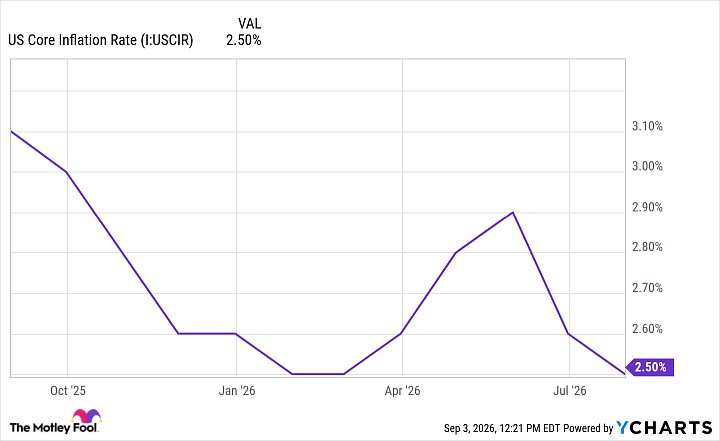
US Core Inflation Rate data by YCharts
The Fed is trying to thread the needle. It doesn't want to risk inflation reverting to higher levels or remaining persistently high. However, it also doesn't want to accidentally tip the economy into a recession, especially as consumers are already struggling with affordability.
Waller is a critical vote that could sway the FOMC
At the FOMC's last meeting, the committee chose to leave rates unchanged within the 3.50%-3.75% range.
However, three members of the 12-member voting committee dissented, preferring a quarter-point hike: Cleveland Fed President Beth Hammack, Minneapolis Fed President Neel Kashkari, and Dallas Fed President Lorie Logan.
So, if Waller moves to prefer a quarter-point hike, that would bring the total to four FOMC members. Furthermore, Fed Governor Michael Barr recently said he would be in favor of raising rates "if inflation appears not to be moderating sufficiently."
Other members of the FOMC could also shift toward favoring a hike if the next inflation report comes in hot.
It would also be interesting to see what the FOMC Chair, Kevin Warsh, does in such a scenario. The market has had a tough time figuring out how Warsh truly views inflation.
In some regards, he's sounded hawkish, saying prices are still too high on numerous occasions. In other circumstances, he's been more vague, talking about other ways the Fed might measure inflation that could make inflation appear lower than it is under the Fed's current measurement tools.
But it's important to note that the FOMC chair's job is to build consensus among the committee. So, even if Warsh has secretly been hawkish, it may have been difficult for him to advocate for a rate hike when most members didn't prefer one.
But if there are four or five members in favor of a rate hike, Warsh would have more latitude to move to the rate-hike camp if he felt that way.
An unprecedented 6-6 tie at the FOMC means interest rates by default would remain unchanged.
According to the CME Group's FedWatch tool, whether interest rates remain unchanged or increase by a quarter point was roughly a 50-50 split as of this writing.
I think next week's August inflation report will ultimately serve as the tiebreaker.