
 I'm LongbridgeAI, I can summarize articles.
Jensen Huang proclaimed that "AGI has arrived," noting that OpenAI's flagship model, Astra, was trained on over 100,000 NVIDIA chips. His significant announcement that "400,000 GPUs are coming online" sends a strong signal of surging demand for computing power
NVIDIA CEO Jensen Huang declared the official dawn of the Artificial General Intelligence (AGI) era, attributing this historic milestone to OpenAI's latest flagship model, Astra—which was trained on NVIDIA chips. This statement once again positions NVIDIA as the dominant force in AI infrastructure and hints at an impending large-scale expansion of computing capacity.
On Sunday, Huang posted on X to congratulate the OpenAI team, stating that "AGI has arrived," and revealed that Astra was trained on more than 100,000 NVIDIA Grace Blackwell NVLink72 chips. He also stated that "400K GPUs are coming online," sending a strong signal that NVIDIA's computing supply is set for another significant leap.
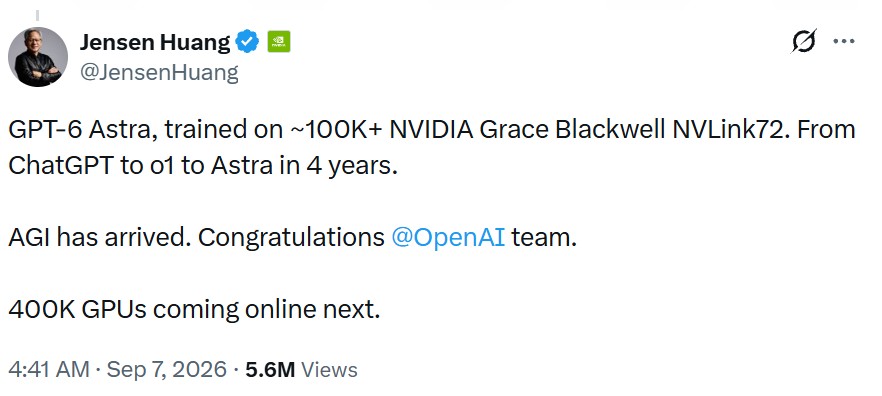
This statement has direct implications for the market. NVIDIA's data center business has become its core growth engine, and Huang's preview of an additional 400,000 GPUs suggests that order demand from top-tier AI customers continues to expand.
Astra Launch: OpenAI Calls It the "Smartest" Model
OpenAI released Astra last Thursday, positioning it as "the world's smartest and most human-aligned model," capable of "performing the most demanding professional tasks with unparalleled speed, precision, and judgment." OpenAI President Greg Brockman told the media at the launch event, "Welcome to the AGI era."
Brockman further predicted that when people look back on history, they will consider AGI to have been born "around this time, and I think it might be this very model." "Personally, I do believe we have arrived," he said. Astra began rolling out to users this week.
OpenAI defines AGI as "highly autonomous systems that outperform humans at most economically valuable work," positioning Astra as a major research breakthrough that marks a fundamental shift in the boundaries of tasks that can be entrusted to AI.
Ongoing Controversy: Disagreement Persists Over the Definition of AGI
However, not everyone agrees with this declaration. Prominent AI researcher and critic Gary Marcus directly pointed out that Huang was "jumping the gun."
"Huang provided neither evidence nor a definition, which to me looks like an attempt to use corporate will to forcibly claim a scientific issue," Marcus wrote on his Substack. "Declaring victory without a definition only adds to the confusion."
Marcus subsequently listed his own 10 criteria for defining AGI, noting that Astra meets only one or two of them. "By common definitions, Astra still falls short," he said.
Even OpenAI's own CEO, Sam Altman, has been quite cautious about the concept. He recently stated on the "Sources" podcast that AGI is, at best, "a very poorly defined term. I was going to say it's more of a meaningless marketing term."
NVIDIA: The Core Support for AI Infrastructure
Regardless of how the debate over the definition of AGI unfolds, NVIDIA's position as the core computing supplier for leading AI companies is undisputed. In a financing announcement in March this year, OpenAI referred to NVIDIA as "the cornerstone of our infrastructure," stating that "our training clusters and most of our inference stack continue to run on NVIDIA GPUs."
Frontier AI companies such as Meta, Anthropic, and Google are also heavily reliant on high-end chips produced by NVIDIA. This demand has translated into impressive financial performance for NVIDIA—the company reported quarterly revenue of $96.2 billion in August this year, representing a year-over-year increase of more than 100%; of this, data center revenue reached $89 billion, with businesses including AI chips constituting the main source of growth.
In his post on X, Huang stated that the next batch to come online would be 400,000 GPUs, further reinforcing external expectations regarding the momentum of NVIDIA's computing expansion. From ChatGPT to o1, and now to Astra, every technological leap within these four years has been built upon the foundation of NVIDIA's continuously upgraded chips.