
 I'm LongbridgeAI, I can summarize articles.
A Morgan Stanley report indicates that the AI industry is entering the "Age of Inference," expected to reshape a global market worth $50-60 trillion. As capital expenditure by cloud service providers slows after 2027, funding will shift from hardware to software and tech giants. Enterprise AI applications are accelerating, with approximately 25% of S&P 500 companies already quantifying AI benefits. Despite a surge in AI-related debt issuance, cash flows are sufficient to cover obligations. Future focus will shift to return on investment, open-source competition, and power and regulatory bottlenecks
Morgan Stanley believes the artificial intelligence industry is moving decisively from the infrastructure construction phase into the "Age of Inference." This technological evolution will digitize and reshape the global knowledge work market, valued at $20-30 trillion, and the consumer market, nearing $30 trillion, thereby driving an unprecedented sector rotation in capital markets.
According to Wind Trading Desk, a research report titled "The Morgan Stanley AI Guidebook: Navigating the Age of Inference," led by Brian Nowak of Morgan Stanley and released on September 7, points out that as the growth rate of data center capital expenditure by hyperscale cloud providers is expected to peak in 2027 and slow significantly in 2028, the flow of funds in the technology cycle is reaching a critical turning point.
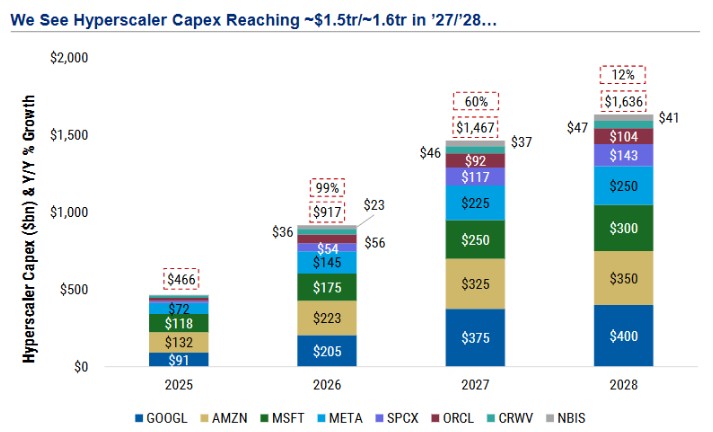 (Capital expenditure by hyperscale cloud computing providers is expected to reach approximately $1.5 trillion in 2027 and $1.6 trillion in 2028)
Investor funds are expected to marginally flow out of the semiconductor and hardware layers and shift massively toward the software layer and AI enablers. Tech giants with complete ecosystems and strong free cash flows, such as Amazon, Google, Microsoft, and META, are poised for a new round of valuation expansion.
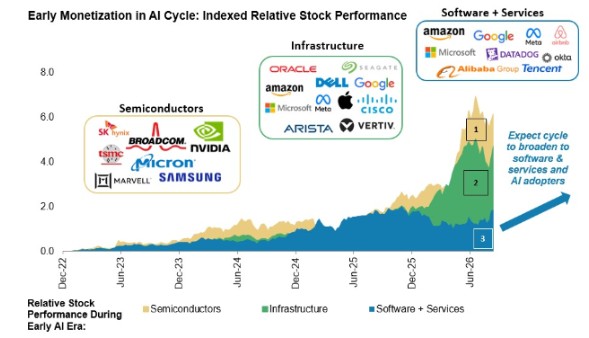 (The AI business cycle is expected to expand into the software and services sectors and AI application enterprises)
The report emphasizes that AI applications in both enterprise and consumer sectors are showing signs of accelerated explosion. By the second quarter of 2026, approximately 25% of companies in the S&P 500 Index had begun to quantify the financial benefits brought by generative AI.
Meanwhile, the AI infrastructure credit financing market has demonstrated strong capacity. Global AI-related debt issuance has reached approximately $450 billion this year. The robust operating cash flows of hyperscale cloud providers can fully cover future debt needs, alleviating market concerns about financing bottlenecks.
During this transition period, market focus will shift comprehensively to AI return on investment, the competitive landscape of open-source models, and the increasingly prominent power and regulatory bottlenecks. Finding a balance between the surge in computing power and physical constraints will determine the final destination of trillions of dollars in inference spending in the next stage.
Capital Flow Reaches a Turning Point: Hardware Cools, Software and Enablers Rise
Morgan Stanley believes that the capital expenditure trajectory of hyperscale cloud providers is the core indicator determining market fund rotation.
Data center capital expenditure is expected to grow by 60% year-over-year in 2027, reaching a total scale of $1.5 trillion. However, constrained by physical limits such as labor, materials, and electricity, as well as the front-loading of some capacity from 2027 to 2029, the growth rate of capital expenditure in 2028 is expected to slow significantly to about 12%.
This slowdown in growth, coupled with accelerated revenue growth in the software layer, marks the imminent occurrence of a typical multi-year technology cycle fund rotation. This is highly consistent with the patterns of the mobile internet era: after the initial explosion in hardware and semiconductors, value shifts to the application and software service layers.
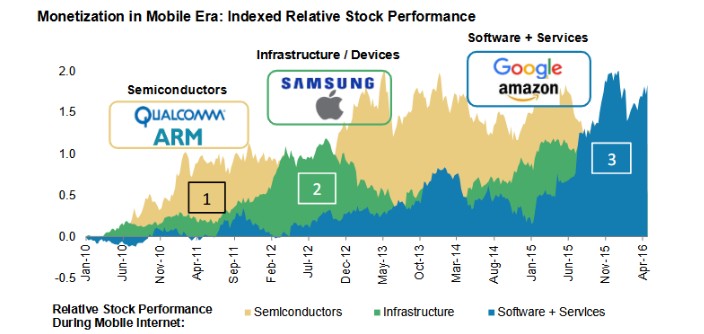 (Relative stock performance during the mobile internet era)
Although hardware layer stocks will not experience a cliff-like decline due to modest valuations, software and enablers will gain greater opportunities for multiple expansion as earnings beats shift to the upper stack.
As capital expenditure materializes, global total computing capacity will grow exponentially. Total computing capacity is expected to surge from 35 GW in 2025 to approximately 145 GW in 2028.
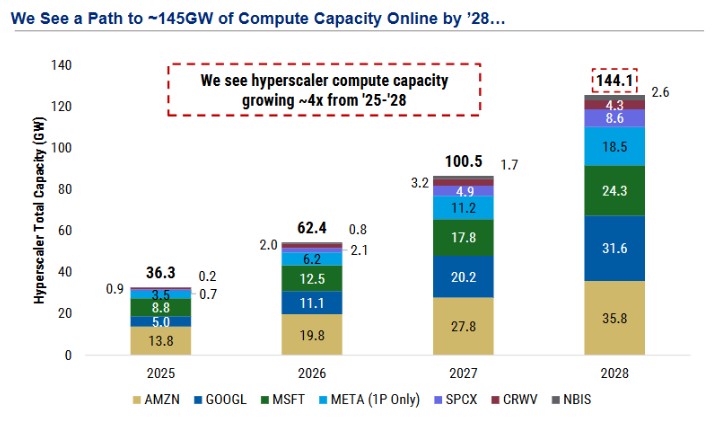
(Morgan Stanley's projected path for computing capacity to reach approximately 145 GW by 2028)
Among this, the share of custom ASIC chips in new computing capacity will jump from 34% in 2025 to 66% in 2028, with Google's TPU and Amazon's Trainium dominating this structural shift.

(The incremental capacity share of ASICs will continue to grow in the coming years)
Penetrating a $60 Trillion Market: Technology and Financial Industries Lead
Entering the Age of Inference, the true test for generative AI is commercial implementation.
The market faces a global knowledge work digitization opportunity worth $20-30 trillion, while the consumer market, including retail, tourism, autonomous driving, food delivery, and advertising, holds approximately $30 trillion in untapped potential.
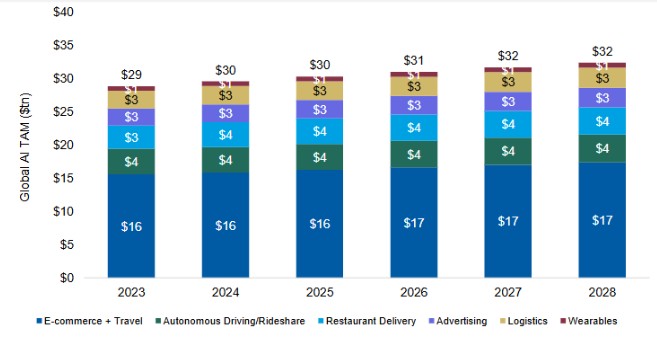 (The report estimates approximately $30 trillion in consumer spending awaits further digitization)
Adoption speed at the application layer is accelerating. From a macroeconomic diffusion perspective, the technology industry is leading in adopting and quantifying generative AI benefits, followed by the financial, healthcare, and industrial sectors.
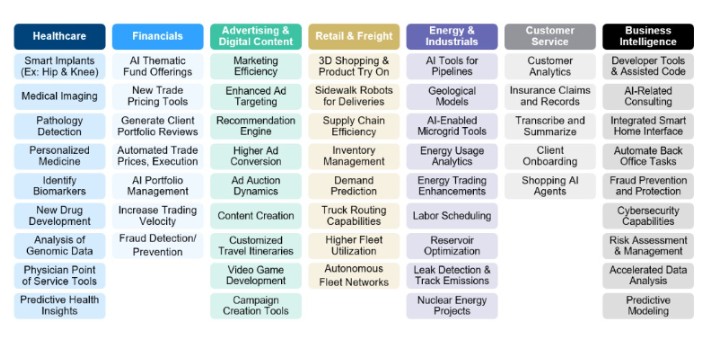
(Application cases cover the entire economic spectrum)
The proportion of technology industry earnings calls mentioning AI benefits has risen sharply from 28% a year ago to 51% today.
Historical analogies suggest that current AI penetration may be severely underestimated. In the second year of cloud computing development (2014), public cloud expenditure accounted for 4% of total IT budgets. Projecting at the same adoption rate, enterprise AI spending will reach approximately $800 billion by 2027.
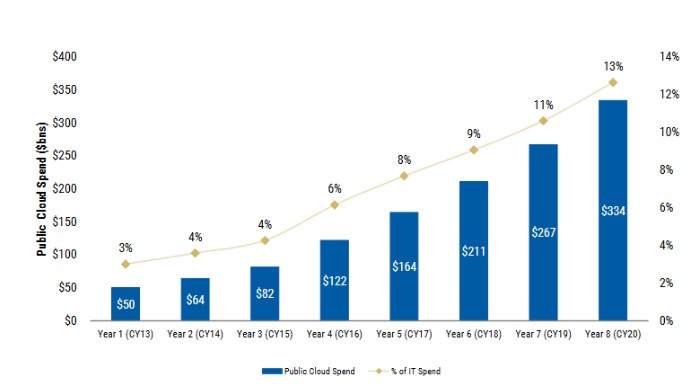 (From an enterprise perspective, it can be considered that public cloud expenditure accounted for 4% of IT budgets in the second year, 2014)
Since AI does not require wholesale infrastructure migration and offers shorter value conversion times, its actual diffusion speed is expected to be faster than cloud computing. On the consumer side, platforms with vast first-party data and distribution channels will hold an absolute advantage.
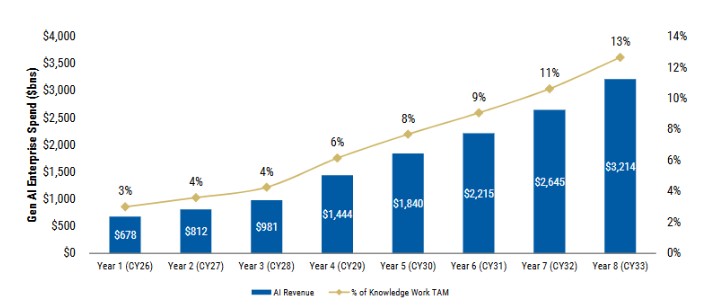 (The development speed of generative AI should be faster; even if its penetration rate is only 4% in the second year, 2027, it implies that generative AI spending in the enterprise sector will reach approximately $800 billion)
Computing Power ROI and Open-Source Models: Reshaping Business Models
Addressing the market's high concern over capital returns, analysis shows that the return on investment for generative AI is highly attractive, with expected ROIC across multiple monetization paths ranging between 25% and 50%.
Among these, enterprises running model APIs on their own infrastructure (such as META, Google, SpaceX) achieve the highest returns, with investment returns reaching approximately 46%. Even pure hyperscale GPU leasing businesses (IaaS) can maintain an ROIC of around 30%.
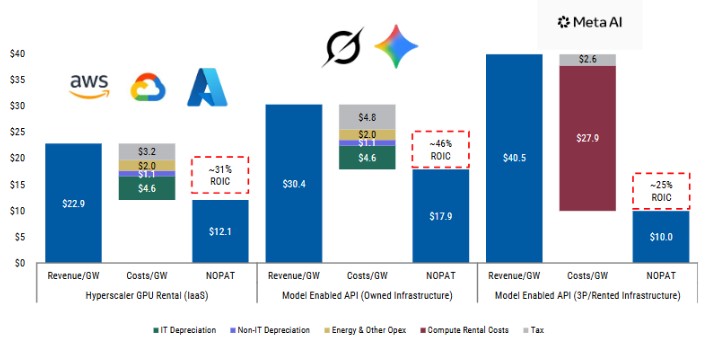
(25%-50% Return on Invested Capital for three generative AI frameworks)
At the model level, open-source models with lower service costs will not only fail to weaken computing power demand but will instead become key to promoting AI adoption across the entire economy.
Open-source models will lower average token prices, triggering the Jevons Paradox, where price declines lead to an explosive growth in inference demand.
This competitive dynamic will force frontier AI labs to continuously innovate to compete for inference spending share, while further consolidating the core value of hyperscale cloud providers' "model orchestration layers" (such as AWS Bedrock, MSFT Foundry, GOOGL Vertex).
These cloud platforms maximize computational efficiency and monetization capabilities by matching the most economical models to different tasks.
Overcoming Infrastructure Bottlenecks: Credit Expansion and Power Breakthroughs
The cornerstone supporting this massive inference market is uninterrupted financing and infrastructure expansion.
Although AI-related debt issuance has surged to approximately $450 billion this year, high-quality hyperscale cloud providers still have significant room for debt issuance. Market adjustment mechanisms will mainly manifest in widening credit spreads.
More importantly, the operating cash flows of Amazon, Google, META, and Microsoft are accelerating. The operating cash flows of these four giants are expected to reach $980 billion in 2027 and $1.2 trillion in 2028, respectively. This scale is seven to eight times the $290 billion in debt needed to be raised during the same period, demonstrating strong balance sheet resilience.
However, physical bottlenecks remain severe. Political scrutiny by state and local governments on data centers regarding electricity cost impacts and water consumption is intensifying.
To cope with grid connection delays, hyperscale data centers will increasingly adopt behind-the-meter on-site power generation solutions, which are expected to increase capital expenditure per GW by approximately $3 billion.
The rigid demand for trading time for electricity makes on-site power generation companies and providers with power shell assets, which benefit directly from this, possess long-term investment appeal.
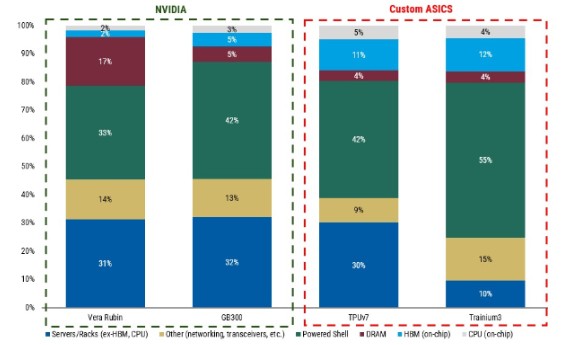
(Power shells and racks remain the largest drivers of computing power investment)
The above exciting content comes from Wind Trading Desk.
For more detailed interpretations, including real-time analysis and frontline research, please join [**Wind Trading Desk ▪ Annual Membership**]

Risk Warning and Disclaimer
The market carries risks; investment requires caution. This article does not constitute personal investment advice, nor does it consider the specific investment goals, financial status, or needs of individual users. Users should consider whether any opinions, views, or conclusions in this article align with their specific circumstances. Investment based on this content is at the user's own risk.