
 I'm LongbridgeAI, I can summarize articles.
Meta launched Muse, described as the world's first personal AI agent, in the US. Unlike standard chatbots, Muse autonomously executes complex tasks such as booking travel, shopping, and managing calendars by accessing authorized user services like email and fitness apps. It features background processing capabilities, allowing it to continue work even when the app is closed, and includes an activity log for transparency. Meta aims to make AI interaction as simple as chatting while providing robust tool generation and proactive reminders.
Author: Su Yang, Tencent Technology
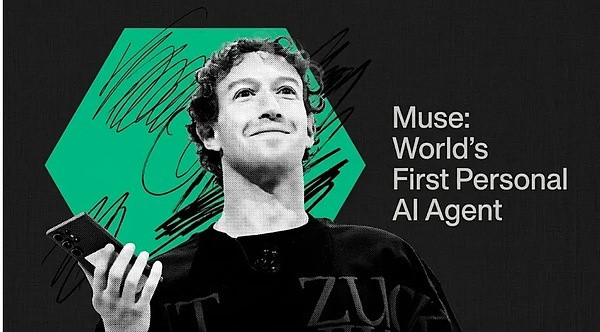
On September 8th, US local time, Meta launched Muse, touted as the "world's first personal AI agent," open to users aged 18 and above in the US. It can be used via iOS, Android, muse.ai, and WhatsApp, and will later be integrated into Meta's AI glasses.
The biggest difference between Muse and ordinary chatbots is that it can directly perform tasks for users.
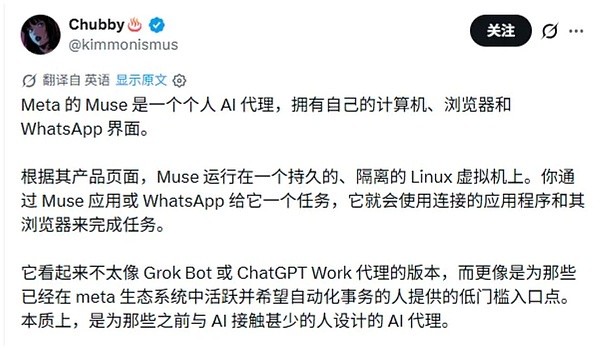
The user tells it a goal, and it can automatically open a browser, search the web, fill out forms, send emails, book trips, and purchase goods, and can even continue processing tasks after the user closes the app. Meta provides each Muse with an independent cloud-based virtual computer, containing its own browser, file system, and terminal. It can access services authorized by the user, such as email, calendar, and fitness apps, and can also remember things the user cares about based on long-term conversations. Furthermore, Muse proactively reminds users, breaks down long-term goals, continues to advance background tasks, and can also generate web pages, PDFs, documents, and interactive tools. In other words, Meta wants ordinary people to directly use AI agents, and to make the usage as simple as chatting. AI from Assistant to Executor The most noteworthy aspect of Muse is that it has begun to handle an entire task. Mona Sarantakos, Meta's product manager, mentioned that she used Muse to handle her child's preparations before the start of school during product testing. Muse diligently checked school emails and the school district website, added important dates to the family calendar, organized the necessary school supplies, found a hoodie her child wanted with a discount, and even booked dinner for the first day of school. One detail, in particular, solidified her trust in Agent's abilities. The school email contained information about her child's upcoming athletic trials, with only 12 hours left until the deadline. Muse proactively discovered this and sent her a reminder before she boarded her flight. She then contacted her husband and completed the registration four hours before the deadline. These kinds of things are difficult to accomplish in a single chat. Muse needs to continuously monitor information, identify noteworthy content, and decide when to remind users. Therefore, Meta also designed background processing capabilities for Muse. Even after the app is closed, it can continue processing tasks assigned by the user. It only returns to notify users when it discovers new important results or needs user approval for the next step. Users can also assign multiple tasks simultaneously without waiting for Muse to complete the previous one. To make these background tasks visible, Meta added an activity log. Users can click on Muse's avatar to see what it is doing, what it has already done, and what permissions it has previously granted. For tasks that take a long time, Muse also has a separate Goals page. It allows you to break down a large goal into multiple steps and continuously track progress. These design elements demonstrate that Meta aims to solve the problem of "how to get AI to continuously perform tasks for the user." Roberto Nickson, an early adopter in the technology and creative fields, believes that personal AI agents have always lacked true product-market fit after receiving early access to Muse. Muse's advantage lies in Meta's vast amount of social relationships and application data. He is particularly optimistic about Muse's performance in online shopping and local recommendations. However, he also stated that he is not yet certain whether Muse will immediately become his primary AI agent used daily. Giving AI a computer: Muse can connect to email, calendar, and fitness apps, as well as Meta's own services such as Instagram and Facebook. On the web, users can search for information, browse websites, fill out forms, and book tickets and make purchases. For example, in Meta's demo video, Muse noticed a flight ticket price had dropped by $40 and then prompted the user to rebook. It also proactively reminds users of upcoming golf tee times and tells them which hole on the course is the most difficult. In shopping scenarios, Muse can find products, compare and select items, and ask the user for their opinion before final payment. If the user has saved a recipe from Instagram, Muse can also compile it into a shopping list, plan menus for parties, remember friends' dietary restrictions, and assist in sending invitations. More complex tasks rely on Muse's own file system and terminal program. Based on these, it can write its own code and create the tools needed to complete the task. It can also generate PDFs, web pages, and other "artifacts." For example, if a user wants to record expenses, Muse can create a continuously updated expense tracking tool; when preparing to study, it can create an interactive learning guide. When designing Muse, the Meta product team also added an Ideas feature. Early testing revealed that Muse offered too many options, leaving some users unsure where to begin. Therefore, the system proactively suggests possible actions based on the user's goals, long-term conversations, and established habits. The interaction method for Muse was also adjusted. It employs a long-lasting main dialogue that users can interrupt at any time and assign multiple tasks consecutively. For projects requiring independent context, Meta has added side chats. AI analyst @kimmonismus believes that Muse is positioned more as a low-barrier entry point for ordinary users to access personal AI agents. It has its own computer and browser and can also be used via WhatsApp. For users already active in the Meta ecosystem, this access method may be easier to learn than AI agents that require learning complex operations.
Giving permissions to AI?
Letting AI directly handle email, shopping, and payments also raises the biggest problem. If an intelligent agent can open web pages, fill out forms, send emails, and even shop for you, the impact of its mistakes is much greater than that of a regular chatbot.
To address this, Meta designed an independent security architecture for Muse.
Each user has their own Muse Secure VM, which is an independent cloud-based virtual machine. Muse and user data are stored within it, and other users' agents cannot access it. This virtual machine also contains an independent Sentinel agent. When Muse wants to access the internet, it must obtain Sentinel's approval. In situations requiring user decision-making, the system will ask further questions. Passwords and payment information are not directly exposed to Muse. After a user connects to the service, their credentials are stored securely. Muse can access these credentials, but cannot see the actual password. Meta also states that passwords entered by the user in their browser will not be seen by Muse. For sensitive operations such as sending emails or making purchases, Muse will require user confirmation. Meta also provides access control for users. For example, an email account can be restricted to Muse for reading only, or it can be allowed to draft and reply to emails on behalf of the user. Muse also provides a complete log of operations, allowing users to see what it has done and what it is about to do. Meta states that users can choose not to allow Muse's interaction data to be used to train Meta's AI models. Conversation and virtual machine data within Muse will also not be provided to Meta's advertising system. Later this year, Meta also plans to launch the Muse Confidential VM. At that time, the entire virtual machine, including user data and conversations with Muse, will be encrypted using a key held only by the user, and even Meta will not be able to access it. Beyond security, Meta has launched a public bug bounty program. Previously, the company had been searching for issues internally through real-world testing, AI agent red team testing, and a private bug bounty program. Betting on a billion-user entry point. Muse is not intended to be a more powerful AI assistant, but rather to bring a personal AI agent—like Jarvis from the Iron Man movies—to users of Meta's services. Meta's Chief AI Officer, Wang Tao, stated that making the product simple and easy to use is one of Muse's design principles. It doesn't require users to have technical experience; instead, it aims to allow ordinary people to directly use AI agents through a chat-like approach. Pricing also reflects this positioning. Most of Muse's features are offered for free, while users with higher computing needs can choose a $20 or $100 monthly subscription. Meta anticipates that most users will remain on the free version. This is also what distinguishes Meta from many current AI agent products. The latter's use cases are still more focused on programming and business tasks, and a mature product model has not yet been formed in the consumer market. Meta hopes that Muse will be geared towards everyday life from the outset, packaging personal AI agents as consumer products that ordinary users can understand and use. Another advantage Meta possesses is its vast application gateway. Muse can already connect to services such as Instagram, WhatsApp, Gmail, Google Calendar, Google Drive, Ticketmaster, and OpenTable. For other services with APIs, users can also allow Muse to create custom connectors. For Meta, this means that Muse doesn't need to cultivate entirely new user scenarios; it can directly integrate into applications and services that users are already using. This aligns perfectly with Mark Zuckerberg's previous vision for personal AI. He has stated that in the future, everyone will have a highly capable personal AI agent that understands their goals and concerns. Muse is Meta's first product to present this vision as a consumer product. Technology analyst Kyle Reidhead believes that consumer AI agents are becoming the next major trend in the AI industry. Following Grok, Meta launched Muse, and Apple and Google are also expected to continue incorporating similar capabilities into their phones and systems. He predicts that the large-scale use of agents will continue to drive up computing demands, and with the future popularization of digital agents, the demand for computing power from physical AI such as robots will be even higher. However, Meta itself acknowledges that it is still in its early stages. Muse needs sufficient application permissions to truly function; and the more permissions it has, the higher the user's demands for privacy and security. Meta is currently choosing to make the entry point simple enough, and then using virtual machines, access control, Sentinel, and manual confirmation mechanisms to mitigate risks. If users are willing to delegate more daily tasks to Muse, then the personal AI agent has the opportunity to transform from a new feature into a tool used every day. Early adopter @alanchen on X believes that Muse's most outstanding feature is its ability to truly and continuously work around user goals while placing security and privacy at the core of the product. This is also the most noteworthy aspect to observe in the next stage of Muse's development. Technically, it can already handle many tasks that previously required users to complete manually; product-wise, Meta is also working to lower the barrier to entry. However, whether a personal AI agent can ultimately become a frequently used tool depends on whether users are willing to use it long-term and gradually entrust it with more real-life tasks. For Meta, the value of Muse therefore lies not only in adding another AI product. It's more like an entry point test for billions of users: if a personal AI agent can enter daily applications, Meta has the opportunity to further integrate AI from chat windows into users' daily lives.