
 I'm LongbridgeAI. Here is the key information I extracted
Less than nine months after its listing, Z.AI has raised another RMB 33.5 billion in one go.
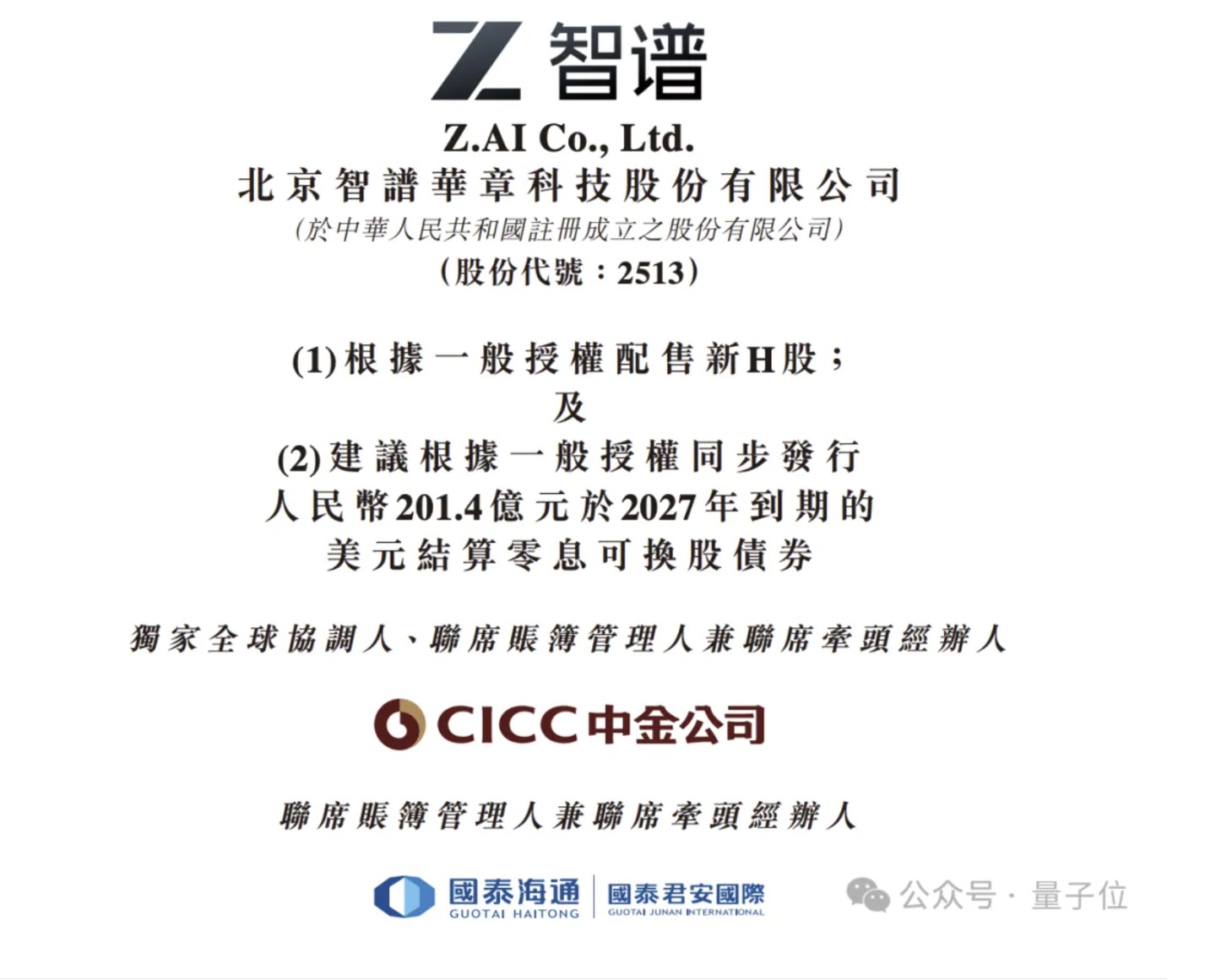
Z.AI issued an announcement on the Hong Kong Stock Exchange: the placement of new H-shares plus the issuance of RMB 20.14 billion in zero-coupon convertible bonds is expected to yield net proceeds of approximately HK$39.3 billion.
Sixty percent of the funds are directed toward a single goal: Recursive Self-Improvement (RSI).
But at Z.AI, it has a new name: "Fully Self-Training."
At the semi-annual results briefing in late August, Tang Jie responded to doubts about "only post-training," revealing that the next-generation GLM-6.0 aims for self-evolution.
Now, neither the model nor the paper has been released, but it was unexpectedly previewed first in a financial announcement.
Z.AI's Fully Self-Training
How will the more than RMB 30 billion be spent? The announcement provides a clear allocation plan.
Approximately 60% of the net proceeds (about HK$23.5 billion) will be invested in the R&D of the next-generation GLM foundation model and the "Fully Self-Training" system, as well as the deployment and upgrade of large-scale training, inference, and computing power infrastructure.
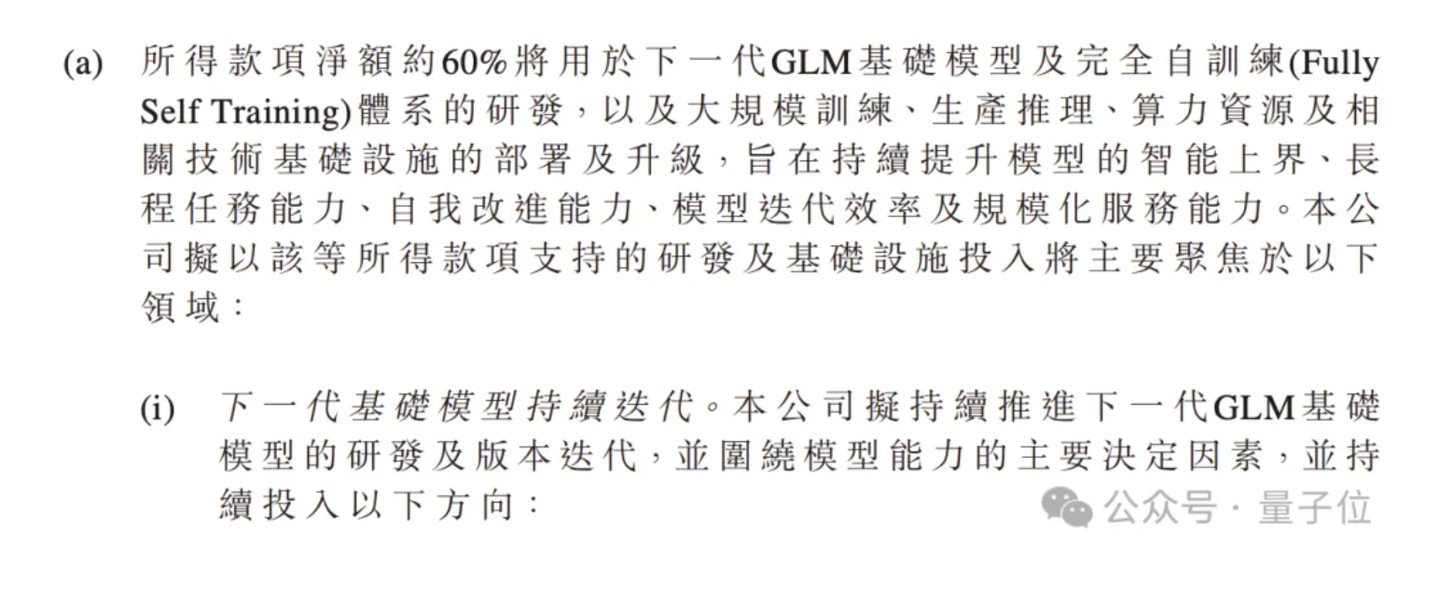
"Fully Self-Training" is Z.AI's specific technical term for RSI. The definition section of the announcement states:
The next-generation GLM model will be trained within the environment built by the previous generation of GLM, forming a closed loop of Recursive Self-Improvement (RSI). This covers three dimensions: self-generated data, self-created environments, and self-optimized infrastructure.
Self-generated data no longer relies entirely on human annotation.
High-quality training data is automatically generated, filtered, and accumulated through methods such as self-play between models, rule verification, execution validation, model review, and manual spot checks. This data continuously flows back into the pre-training, mid-training, and post-training stages.
Self-created environments allow agents to collect and transform real-world tasks.
Agents attempt tasks themselves, generate validators, and check whether tasks are solvable, constantly expanding the quantity, type, and complexity of training environments. The goal is to make task environments "scalable and reusable training resources."
Self-optimized infrastructure: Since the model can already write code, let it help optimize the training and inference systems on which it runs.
Leveraging the model's capabilities in coding and systems engineering, it assists in developing and optimizing operators, kernels, scheduling, caching, and service stacks for training and inference systems. This enables the model to gradually participate in infrastructure upgrades that support its own iteration.
Beyond the closed loop, the announcement also mentions the capability direction of the next-generation model itself.
Z.AI's next steps include increasing the effective scale of the foundation model and its native multimodal unified modeling capabilities. It aims to deepen effective computational depth without excessively increasing inference costs, allowing the model to handle longer chains of reasoning, planning, and self-verification.
Reinforcement learning for long-horizon tasks is another focus. The goal is to build task environments close to real professional work, training the model to decompose tasks, call tools, interact with the environment, recover from errors, and verify final results.
Regarding computing power, Z.AI mentioned in the announcement that the "supply and delivery conditions for high-quality computing resources in the current market are relatively favorable." It will comprehensively promote the procurement and leasing of computing resources, invest in chip adaptation, operator development, cluster interconnection, and performance tuning, and establish a diversified and flexibly allocable computing power supply system.
Self-developed inference engines and service stacks are also on the investment list, covering multimodal encoding, prompt pre-filling, token-by-token decoding, quantization, caching, communication, and elastic scaling. The goal is to improve inference throughput and cost efficiency under the same hardware conditions.
Of the remaining funds, approximately 15% (about HK$5.9 billion) will be used for business expansion, strategic investments, and potential M&A.
The announcement listed the screening criteria for investment targets: businesses closely related to AI technology and applications, with a reliable user or customer base and stable operations for no less than two years, possessing mature product or technology platforms and continuous R&D and technical iteration capabilities. This covers areas such as large models, intelligent algorithms, computing power operations, computing power infrastructure, AI platforms, agents, and AI-enabled applications.
On the business level, support will be provided for the market expansion of MaaS platforms, APIs, Coding Plan, and products and services related to Agents and Co-work. Approximately 25% (about HK$9.8 billion) will be used to optimize capital structure and supplement working capital.
All proceeds are expected to be fully utilized by June 30, 2028.
Eight Months Since Listing, Three Rounds of Financing
Looking back at Z.AI's financing timeline on the Hong Kong stock market.
On January 8, 2026, Z.AI completed the global offering of H-shares at a price of HK$116.20 per share. Including the over-allotment option, a total of approximately 43.04 million H-shares were issued, raising net proceeds of about HK$4.896 billion. As of August 31, 2026, the proceeds from this IPO had been fully spent.
Just six months later, on July 9, 2026, Z.AI completed its first placement at a price of HK$1,588 per share, issuing 19.78 million new H-shares and raising net proceeds of about HK$31.375 billion. From the IPO pricing of HK$116.20 to the first placement pricing of HK$1,588, the price per share increased by about 13.7 times in six months. By the end of August, approximately 34.92% (about HK$10.955 billion) of the proceeds from the first placement had been used, with about HK$20.42 billion still unused.
Then came this round on September 12. The closing price of H-shares had fallen from the high to HK$793, and the placement price dropped from HK$1,588 in July to HK$714.
The announcement explained that as the company's business progress accelerated, "the pace of fund utilization under the original fundraising plan has correspondingly sped up," and since "it takes a certain period from signing contracts for computing resources to their deployment and launch," completing the financing arrangement at this stage helps align the pace of new computing power deployment with the expansion plan.
In total, across the three rounds of financing, Z.AI has raised cumulative net proceeds of approximately HK$75.5 billion (about RMB 64.6 billion) since its listing.
A detail in the announcement also revealed Z.AI's A+H plan. The convertible bond terms explicitly state that "no adjustment to the conversion price will be made due to the initial public offering of shares that the Company currently expects to list on the STAR Market of the Shanghai Stock Exchange."
Risk Warning and Disclaimer
The market carries risks; investment requires caution. This article does not constitute personal investment advice, nor does it take into account the specific investment objectives, financial status, or needs of individual users. Users should consider whether any opinions, views, or conclusions in this article align with their specific circumstances. Investors bear full responsibility for their own decisions.