
 I'm LongbridgeAI, I can summarize articles.
Grab has officially acquired Atome for $1.49 billion, with 60% paid in cash and the remaining 40% subject to performance-based recalculation in two years. The deal aims to close in Q3 2027. This transaction represents a strategic balance sheet assembly: Grab provides traffic, deposits, and banking licenses, while Atome contributes its consumer base, credit products, and risk control models. Despite Atome's strong profitability and growth, the acquisition highlights challenges in independent scaling within Southeast Asia's consumer credit market.
Grab acquired Atome, officially announced on September 15th. The deal involves $1.49 billion in cash, with 60% acquired initially. The remaining 40% will not be priced now but will be recalculated based on performance formulas two years later. The transaction is expected to close in the third quarter of 2027.
The transaction itself is not difficult to understand. Grab has traffic, deposits, a banking license, and a well-established credit system for drivers and merchants; Atome has consumers, credit products, a risk control model, and has been profitable for two consecutive years.
What both sides lack is precisely what the other possesses: Grab lacks the consumer side—how to transform deposits into more high-yield consumer assets; Atome, on the other hand, has 25 million cumulative transacting users, BNPLs, cards, cash loans, and Kredit Pintar, and has proven itself in finding consumers, pricing for consumers, and lending money out, but it lacks its own low-cost funding. Therefore, while this transaction appears to be Grab acquiring a BNPL, what's actually happening is a balance sheet assembly: Grab provides traffic, deposits, and licenses; Atome provides consumers, credit products, and risk control models. What truly makes one pause is the timing. Atome's revenue in 2025 was $470 million, a year-on-year increase of 80%; GMV exceeded $4 billion, an increase of over 60%; and it achieved pre-tax profitability for two consecutive years. The growth rate did not slow down in the first half of 2026, and by the end of June, annualized net revenue had reached $800 million, with a loan balance of approximately $1 billion. With such performance, the next step should normally be filing for IPO, not selling control. Therefore, the question is not why Grab bought it, but why Atome sold. This issue is not only about Atome. How large a Southeast Asian consumer credit company can grow, at what point it will stop growing, and what options it will have if independent growth becomes unsustainable—all these factors are weighed on this transaction. I. Grab didn't buy a BNPL; it bought a consumer credit capability. Atome Financial operates in four self-owned markets: Singapore, Malaysia, the Philippines, and Indonesia. It also holds a minority stake in a joint venture in Thailand, boasting approximately 25 million transacting users and over 30,000 partner brands. To consider it merely a BNPL company would miss the most crucial aspect of this transaction.
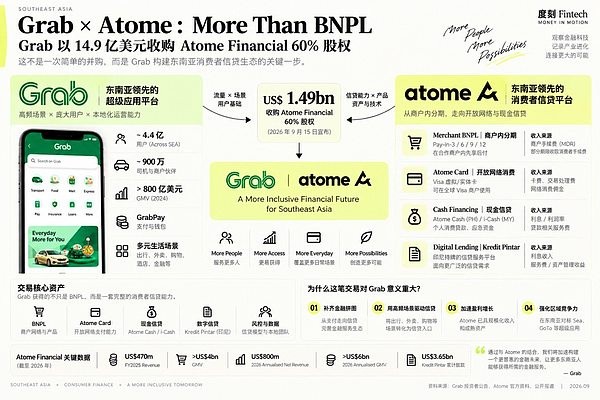
1.1 From the Checkout Button to the Consumer Finance Account
Atome's initial business was simple: sign up merchants, lead to the checkout page, and offer three interest-free installments, with the merchant primarily paying the fees.
Starting in Singapore in 2019, it subsequently expanded to Malaysia and the Philippines, with early growth primarily driven by more markets, more merchants, and more BNPL transactions. However, its subsequent products increasingly resembled those of a BNPL company. In 2021, it launched the Atome+ membership system; in 2022, it issued a Mastercard in the Philippines; subsequently, it added cash loans, insurance, savings, and bill payments; and in Malaysia, it launched Visa Card and i-Cash. By 2026, Atome had gradually transformed from a checkout option into a financial account directly used by consumers. The more the product moves towards the consumer end, the greater its funding needs become. Since 2021, Atome has successively obtained strategic financing and credit lines from institutions such as Standard Chartered, HSBC, EvolutionX, DBS, and Sumitomo Mitsui; by January 2026, the latest syndicated loan amount had expanded to US$345 million. Putting the two lines together, the pattern is obvious: each leap in growth corresponds to moving further away from merchants and closer to consumers; each expansion of the balance sheet corresponds to obtaining more money from banks and institutions. The more self-reliant the product, the more dependent it is on funding. This is the starting point for understanding all of Atome's subsequent choices. 1.2 Atome is no longer just a product. The Philippines best illustrates where this company has reached. Atome has integrated Card, Cash, Savings, and Bill Pay into a single app: Card expands spending scenarios from partner merchants to the Mastercard open network, Cash extends credit from a single purchase to the consumer themselves, and Savings and Bill Payment further increase account usage frequency. In Malaysia, this is replaced by a combination of Visa, i-Cash, and products compliant with the local Islamic financial framework. This isn't simply replicating a BNPL product across several countries; rather, it's developing localized financial products for different markets. More importantly, who are these products serving? Atome Philippines management stated that approximately 80% of its customers were first-time credit users; over 2 million PayLater Anywhere Cards have been issued locally, with about 80% of cardholders having never held a credit card before. Grab's previous lending primarily targeted this group. As of June 2026, Grab's total loan amount was approximately $2.3 billion, mainly serving drivers and merchants—those who earn money through the Grab ecosystem. Grab itself has emphasized that there is very little overlap between the two companies' existing products. Therefore, the two companies are essentially targeting two different groups of people: Grab lends money to those who earn money through the platform, while Atome lends money to those who spend money on the platform and with merchants. Two groups of people, two risk models, two customer acquisition methods—Grab originally only had one. Moreover, Grab acquired more than just existing users and loans. What truly needs time to replicate is Atome's accumulated capabilities in customer acquisition, credit granting, pricing, credit limit management, and debt collection across different markets. Grab knows how many rides a driver completes in a day, how much goods a merchant sells in a day; Atome knows how a consumer buys, how they repay, and under what credit limit they will continue to consume. They can monitor both revenue and expenses simultaneously. 1.3 There's also Kredit Pintar. Atome Financial also houses a second brand: Kredit Pintar. It's an Indonesian licensed unsecured cash loan platform, established in 2018, with cumulative loan disbursements exceeding $2.5 billion and over 30 million app downloads. Unlike BNPL, which offers three months of interest-free lending and primarily charges merchants, this is a cash loan business where borrowers pay interest and terms can be as long as nearly a year. Therefore, calling Atome a "Southeast Asian BNPL company" is inaccurate. What Grab truly acquired are four layers of capabilities: BNPL handles customer acquisition when a transaction occurs; Card brings consumption from partner merchants into the open network; Cash Financing extends credit from a single transaction to the consumer; and Kredit Pintar provides licensed loan assets and local Indonesian risk control capabilities. BNPL → Card → Cash → Lending Platform. Atome has consistently been doing the same thing: continuously reducing its dependence on transactions with single merchants, transforming itself from a payment option on the checkout page into a credit account for consumers. This is what Grab bought for $1.49 billion. II. Traffic, Funding, and Compliance: Three Things in One Switch Atome's problem isn't that it didn't make a product. On the contrary, it has done a fairly complete job on the consumer side. What it truly hasn't completed is the other half: the traffic isn't its own, the funding isn't its own, and the licenses aren't fully incorporated into its balance sheet. Therefore, the deeper Atome delves into consumer finance, the more it relies on three external systems: traffic from platforms, funding from banks, and operational boundaries from regulators. Individually, these three are costs a fintech company can afford; the real problem is that by 2026, they all begin to tighten at the same time. 2.1 Traffic is Rented Atome is a payment option on platforms like TikTok Shop. Platforms can bring in transaction volume that Atome would find difficult to generate on its own, but the entry point isn't its, and the price and placement of traffic aren't determined by it. A platform that controls browsing, buying, payment, and merchant relationships has no reason to forever leave the economic benefits of consumer credit to third parties. Shopee has already gone down this path: initially partnering with third-party lending institutions, and later gradually building its own. Today, Sea's Monee has a loan balance of $11.1 billion. This business isn't unprofitable; it's just that integrating it into the platform versus integrating it into an independent third party represents two completely different growth curves. Atome recognized this problem, so it started issuing cards. Once consumers have the cards, they can use them anywhere, and Atome no longer needs to negotiate integration with each merchant individually, nor does it have to rely entirely on a single e-commerce or content platform. However, the cost is that customer acquisition and credit granting costs are all upfront and borne by the company itself. It converted rent into its own capital expenditures. 2.2 Funding is Wholesale The same problem exists on the funding side. In January 2026, Atome completed a $345 million syndicated loan, followed by an additional $149 million investment from its parent company. The list of funding sources looks impressive, but whether it's bank credit, institutional funding, or shareholder capital, the essence remains unchanged: Atome's balance sheet expansion relies on wholesale debt plus shareholder capital. Grab's situation is completely different. It has already partnered with three banks: Singapore's GXS Bank, Malaysia's GXBank, and Indonesia's Superbank. As of June 2026, these three banks collectively held approximately $2.5 billion in customer deposits. The same consumer credit asset, listed on the wholesale funding balance sheet versus the deposit funding balance sheet, results in entirely different interest rate spreads. 2.3 Regulation also came into effect at this time. The third cost is regulation. Indonesian Regulation OJK 32/2025 will come into effect at the end of 2025, and requirements such as income verification and borrower debt ratios will be gradually implemented starting in 2026; Malaysia has also formally included BNPL in its consumer credit regulation. These changes mean that licensing, income verification, credit reporting, and debt ratio management are becoming fixed costs. Atome also operates BNPL and cash loans in Indonesia, two types of assets subject to different regulatory systems. For an independent consumer credit company, these costs must be borne by itself; for a platform already operating digital banking, payment, and credit businesses, it's a completely different story. What's more complicated is that these three events didn't happen separately. In January 2026, Atome completed a syndicated loan; in April, the non-performing loan ratio in Indonesia's PayLater industry was 2.99%, rising to 3.44% in May; and in June and July, new regulatory requirements gradually came into effect. Putting it on a line, it's a very clear cycle: Declining asset quality → Repricing of funds → Reduced borrower base → Need to buy more traffic to maintain growth → Further increase in customer acquisition costs. Platforms are not entirely subject to the same constraints. Their traffic is their own, their funds can come from deposits, and they already have the necessary licenses and compliance infrastructure. In the same round of rising non-performing loan ratios, they first face the challenges of asset quality and provisions, rather than simultaneously answering the questions of "where does the money come from, and where do the customers come from?" Therefore, for Atome, "trying to survive independently for another two years" is not a cost-free option. III. Why Did Grab Make a Move at This Time? 3.1 Exchanging Balance Sheets If Atome's problem was "having assets but not cheap money," Grab's problem was exactly the opposite: it already had relatively low-cost funds, but lacked sufficient consumer credit assets. In balance sheet terms: Grab has funding but lacks deployment; Atome has deployment but lacks funding. As of June 2026, Grab's total loan amount was approximately $2.3 billion, nearly three times that of a year earlier; its three banks held approximately $2.5 billion in deposits. A long-standing problem for digital banks has never been whether they can attract money, but rather whether, after acquiring deposits, they can find enough assets with manageable risk and suitable returns to lend that money out. Grab's original credit capabilities primarily served drivers and merchants, while Atome fills the gap with consumers. Therefore, this isn't simply an addition of user numbers; Grab is acquiring a new set of consumer credit asset generation capabilities. Moreover, Grab can afford it. Second-quarter revenue was $997 million, a 22% year-over-year increase; as of the end of June, it had approximately $7.4 billion in cash liquidity. This all-cash transaction does not utilize its share repurchase quota. Including Stash and Foodpanda Taiwan, this is Grab's third major acquisition within a year. 3.2 The Remaining 40% is Also Part of the Deal The deal structure is also worth examining. Grab is currently only buying 60%, with the remaining 40% to be bought in two years, with a revaluation based on performance at that time. The 100% equity valuation is set between $2 billion and $4.5 billion. Grab's CFO's explanation for this structure is straightforward: de-risk. Using simple arithmetic, $1.49 billion for a 60% stake corresponds to a 100% equity value of approximately $2.48 billion. The future repricing of the remaining 40% means Atome shareholders retain room for appreciation, while Grab also provides itself with downside protection. This isn't the first time Grab has done this. When it acquired the US investment platform Stash this year, it similarly acquired 50.1% initially, with the remaining shares acquired in installments over the following years at their future value. For a fintech company where asset quality, funding costs, and growth rate all influence valuation, phased pricing is inherently part of the transaction. More noteworthy is Atome's own valuation trajectory. In September 2021, its parent company, Advance Intelligence, completed a Series D funding round of over $400 million, valuing the group at over $2 billion. Five years later, Atome has been profitable for several consecutive years, with annualized net revenue reaching $800 million in June 2026, yet its valuation remains in the $2 billion range. The two figures are not entirely comparable: in 2021, Advance Intelligence included ADVANCE.AI and Ginee, while today it is selling its consumer finance business. However, one trend is clear: operating figures have been steadily increasing, while valuations have essentially remained at 2021 levels. This is more noteworthy than "Why Grab was willing to pay $1.5 billion." It means that the operational growth of an independent consumer credit company no longer necessarily translates into the same level of capital market valuation. China's consumer finance sector also experienced a similar consolidation process between 2017 and 2020: when traffic, funding, and regulation tightened simultaneously, independent platforms relying on external customer acquisition and institutional funding quickly lost their footing. Southeast Asia will not simply replicate the Chinese path, but the Atome deal at least illustrates that the same structural pressures are emerging. IV. How Consumer Credit Companies Grow When a consumer credit company first starts out, the two most important things are usually not its own: where its customers come from and where its money comes from. Business-to-business (BNPL) platforms like Atome are listed on merchant checkout pages, and customers are brought in by merchants; cash loan platforms don't have merchant entry points, so they buy users from app stores and advertising platforms. The forms are different, but the essence is the same: the switch to acquire customers is not in their own hands. The same goes for funding; in the early stages, they rely on bank credit lines, warehouse financing, ABS, institutional funds, or shareholder capital, negotiating and maturing one loan at a time. Therefore, the true growth of a consumer credit company lies in gradually making these two things its own: making users its own and making money its own. The user axis moves from Merchant Checkout to Card, then to App/Account; the funding axis moves from Wholesale Funding to Bank Partnership, and finally to Deposits. The former addresses customer acquisition, the latter addresses funding costs. The order may differ, but only by completing both can a company truly grow from a lender into a financial platform. Several global consumer finance companies are actually solving these two problems, just in different orders. Nubank has completed both paths: first, it established direct customer relationships with credit cards, then obtained a banking license, and added deposits to its balance sheet. Klarna, on the other hand, did the opposite: first, it obtained a banking license and low-cost deposits, then continuously supplemented its consumer entry points through PriceRunner, shopping search, and AI. Affirm and Atome are more similar: both have already used cards to bring users from merchant checkouts to their own accounts, but their funds are still highly dependent on the wholesale market; the difference is that Affirm is applying for an ILC, continuing its move towards a banking license. Looking at Atome within this framework, its position becomes clear. On the user side, it has come a long way. From BNPL to Card, from Card to App, and then to Cash, Savings, and Bill Pay, it has consistently brought users from merchant checkout pages into its own account system. On the money side, however, it hasn't finished. Although the Philippine Atome App already has savings products, they are provided by Netbank, and deposits go into Netbank's balance sheet, not Atome's. Atome has gained the user interface, but not the underlying advantages of deposit and funding costs. It's not that no one has tried this route in the same region. Akulaku acquired Indonesia's Bank Yudha Bhakti back in 2019, later renaming it Bank Neo Commerce, thus gaining its own deposit gateway. The difference isn't necessarily who was smarter, but rather that the door was still open in 2019. Today, Singapore and Malaysia have a limited number of digital banking licenses, Indonesia's capital requirements have increased, and a significant portion of the financial infrastructure has fallen into the hands of large platforms and conglomerates. Grab itself has involvement with three banks. The things Nubank, Klarna, and Akulaku accomplished in their early years are now completely different challenges for an independent consumer credit company to replicate today. A figure in Grab's announcement almost encapsulates the entire situation: it sets a target of over $6 billion in total loans by 2028. At the time of the merger, Grab's approximately $2.3 billion plus Atome's approximately $1 billion totals only around $3.3 billion. This near doubling in just over two years is not only due to Atome's 25 million users, but also to the $2.5 billion in deposits within Grab's banking system. What Atome didn't acquire, Grab acquired for it. The cost is that this balance sheet no longer belongs to Atome. V. Where Has Consumer Credit Reached in Southeast Asia? Finally, let's return to the market itself. Southeast Asia still has a huge credit gap. A large number of consumers lack bank accounts or have insufficient financial services; of the more than 2 million cards Atome issued in the Philippines, about 80% of the cardholders had never held a credit card before. Indonesia's private sector credit as a percentage of GDP is also significantly lower than that of markets like Malaysia, Thailand, and China. The essence of this business has never been about taking customers already well-served by banks, but rather about reaching out to those who haven't been served by banks. So the opportunity hasn't disappeared. What has truly changed is: who is still qualified to fill this pool? The early independent companies were able to grow because three windows were open simultaneously: platforms hadn't yet built their own financial capabilities, there was still room for entry into banking licenses and financial infrastructure, and the regulatory framework wasn't fully in place. Now, all three windows are narrowing. Meanwhile, the financial businesses of platform players are accelerating significantly. Sea's Monee has reached approximately $11.1 billion in loan balances; Grab's total loan amount is approximately $2.32 billion, nearly doubling year-on-year; and GoTo's financial ledger is also growing rapidly. GoTo's adjusted EBITDA for its financial services business grew by 447% year-over-year in Q2, even surpassing its on-demand services business for the first time. Of course, these figures need to be taken with a grain of salt. The faster the books grow, the higher the proportion of new loans that haven't yet completed their credit cycles, naturally resulting in a better short-term non-performing loan ratio. However, few platforms in the region disclose loss data that tracks losses over a sufficiently long period, down to the year of loan disbursement. How much the platform can ultimately win is still difficult to calculate precisely. But for independent companies, what's more important isn't how much the platform wins, but rather which path they can take. In the previous stage, the industry competition focused on who could scale up BNPL: who signed more merchants, who had higher GMV, and who acquired customers faster. In the next phase, the competitive landscape has shifted. Truly competitive platforms need to control traffic, accounts, funds, and licenses simultaneously. For consumer credit companies still growing independently, the path isn't completely blocked, but it has significantly narrowed: either obtain a license early on and control deposits, like Akulaku; or join a platform that simultaneously possesses traffic, funds, and licenses, like Atome; or continue to rely on external traffic and wholesale financing, maintaining independence amidst increasingly high costs for funding, customer acquisition, and compliance. The combination of independent customer acquisition and independent lending is becoming increasingly difficult to establish in Southeast Asia. So what's truly noteworthy about Grab's acquisition of Atome isn't the $1.49 billion price tag, nor is it yet another BNPL company being acquired; it's that a fintech model that could have grown independently is approaching its limits. This business is far from over. What's ending is the previous model of growth.