
 I'm LongbridgeAI, I can summarize articles.
President Trump signed a voluntary AI safety pact with top tech CEOs, including Zuckerberg and Musk. The agreement mandates independent audits, stronger internal controls, and board-level oversight for frontier AI systems. While not legally binding, it leaves room for future regulation. Tech leaders praised the move as a significant step toward responsible AI development.
On Tuesday, President Donald Trump brought leaders of some of the world’s biggest AI companies together around a voluntary safety pact calling for independent audits, stronger internal controls and board-level oversight of advanced AI systems.
Trump’s AI Safety Accord
In a Truth Social post, Trump released the White House Accord on Super Intelligence, also described as a "Joint Commitment on Frontier Responsibilities," after hosting leading technology executives at the White House.
The agreement was signed by Trump and Alphabet Inc. (NASDAQ:GOOG) (NASDAQ:GOOG) CEO Sundar Pichai, Anthropic CEO Dario Amodei, Meta Platforms, Inc. (NASDAQ:META) CEO Mark Zuckerberg, OpenAI president Greg Brockman, Space Exploration Technologies Corp. (NASDAQ:SPCX) xAI CEO Elon Musk and Nvidia Corp. (NASDAQ:NVDA) CEO Jensen Huang, according to the document.
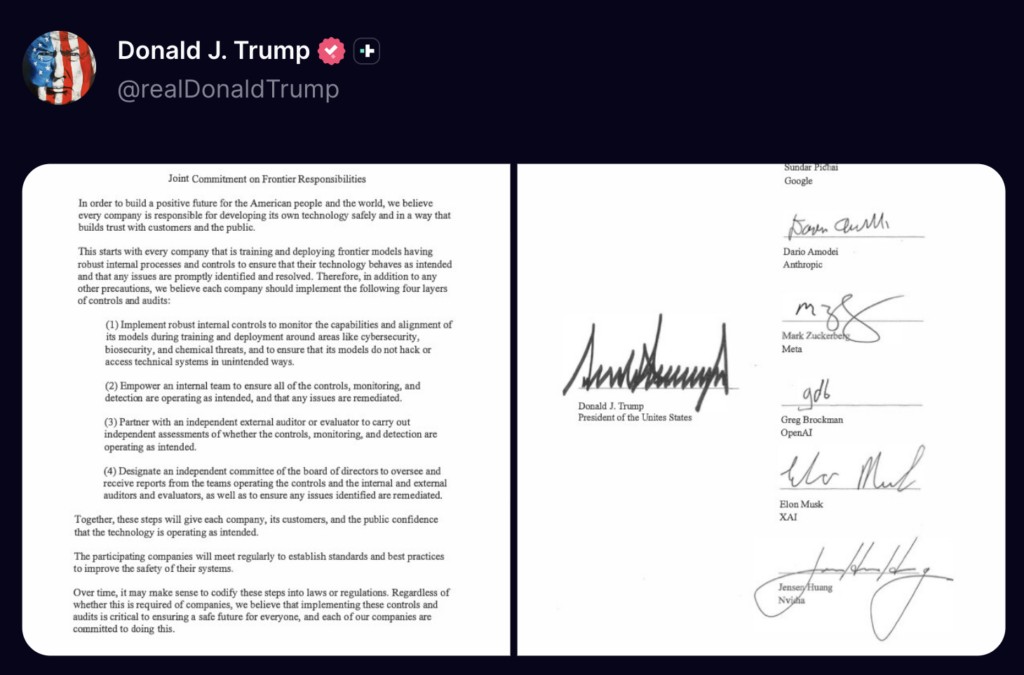
While speaking with reporters, Trump described the pact as "morally binding," adding that companies should take responsibility for policing their own AI development.
Read Also:Anthropic IPO Prospectus Spends 80 Of 261 Pages On Risk, Warns AI Could Pose ‘Catastrophic or Existential Risks’ to Humanity
What OpenAI, Anthropic and Others Agreed To
The accord outlines four layers of controls for companies developing frontier AI models.
Companies are expected to establish internal systems to monitor AI capabilities and alignment during training and deployment, particularly for risks involving cybersecurity, biosecurity and chemical threats.
They also agreed to use independent external auditors or evaluators to assess whether those safeguards are working as intended.
A separate independent committee of each company’s board would oversee the process and receive reports from internal teams and outside auditors.
Companies would also maintain internal teams responsible for ensuring their monitoring and detection systems continue to function properly.
Could AI Safety Rules Become Law
The accord leaves the door open to future regulation, stating that "it may make sense to codify these steps into laws or regulations" over time.
The participating companies also agreed to meet regularly to develop safety standards and best practices.
Taking to X, Zuckerberg called the agreement a "significant positive step," saying multiple layers of audits and reviews could give the public more confidence in advanced AI systems.
I think it's a significant positive step that the leaders of every major American lab have committed to implementing robust internal controls and multiple layers of audits and reviews. This should give people more confidence that the technology each lab is building will work as… https://t.co/01onnEUrjP
— Mark Zuckerberg (@finkd) September 30, 2026
Musk responded to his post, saying, "Yes."
Former White House AI and Crypto Czar David Sacks also took to X and said, "This is far better than waiting years for some international agreement that would probably never happen."
Only President Trump could convene all the leaders of the top companies developing chips, data centers and frontier models for Super Intelligence. This new Industrial Revolution has already created a million new jobs and is spurring a bigger infrastructure build-out than the… pic.twitter.com/tih4YNXmYt
— David Sacks (@DavidSacks) September 29, 2026
Disclaimer: This content was partially produced with the help of AI tools and was reviewed and published by Benzinga editors.
Read Also:Alexandr Wang Praises Meta's Muse for Tackling an Everyday Neighborhood Problem: 'Seriously Awesome Use Case'
Photo: IAB Studio / Shutterstock
Login to unlock2,568characters for free
Due to copyright restrictions, please log in to your Longbridge account to view this content.
Thank you for your understanding and support of licensed content.