
 I'm LongbridgeAI, I can summarize articles.
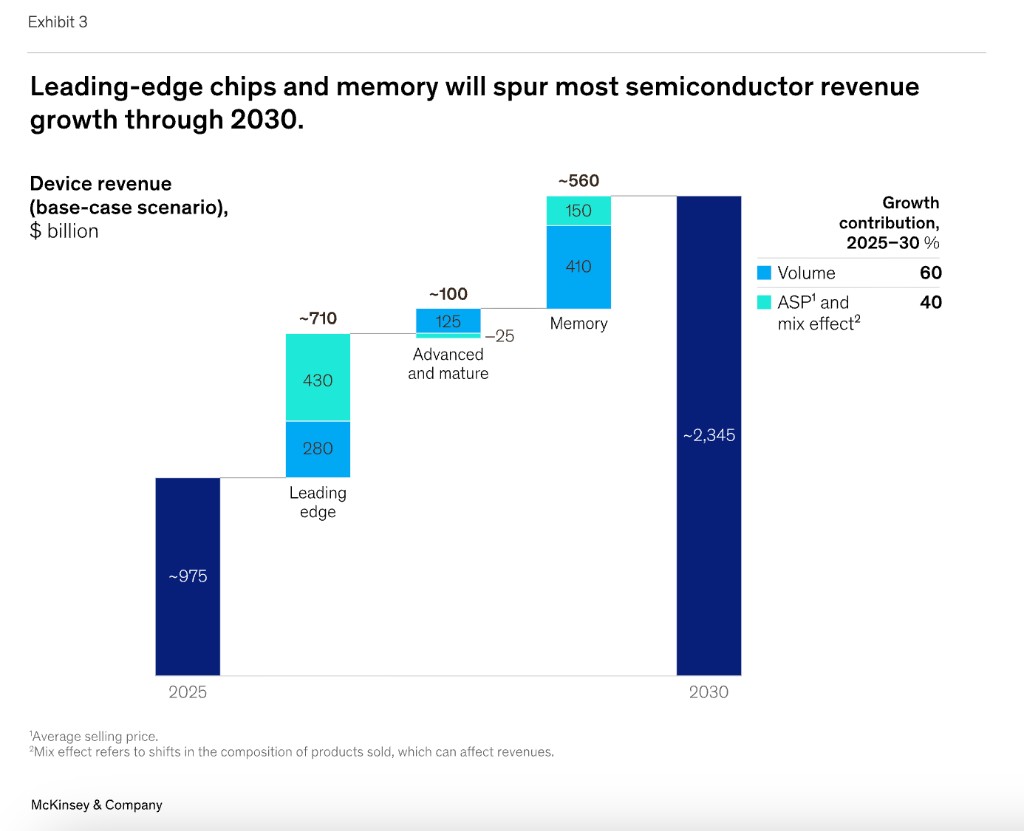
McKinsey expects wafer shipments to grow at an average annual rate of about 7% in the coming years, but prices for advanced-node chips and memory will rise significantly, becoming the main driver of market expansion. By 2030, advanced-node chips and memory are projected to contribute incremental value of approximately $710 billion and $560 billion, respectively
The semiconductor industry is undergoing a structural shift driven by AI demand: McKinsey has significantly raised its forecast for the global semiconductor market size in 2030, yet the growth rate for shipments has not been markedly increased, with price hikes becoming the primary driver of market expansion.
McKinsey’s latest research raises the baseline forecast for the 2030 global semiconductor market size from $1.6 trillion (as of autumn 2025) to $2.3 trillion, an increase of approximately 44%. During the same period, global wafer shipments are expected to maintain an average annual growth rate of about 7%, largely consistent with previous forecasts. This means that the additional market value stems more from rising ASPs for advanced-node chips and memory rather than pure shipment growth.
AI infrastructure investment is the core driver of this change. The five major hyperscale cloud service providers plan to spend a combined total of approximately $800 billion on capital expenditures in 2026, rising further to $1 trillion in 2027, with the vast majority directed toward AI infrastructure, continuously pushing up demand and prices for advanced-node chips and memory.
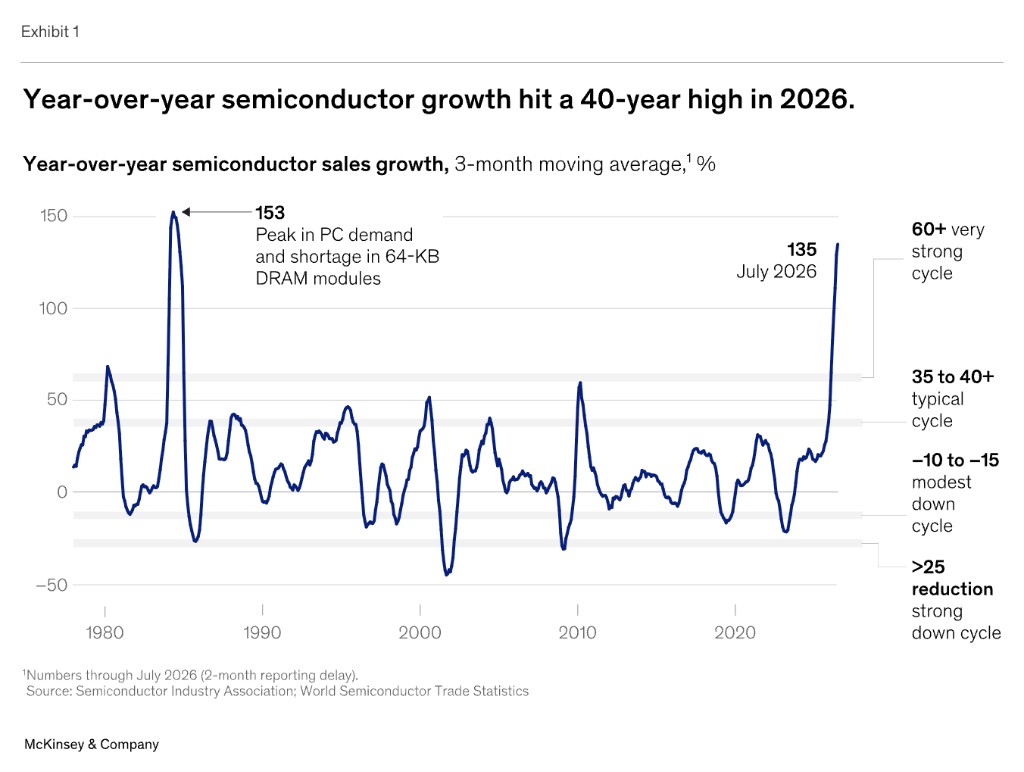
In the first half of 2026, the year-over-year growth rate of global semiconductor sales hit its highest level since the mid-1980s, reaching a 40-year high in July; shortly thereafter, global semiconductor market revenue surpassed $1 trillion for the first time.
Market Size Forecast Raised by 44%, Shipment Growth Not Significantly Accelerated
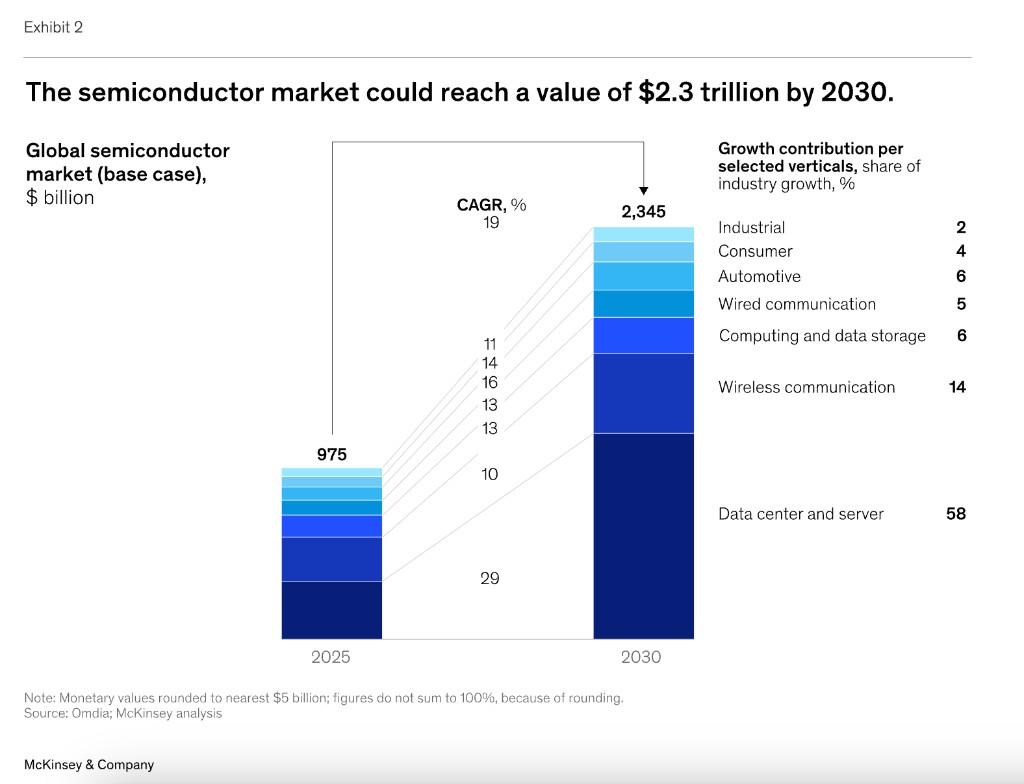
McKinsey has raised the CAGR for the global semiconductor market from 2025 to 2030 from the previously forecast 13% to 19%, significantly higher than the historical average of 9% from 2014 to 2024. Its forecast range is $1.7 trillion to $2.6 trillion, with a baseline scenario of $2.3 trillion.
This forecast includes fabless companies, OEMs developing their own chips, and vertically integrated chip enterprises in its statistics, and incorporates more detailed data on Chinese companies, which may result in higher forecast values compared to some other institutions. Another major analysis firm also expects the market size to reach $2.3 trillion by 2030, while two other firms have forecast ranges of $1.7 trillion to $2 trillion.
More notably, revenue growth and shipment growth are becoming "significantly decoupled." McKinsey expects the overall wafer volume CAGR to be around 7% by 2030, roughly similar to the autumn 2025 forecast, and not synchronously increased despite the substantial upward revision of the market size forecast.
This implies that the upward revision of the 2030 market size from $1.6 trillion to $2.3 trillion is mainly driven by ASP increases and changes in product mix, rather than a significant surge in chip shipments. If AI demand continues to expand, the semiconductor industry's long-standing growth model dominated by capacity cycles may change.
Advanced Node ASPs Rise Against Historical Trends
Server and data center chips will become the fastest-growing segment. McKinsey expects revenue in this market to increase from $330 billion in 2025 to $1.2 trillion in 2030, with a CAGR of 29%; wireless communication chips rank second, with expected incremental revenue of approximately $205 billion and a CAGR of 10%.
Regarding advanced nodes, McKinsey defines nodes of 7nm and below as advanced nodes and points out that their ASP trends have reversed historical patterns. In the past, wafer ASPs typically declined continuously during the first two years after product launch; for example, 28nm process wafers saw an annual decline of about 10%, and 150nm process wafers about 25%.
Today, however, 3nm and 5nm wafer ASPs are rising at an annual rate of 2% or higher, primarily driven by strong demand for AI and high-performance computing, coupled with limited advanced capacity. By 2030, ASP increases, shipment growth, and changes in product mix are expected to jointly bring approximately $710 billion in incremental value for advanced-node chips.
DRAM Prices Cumulatively Rise Six-Fold, Memory Contributes $560 Billion in Incremental Value
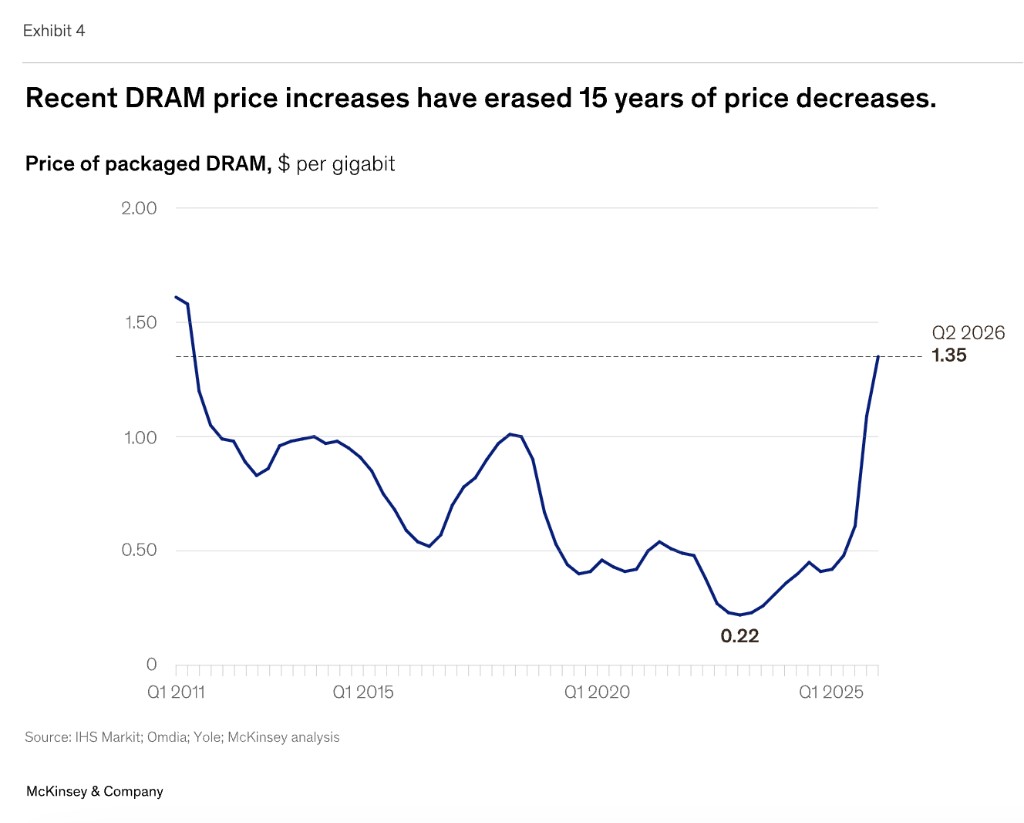
Price changes in memory are even more pronounced. AI model training and inference require large amounts of high-capacity, high-bandwidth storage, with HBM particularly constrained by supply. Since early 2023, DRAM prices have cumulatively risen by about six times, with ASPs returning to their 2011 highs; calculated based on historical price levels corresponding to the same production growth rates, current DRAM ASPs are approximately 550% higher.
Supply cannot be released quickly in the short term. McKinsey expects that if certain long-term supply expansion measures proceed smoothly, memory supply may begin to catch up with demand around 2027, causing prices to subsequently trend downward, though they may still remain above historical norms.
Commercial HBM gross margins are expected to decrease from about 80% in 2024 to about 50% in 2030, mainly due to intensified competition in the accelerator market rather than a decline in ASPs. Even so, memory is still expected to contribute approximately $560 billion in incremental market value, becoming an important source of AI-driven semiconductor growth.
Mature Nodes See Volume Increase and Price Decline, Contributing Relatively Limited Growth
Mature nodes and other chips will also benefit from the expansion of AI infrastructure, including Field-Programmable Gate Arrays (FPGAs) that can flexibly adapt to AI architectures, interconnect and data flow components, and data center power electronics. Sub-sectors such as photonics and power devices are also expected to grow relatively quickly.
However, overall, the growth momentum in this segment is far weaker than that of advanced-node chips and memory. Shipments will continue to increase, but ASPs are expected to continue declining, with this segment projected to contribute only about $100 billion in incremental value by 2030.
Thus, McKinsey’s upward revision is not simply an increase in semiconductor shipment expectations, but a re-evaluation of the impact of the AI supply-demand gap on chip prices and product structure. With no significant upward revision in shipment growth rates, rising ASPs for advanced nodes and memory are becoming the main forces driving the semiconductor market size beyond $2 trillion.