
 I'm LongbridgeAI. Here is the key information I extracted
Artificial intelligence is spawning the largest infrastructure investment wave in US history, with a scale so vast that it dwarfs all previous historical precedents.
According to the latest research from the Brookings Institution, total investment in US AI data center construction between 2025 and 2032 will reach $10.3 trillion, averaging approximately 3.63% of GDP annually. This ratio is not only 1.6 times the peak of the railway era but also more than three times that of the internet and telecommunications boom. Stijn Van Nieuwerburgh, a professor at Columbia Business School, points out that the macroeconomic impact of this investment wave will be profound and cannot be ignored.
Massive capital expenditures are also changing how AI construction is financed. AI investments by hyperscale cloud providers like Meta and Microsoft have exceeded cash flows from operating activities, with an increasing number of projects securing funding through leases, joint ventures, special purpose vehicles (SPVs), private credit, and securitization. Taking Meta's Hyperion data center as an example, approximately $30 billion in project assets carry $27 billion in debt, resulting in a project-level debt-to-asset ratio of 90%, yet the related debt is not directly listed on Meta's balance sheet.
Van Nieuwerburgh does not conclude that AI has formed a bubble, and he also believes it is premature to assert the existence of systemic risk. What truly concerns him is that off-balance-sheet financing makes it difficult for the market to see the full extent of economic liabilities. Approximately $1.4 trillion in debt has been issued for such structures, with banks holding about $700 billion to $800 billion of it. If demand, revenue, or project progress falls short of expectations, it remains unclear whether the risk stays with tech companies, project shareholders, and private credit institutions, or returns to the banking system, as there is currently no disclosure and measurement framework capable of answering this question.
In its latest podcast, the Brookings Institution discussed Van Nieuwerburgh's new paper, "Financing AI Infrastructure Construction," examining the scale of AI construction, off-balance-sheet financing structures, and potential transmission risks from the perspectives of financial regulation and the subprime mortgage crisis.
Key points from the interview:
Between 2025 and 2032, total US investment in AI infrastructure, including data centers, power, and chips, could reach $10.3 trillion, equivalent to 3.63% of GDP annually.
Relative to the size of the economy, AI construction could be about 50% higher than the railway investment boom from 1870 to 1890 and more than three times the internet and fiber optic construction boom.
The estimated cost of a 100-megawatt AI training campus in 2025 is approximately $4.1 billion, with about two-thirds coming from information technology equipment and one-third from data center buildings and power infrastructure.
Meta's Hyperion project shows that hyperscale cloud providers are shifting from self-building and holding assets to leasing. Approximately $30 billion in project assets issued $27 billion in debt, achieving a project leverage ratio of 90%, but the debt remains within joint ventures and special purpose vehicles.
Hyperion utilizes five consecutive four-year leases. In the future, Meta must either renew the leases or pay a residual value guarantee, but under current accounting rules, both obligations may temporarily remain off the balance sheet, creating what Van Nieuwerburgh calls a "probability vacuum."
Approximately $1.4 trillion in debt has been issued for related structures, with about half held by banks. If the cash flow of a project with 90% leverage drops by 10%, equity could be completely wiped out; if the drop continues, it will begin to impair debt claims.
The policy focus should not be on stopping AI investment but on establishing a comparable disclosure system to track asset owners, debt holders, lease signatories, and guarantors, and to identify risk connections between banks, insurance companies, pension funds, bond funds, and private credit.
Unprecedented Scale: AI Investment Crushes All Historical Precedents
Van Nieuwerburgh estimates that the annual investment scale for US AI data center construction between 2025 and 2032 will be approximately 3.63% of GDP. For comparison, during the peak of US railway construction (1870–1890), annual investment accounted for about 2.2% of GDP; the interstate highway system construction (1950s) and the internet and fiber optic boom were both around 1.1%; canal construction was about 0.66%; and electrification was about 0.5%.
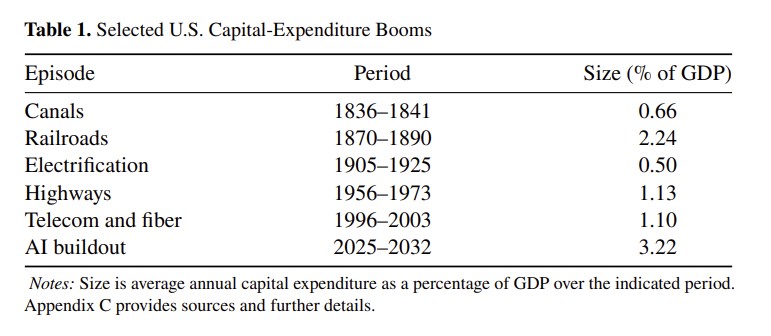
Van Nieuwerburgh stated that even with more optimistic macroeconomic assumptions, this figure is difficult to significantly reduce.
If nominal GDP growth is assumed to be 5% per year (corresponding to 3% inflation and 2% real growth), the ratio drops to about 3.5%; even if AI drives strong productivity growth and real GDP growth reaches 4%, the annual investment share would only drop to about 3%. "This number is not sensitive to a 1 percentage point change in macroeconomic variables," he said.
In terms of cost composition, the construction cost of each 100-megawatt AI training data center is approximately $4.1 billion, with about two-thirds coming from IT equipment (including servers, chips, and fiber optics) and one-third from the data center building itself and supporting power infrastructure, with costs increasing at a rate of about 4% annually.
He also cited the "Jevons Paradox" to explain why declining computing costs do not reduce overall investment demand: improvements in computing efficiency trigger larger-scale computing demand, with "a queue of use cases stretching 12 miles long," as one data center developer described the applications awaiting computation.
Off-Balance-Sheet Financing: Leverage Risk is Going "Undercover"
As capital expenditures by hyperscale cloud providers continue to exceed their own operating cash flows, financing models are undergoing a structural shift—from self-owned construction to leasing, joint ventures, and private credit. In his paper, Van Nieuwerburgh uses Meta's Hyperion data center project as an example to dissect the operational logic and potential risks of such structures.
According to the paper, Meta initially planned to build the facility itself but ultimately sold a 20% equity stake to private credit firm Blue Owl for $2.5 billion, retaining a 20% interest. The two parties jointly established a special purpose vehicle (SPV) named "Beignet," which subsequently issued $27 billion in debt against assets valued at approximately $30 billion, resulting in a project-level debt-to-asset ratio as high as 90% and a debt service coverage ratio of about 1.15x.

The key point is that since Meta holds only a minority stake in the joint venture, the debt issued by Beignet does not need to be consolidated into Meta's balance sheet, allowing Meta to present a low-leverage financial image externally.
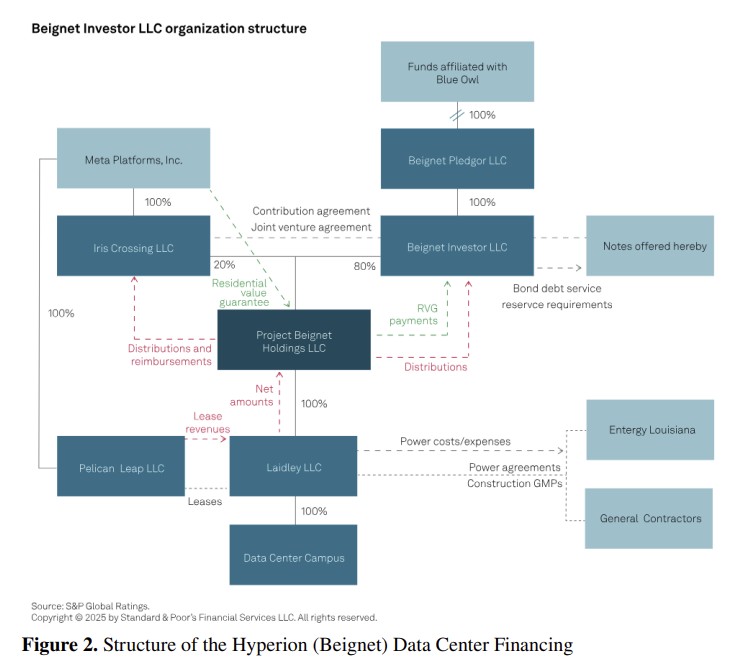
Regarding lease arrangements, Meta did not sign a single long-term lease but rather five consecutive four-year leases—upon the expiration of each four-year term, Meta has the option not to renew.
Van Nieuwerburgh pointed out that this means Meta actually holds significant contingent liabilities: if it renews, it must bear subsequent lease obligations; if it does not renew, it must pay a "Residual Value Guarantee" to ensure the project debt is repaid.
However, under current US Generally Accepted Accounting Principles (GAAP), neither of these contingent liabilities needs to be recorded on the balance sheet because the probability threshold of 70% for recognition has not been met, creating what Van Nieuwerburgh calls a "probability vacuum"—"one of the two obligations is certain to occur, but neither is reflected on the balance sheet."
The Ghost of the Subprime Crisis: Risk Drifting in the Financial System
In the interview, Aaron Klein, a senior fellow at the Brookings Institution, compared the aforementioned off-balance-sheet financing structures to the Structured Investment Vehicles (SIVs) of the 2008 subprime mortgage crisis, prompting a detailed response from Van Nieuwerburgh.
Van Nieuwerburgh acknowledged the similarities but also highlighted key differences in the current structure.
He pointed out that the core issue of the subprime crisis was severe maturity mismatch—SIVs financed long-term mortgages with short-term asset-backed commercial paper, causing the system to collapse rapidly once market liquidity tightened. In contrast, in current AI data center financing, most situations are similar to Hyperion, matching long-term project debt with long-term assets, limiting maturity mismatch risk. Additionally, Meta remains an investment-grade credit entity with a robust financial position.
However, he noted that risk has not disappeared but has shifted. According to his preliminary statistics, approximately $1.4 trillion in debt has been issued for such structures to date, with $700 billion to $800 billion held by the banking system. Traditional banking leverage is around 90%, while the overall leverage of the private credit industry is about 50%, with connections to the banking system such as credit lines.
"The ultimate key question is: If the music stops, will we experience an internet bubble-style crash like in 2001—where the stock market plunges but the banking system remains intact—or a financial crisis like in 2008, where the banking system is damaged and credit contraction spreads throughout the economy?" Van Nieuwerburgh said, "Currently, we do not have a measurement framework capable of answering this question."
Transparency is Urgent
Van Nieuwerburgh issued specific warnings and recommendations for the regulatory system.
He pointed out that current GAAP standards are set by the FASB (Financial Accounting Standards Board). Meta followed existing rules and did not commit fraud or violations, but the rules themselves urgently need review. The FASB could revise relevant recognition and consolidation rules; the SEC could require listed companies to provide more adequate disclosures regarding such contingent liabilities, rather than presenting them limitedly in the footnotes of 10-K or 10-Q filings.
Regarding the monitoring of systemic risk, he suggested that regulators—including the Federal Reserve, the Treasury Department, and various financial regulatory agencies—focus on establishing a complete "economic capital stack" disclosure mechanism. This would clarify ownership of each major asset, debt bearers, lease signatories, construction and residual value guarantors, and the actual risk bearers if demand falls short of expectations. "The goal is not to stop investment but to achieve reasonable pricing through transparency, allowing regulators to see risk concentrations in advance and reducing the probability of being suddenly 'hit' by hidden liabilities during a downturn," he said.
Van Nieuwerburgh emphasized that taxpayers are also involved indirectly—states provide subsidies for data center projects through tax breaks, equipment purchase tax exemptions, and electricity discounts, with some states recently beginning to retract some of these preferential policies. Meanwhile, if AI truly unleashes strong productivity growth, the resulting GDP expansion and broadened tax base will indirectly benefit all taxpayers. "We all have exposure to AI, and overall, we should hope for the success of this technology."
Below is the full transcript of the interview
Jan Eberly (Host):
Welcome to Season 9 of the Brookings Economic Activity Podcast. I am Jan Eberly, the James R. and Helen D. Russell Professor of Finance at Northwestern University. In this season, we will hear discussions centered on papers from the Brookings Economic Activity Conference held in fall 2026. This conference was hosted by the Brookings Institution in September.
Jón Steinsson (Host):
I am Jón Steinsson, the Marek Professor of Public Policy and Economics at the University of California, Berkeley. We are co-editors of the Brookings Papers on Economic Activity. This is a semi-annual conference and journal that addresses the most pressing economic challenges of the day by combining rigorous research with real-time policy analysis.
Jan Eberly (Host):
As always, this season features a series of timely topics, including energy markets, inflation, the impact of immigration on labor and housing markets, and AI financing. In upcoming episodes, we will delve deeper into these conference papers and, more importantly, how policymakers should think about the issues they explore.
Jón Steinsson (Host):
This episode discusses the AI boom, but focuses on an aspect not always in the spotlight: how exactly are we paying for all the current AI investment? Aaron Klein, a senior fellow in the Economic Studies program at the Brookings Institution, will discuss Stijn Van Nieuwerburgh's new paper, "Financing AI Infrastructure Construction, with him.
Jan Eberly (Host):
The numbers here are staggering. Van Nieuwerburgh estimates that by 2032, annual investment required for US data center construction will equal approximately 3.6% of GDP. Relative to the size of the economy, this is larger than the railway construction boom, the interstate highway system construction, or grid construction.
Jón Steinsson (Host):
Surprisingly, companies like Meta and Microsoft are currently spending more on AI than the cash flow generated by their operating activities. Therefore, they are increasingly relying on leases, joint ventures, and private credit to bridge the funding gap. For those familiar with past investment booms, such as the internet or fiber optic construction boom of the early 2000s, this situation is not unfamiliar.
Jan Eberly (Host):
Van Nieuwerburgh specifically analyzes Meta's Hyperion data center project to illustrate how these financing structures actually work and why they make leverage—that is, debt—harder to see from the outside. He does not call it a bubble, as judging bubbles is always tricky, but he clearly points out what regulators and investors should pay attention to.
Jón Steinsson (Host):
Let's hand it over to Aaron and Stijn.
Aaron Klein (Interviewer):
Thank you, Jon, and thank you, Jan. It's a pleasure to work with you again. Stijn, hello, and thank you for joining the show.
Stijn Van Nieuwerburgh (Guest):
Hello, Aaron.
Aaron Klein (Interviewer):
Where are you based now?
Stijn Van Nieuwerburgh (Guest):
I am based at Columbia University in New York City.
Aaron Klein (Interviewer):
Oh, that is the world capital. Perhaps, in the AI field, the US is trying to become the next economic capital of the world.
Your paper is excellent, and I want to get straight to the point. You estimate that from now until 2032, annual investment required for AI data center construction will equal 3.6% of GDP. This is a huge number. How does it compare to past infrastructure construction booms like canals, railways, or the interstate highway system?
Stijn Van Nieuwerburgh (Guest):
Yes, my central estimate is that from 2025 to 2032, annual investment will equal 3.6% of GDP. Roughly calculated on the same basis, during the approximately 20-year peak period of the railway construction boom from 1870 to 1890, average investment was about 2.2% of GDP.
Highway construction in the 1950s was about 1.1% of GDP. The telecommunications and fiber optic construction boom, or the internet boom, was about 1.1%. Canal construction was about 0.66%, and electrification construction was about 0.5%. So, this estimate for AI investment is about 50% higher than the largest of these previous capital expenditure booms, the railway construction boom, and more than three times the internet boom.
Obviously, this is an extremely large number. However, I want to add two caveats. First, estimates for these historical events do not always use completely consistent methodologies, and some periods are very distant. For example, in the railway data, there are indeed years where investment peaks exceeded 4% of GDP. The railway data does not include locomotives and rolling stock, so it may be slightly underestimated.
But the point here is not to pursue false precision, but to highlight that the technological boom we are experiencing is indeed massive and will have macroeconomic impacts.
Aaron Klein (Interviewer):
Let me probe further on this point. When I read the paper carefully, I saw that your valuation for a 100-megawatt AI training campus is slightly over $4 billion.
And throughout the period, this valuation seems to remain basically unchanged. I always think of Moore's Law, which states that computing power becomes cheaper over time. How did you make this estimate? I know it's only the next six years, but computing power seems to get much cheaper every few years.
Stijn Van Nieuwerburgh (Guest):
Yes. First, I want to clarify the assumptions in the paper. You are correct that the paper uses a cost of about $4.1 billion for a 100-megawatt facility in 2025, and then assumes this dollar cost rises by 4% annually. We did not assume nominal prices remain constant. It should be noted that of the $41 million per megawatt cost, about two-thirds come from information technology equipment, including all fiber optics and peripheral devices; the other third comes from real estate, meaning the data center building itself, all equipment within it, and power infrastructure.
I think you are right that historically, improvements in computing efficiency have been very rapid. The cost per unit of computation is usually declining. But this paper actually measures the scale of these data centers in megawatts rather than FLOPS, or floating-point operations per second. Therefore, my understanding is that better chips might allow more FLOPS per watt of electricity; meanwhile, as the cost per FLOP declines, developers of frontier models will train increasingly larger models.
Inference demand will also increase. You and I will keep clicking on applications and ChatGPT windows, asking more and more questions. Therefore, even if the performance obtained per dollar continues to improve, the cost of frontier technology racks may still continue to rise. These are actually two opposing forces.
Efficiency improvements reduce the capacity needed to complete a fixed workload, but declining computing costs induce much higher computing demand. This is known as the rebound effect, sometimes referred to as the Jevons Paradox: when something becomes cheaper, we sometimes use it more.
A data center developer once described it to me this way: "The queue of use cases stretches a full 12 miles." There are still many things we have not used computers to process. Once computing costs decline, we will do more of these things.
Aaron Klein (Interviewer):
Yes, I come from the banking industry. I always remember one thing a banker told me: when they launched online banking, allowing customers to check their account balances online, they originally thought call center usage would decrease, saving significant costs, because before that, people had to pick up the phone, dial, and ask how much money was in their account.
As a result, online queries were actually more expensive. Although the cost per query was lower, because it was much more convenient, people queried far more frequently, without having to pick up the phone, dial, and wait online. Therefore, it makes sense to understand this functional relationship with this logic, and you are basically assuming these two effects offset each other.
Let me probe another assumption, which is the 4% nominal growth rate you used for GDP, which you mentioned in your previous answer. Is this based on 2% inflation and 2% real growth, or is there another basis? What happens if inflation is 3%, as has roughly been the case in recent years, and real growth is only 1%?
Related to this, almost no one predicts a recession in their models, but over a seven-year horizon, the probability of no recession occurring eventually drops to zero. How sensitive is your model to inflation, real economic growth, and the probability of recession?
Stijn Van Nieuwerburgh (Guest):
That is a good question. Frankly, that 4% path is not a finely calibrated macroeconomic forecast, but rather a standardized assumption for ease of use. Historically, nominal GDP growth has been roughly at this level, with about 2% from inflation and about 2% from real economic growth.
If we wanted to assume inflation was 3%, or nominal growth was 3%, we could let GDP grow at a slightly higher rate from 2025 to 2032. Mechanically, this would expand the denominator in the investment-to-GDP ratio and lower the core figure of 3.6%. For example, if you assume nominal growth is 5%, perhaps because you want to raise the inflation assumption from 2% to 3%, this number would drop from 3.6% of GDP to 3.5%. So, it is not particularly sensitive.
Of course, there is another question: if we think 3% inflation affects the entire economy, wouldn't it also affect the cost of AI construction? Therefore, if you let the cost in the numerator rise at the same rate as GDP growth in the denominator, the ratio would not change. This is precisely why I chose the number 4%. Please remember, I let AI costs rise by 4%, while also hoping GDP rises by 4%, so that mechanical inflation effects do not distort this ratio.
As for recessions, that is a good question. One can imagine that a recession would reduce AI demand, tighten financing constraints, and lead to project cancellations, thus potentially significantly shrinking the numerator.
Similarly, I am not trying to predict the business cycle three to eight years out. I do think, as you said, that a recession is possible. I think that would lead to a decline in both GDP and AI investment; in that scenario, I guess the numerator would decline more than the denominator.
Aaron Klein (Interviewer):
Yes, historically, after such large-scale investment expansions, there is usually some degree of overinvestment and some form of recession. The most recent case you listed is the internet bubble boom and bust of 2001. Looking further back, railways and canals also experienced certain boom-bust cycles.
Let's temporarily move away from macro issues. Interestingly, a 1% change in nominal GDP does not significantly impact your base estimate. Whether for economic growth or inflation rates, 1% is a large change, but your model still indicates that the scale of the AI investment boom here will be three times that of the highway and interstate highway construction boom, which indeed thoroughly transformed the US.
Stijn Van Nieuwerburgh (Guest):
On this point, I want to add one more sentence. Some people believe we are about to witness a growth miracle, so the real growth rate of GDP might not be 2%, but reach 4%, meaning nominal growth increases from 4% to 6%, or even higher. If you assume very, very strong growth, the core figure I gave of investment at 3.6% of GDP could drop all the way to 3%.
But getting it below 3% would be difficult. So, even if you are willing to assume that AI will drive significant growth in the US economy over the next eight years, this result is still not that sensitive.
Aaron Klein (Interviewer):
Let's talk about a specific deal. I think your paper does a very good job of discussing the big picture while guiding the reader step-by-step through an analysis of a transaction.
You used Meta's Hyperion data center as a case study, detailing a very specific transaction. What does this deal reveal about how these projects are actually financed?
Stijn Van Nieuwerburgh (Guest):
I chose Hyperion not only because it is a huge transaction, but also because I believe it is a template for the financing of many similar projects. It clearly reveals how creditworthy tech companies like Meta can obtain new computing capacity without listing all project debt on their own balance sheets.
The process is interesting. Meta initially planned to build and fully hold this facility on its own balance sheet, just as hyperscale cloud providers traditionally built their own data centers. But a change has occurred in the past few years, which I call a "massive risk transfer" from "self-build" to "lease." Now, third-party owners and infrastructure funds are responsible for building and holding these facilities. Therefore, Meta actually sold a 20% stake in the Hyperion data center to a private credit company named Blue Owl for $2.5 billion, while retaining a 20% equity interest.
Subsequently, the two parties jointly established a joint venture named Beignet. This is a special purpose vehicle whose only asset is the data center named Hyperion, located in Richland Parish, Louisiana. It is a giant data center, with an initial phase of about 2 gigawatts, which is the phase I am focusing on, with potential future expansion to 5 gigawatts.
Afterward, Beignet decided to issue large-scale debt. Based on Hyperion assets valued at approximately $30 billion, it issued $27 billion in debt. Consider this number: the project-level debt-to-asset ratio reached 90%, with a debt service coverage ratio of about 1.15.
In this process, Meta itself maintained low leverage because it only held that 20% interest in the joint venture. None of the debt issued by Beignet needed to be listed on Meta's own balance sheet. Therefore, Meta could continue to appear as a low-leverage company, while simultaneously bearing huge leverage of up to 90% on this data center. However, without Meta's commitment to long-term lease the facility, no one would have built this data center.
Sometimes, hyperscale cloud provider tenants sign 10-, 15-, or 20-year leases. Meta adopted a slightly different, and I think interesting, approach: it signed five consecutive four-year leases. You might ask, "Aren't five four-year leases essentially equivalent to a 20-year lease?"
Not exactly, because every four years, Meta has the opportunity to exit any of the nine buildings in the campus and can decide not to renew the corresponding lease. Therefore, Meta has great flexibility in this contract. If, after four, eight, or twelve years, for any reason, it no longer needs that much computing capacity, it can exit directly.
Wouldn't bondholders worry about being left out in the cold? Meta must also commit to signing a so-called residual value guarantee. This guarantee basically stipulates that if Meta decides not to renew the lease, for example, after eight years, it must pay a penalty, or what could be called a lease non-renewal fee, which is this residual value guarantee. The amount is sufficient to repay the debt associated with that specific building.
Therefore, from the perspective of bondholders providing funds for the $27 billion debt, those selling these bonds certainly want investors to view them as very safe investments: either Meta continues to pay rent, which is sufficient to pay the interest and principal of the debt; or Meta does not renew and pays a lump sum, ensuring the debt is also repaid.
So, as long as Meta remains solvent and does not enter bankruptcy proceedings, this debt will be repaid.
Aaron Klein (Interviewer):
I come from the field of financial regulation and witnessed the subprime disaster and the global financial crisis. Narratives often focus on bankrupt large companies like Bear Stearns, AIG, Fannie Mae, and Lehman Brothers, but one part is often overlooked: the first canary in the coal mine was actually the so-called Structured Investment Vehicles, or SIVs. They essentially allowed large banks to gain huge exposure to subprime mortgages through these off-balance-sheet investments.
The Federal Reserve and other bank regulators accepted this accounting system, believing the risk was off-balance-sheet, so banks were protected. This is exactly what you just said. Meta is creating a lot of off-balance-sheet risk, so it looks like it doesn't have to report these four-year leases with options, nor does it have to report residual value payments, making Meta appear to remain in a relatively low-leverage state.
Meanwhile, the project transactions don't look like they have 90% debt leverage either, because Meta is standing in the shadow behind it. The banking crisis revealed that banks' off-balance-sheet tools eventually returned on-balance-sheet because of reputational risk. Banks couldn't simply let investors who had received various promises bear all the losses, and this was the earliest signal of problems emerging.
Then-US Treasury Secretary Paulson proposed establishing a "Super SIV" government-led initiative to save these SIVs, but it ultimately yielded little result. However, this helps explain why regulators said one moment that banks had limited exposure to subprime loans, and the next moment said, "The subprime problem is uncontrollable and threatening the global financial system; we must bail out the banks, or the world will collapse."
One can imagine a scenario: if all AI companies run into trouble, including Google, Meta, and Amazon, these companies are also "too big to fail" from another perspective, and now they are hiding their leverage. Do you think Meta and other hyperscale cloud providers' use of off-balance-sheet accounting shares similarities with the practices banks adopted during another mortgage boom in the 2000s?
Stijn Van Nieuwerburgh (Guest):
Yes, I think there are clear similarities here. Like you, I have studied the subprime crisis in depth and taught securitization courses for many years after the crisis. As you said, the concept of securitization is to disperse risk from the highly leveraged banking system to ideally unleveraged investors, such as pension funds, sovereign wealth funds, and mutual funds.
But in the subprime crisis, the promise of securitization was never fully realized, because banks often retained the tranches of these securitized products that bore losses first, or brought these exposures back onto their balance sheets through guarantees, as you pointed out, sometimes for reputational reasons.
The similarity here is that the legal isolation achieved by Meta through the Hyperion case we just discussed may underestimate the actual economic recourse liability. Perhaps in some circumstances, hyperscale cloud providers will decide to support strategically important projects like Hyperion, rather than strictly enforcing every legal exit right, and will not fully rely on the bankruptcy isolation achieved by this structure.
However, Hyperion is a specific operating asset with an investment-grade tenant and long-term project debt. I think this is a key difference between it and the subprime crisis.
The place where the subprime crisis truly went wrong was the presence of significant maturity mismatch. Many SIVs invested in long-term mortgages but financed them with short-term debt. I am particularly thinking of asset-backed commercial paper. At the time, this was a huge market, growing from hundreds of billions of dollars to over $1 trillion around 2006, 2007, and 2008.
So, at least for now, the major difference here is that I do not see a large amount of short-term liability exposure. Usually, as in the Hyperion example, the special purpose vehicle uses long-term debt to finance the long-term asset of the data center, so there is no same maturity mismatch. Additionally, Meta is currently still an investment-grade credit entity with public credit ratings; its current balance sheet is very strong, and it is a highly profitable company.
Therefore, conditions would have to become very bad for Meta to go bankrupt. This is not impossible, but at least from today's perspective, it seems like a rather remote possibility.
One area where more short-term debt appears is when people start financing GPUs. In addition to financing real estate like data centers, people are increasingly financing GPUs. GPUs are chips, and chips depreciate relatively quickly. Therefore, this might be a five-year instrument, not a 20-year investment; it might be a four-, five-, or six-year investment. It is in this area that we see more short-term exposure, and of course, the technical risk that the future value of these chips may be lower than their current value.
So, what I want to express is that there are both similarities and differences between the two.
Aaron Klein (Interviewer):
Let's go a bit deeper. I remember you mentioned asset-backed securities. The Federal Reserve once implemented a massive bailout for US companies through this market, involving companies like GE.
Part of the mismatch in securitization structures is that banks package these long-term assets into short-term, continuously renewable assets for promotion. Regarding private credit, I saw a familiar name in the Hyperion transaction—Blue Owl. It was one of the first private credit funds to encounter serious problems as investors tried to redeem funds.
As you pointed out, there is a maturity mismatch between debt and assets; but the contributors to private capital, i.e., Blue Owl's investors, also have the right to sell their shares in Blue Owl—essentially selling their credit exposure—and Blue Owl has suspended such redemptions.
I see that the fund mentioned in your case is Blue Owl, and it has encountered some problems. Is this transaction related to Blue Owl's broader issues? From Blue Owl's experience, do you see any factors that might exacerbate this mismatch between private credit investors and the private credit assets they hold?
Stijn Van Nieuwerburgh (Guest):
That is a good question. I would distinguish between the fund manager and the specific project. Blue Owl's credit platform did face real pressure from these redemption requests. Such funds usually have redemption restrictions, known as "gates," which can limit the proportion of investments investors can redeem in a given quarter. In a sense, this gives them time to resolve underlying issues.
Usually, the redemption volume each quarter is relatively small. Of course, if 2% of investors want their money back each quarter for 20 consecutive quarters, that would still account for a significant portion of the investment scale.
Another point is that Blue Owl made an equity investment in Hyperion. I believe the private credit fund facing redemption requests is not the same one investing in Hyperion. But I think you raised a broader question: these are indeed long-term investments, but if investors in private credit funds have the right to redeem part of their investment within a shorter timeframe, this also creates a maturity mismatch.
Structurally, it is very important to match the timing, meaning clearly telling investors: "This is an investment in a long-term asset. You cannot exit for the next 10 or 15 years." Otherwise, we indeed recreate the risk of a run through the back door.
At the same time, I also want to point out that as long as Meta does not go bankrupt, this specific asset, the Hyperion asset, will generate enough cash flow to repay the debt. Therefore, one could say that behind these investments is a relatively safe, well-funded, investment-grade rated tenant.
Aaron Klein (Interviewer):
Right, it's just that they are not that liquid. You raised an accounting issue. Senator Paul Sarbanes was my first boss, and I served as his chief economist, working on the Sarbanes-Oxley Act, so accounting reform legislation is very special to me. Everyone may remember the accounting crises involving large companies like Enron and WorldCom, where we found that accountants were not handling the books truthfully. Therefore, the US established a regulatory agency—the Public Company Accounting Oversight Board, or PCAOB—to oversee the audits of the Big Four accounting firms.
Do you think the PCAOB is aware of some of these accounting tricks? Can it take action? Do you think there is a conflict of interest for the accounting firms handling the accounting for these projects? As you said, these projects are legally independent, and Beignet may have moved off Meta's balance sheet. But if I am an accounting firm and Meta is my client, I naturally want to keep Meta satisfied, and now I am doing another set of independent accounting for an independent entity named Beignet.
Are you worried about the accounting treatment of these projects? Please explain again the accounting mechanism you mentioned, and whether you think accounting regulators have noticed it.
Stijn Van Nieuwerburgh (Guest):
Let me first explain what I mean by "probability vacuum." Returning to the Hyperion transaction, Meta signed five consecutive four-year leases. Only the first one, the current lease, needs to be listed as a lease liability on its balance sheet. The leases for the subsequent 16 years, the next four four-year leases, are considered future leases. Under US GAAP, if the likelihood of a liability occurring does not reach at least 70%, it does not need to be listed on the balance sheet.
Therefore, Meta actually has large future lease commitments in this transaction, which are currently not reflected on the balance sheet. These commitments will only be reflected when Meta starts the next lease.
At the same time, remember that if Meta does not renew the lease, it needs to pay a residual value guarantee to this structure. The likelihood of this obligation occurring also has not reached at least 70%, so it also does not need to be listed on Meta's balance sheet.
Therefore, Meta is certain to bear one of the two obligations. After four, eight, or twelve years, it will either renew the lease or pay the residual value guarantee. One of these two things is guaranteed to happen, but neither is reflected on the balance sheet, because the likelihood of either one occurring individually has not reached 70%.
The probability calculation here literally does not add up. However, this in itself does not mean illegality exists; it is just how US GAAP is prescribed. Meta complied with these rules, there was no fraud, and no one accused it of misconduct. In this case, it is the Financial Accounting Standards Board, or FASB, that determines the recognition and consolidation rules.
The FASB could modify these rules, and perhaps it should. The Securities and Exchange Commission could require listed companies to disclose this information and enforce relevant reporting obligations, at least letting investors know what liabilities might arise in the future. Companies themselves disclose some future obligations in the footnotes of their 10-K and 10-Q reports, so diligent investors can find this evidence. But we should perhaps make all of this more transparent.
Furthermore, you raised an important question about the client-pays model. I think this remains a structural concern. The Sarbanes-Oxley Act prohibited certain non-audit services, required certain matters to be approved and supervised by the audit committee in advance, rotated certain key partners, and enhanced the powers of the PCAOB. I think these safeguards reduced conflicts of interest, but did not eliminate a commercial fact: audit firms are still paid by the issuer.
These leases, guarantees, and consolidation decisions are highly dependent on judgment, so they deserve close attention from audit committees and the PCAOB.
Aaron Klein (Interviewer):
Let's discuss another possible scenario: AI demand growth is not as fast as expected. Historically, there have been many booms where people claimed they would bring a new world, but demand ultimately did not grow that quickly, or a new technology emerged that quickly surpassed the old one.
The canal construction boom you mentioned did not last as long as some originally envisioned, because railway technology subsequently appeared. With steam locomotives, transporting goods via canals suddenly became less cost-effective than before.
I sometimes use the second law of thermodynamics to understand risk: risk cannot be eliminated, only transferred. If the situation changes significantly, the construction boom is underway, but ultimately fails, who bears the risk? Will the risk return to the banking system? Will it stay within tech companies like Google and Meta? Or will it be borne by Blue Owl and private capital investors? After studying the details of this industry, where do you find the risk actually lands?
Stijn Van Nieuwerburgh (Guest):
This is the key question. I think we need to give a precise answer to this, which is also what I am currently researching. I spent most of this summer mapping all the financial liabilities borne by these companies among themselves, trying to figure out who ultimately bears the risk brought by this AI construction boom.
This is a difficult question, partly due to the lack of transparency in the system we discussed earlier. We do not have a reporting system capable of answering this question, and perhaps we should establish one.
If we observe the process of data center financing moving from on-balance-sheet to off-balance-sheet, we find that a large amount of risk has shifted from these tech companies to the outside world, i.e., all other investors. Usually, the first loss is borne by the project's equity investors. Suppose you are the data center owner, the tenant does not renew, and no one else needs this GPU facility, perhaps because quantum computing has appeared, or edge computing has risen, and everyone is doing computing on their phones instead of in your data center, then the loss falls on you.
Similarly, if construction is delayed, and you have issued debt like Hyperion, but the local community is unwilling to continue issuing construction permits, there will be a mismatch between the debt maturity date and the time revenue starts flowing. Again, the first loss is borne by equity investors; if the loss is large enough, it will begin to affect creditors.
Remember, if the project leverage ratio is 90%, a 10% drop in cash flow will cause debt to start being impaired. A 10% drop in cash flow wipes out all equity, and a little more drop, under 90% leverage, will erode debt claims.
Even with this off-balance-sheet financing, hyperscale cloud providers currently still bear significant risk. The reason is that they usually still own the information technology equipment. When we say they are leasing data centers, we mean they are renting building space and the power provided with the building, but they usually still own the servers themselves. This is generally how it operates.
As we discussed earlier, servers are also increasingly being leased, meaning held by others. But currently, most information technology equipment is still financed by the hyperscale cloud providers themselves. There is a reason why hyperscale cloud providers' capital expenditures reached $800 billion in 2026, a large part of which is the information technology equipment they still hold themselves.
As for the banks you asked about, I think that is indeed a key question. According to a statistic I saw, approximately $1.4 trillion in debt has been issued for these structures to date. About half of this, $700 billion to $800 billion, is held by banks. The leverage ratio of the entire banking industry is about 90%, while the overall leverage ratio of the private credit industry is about 50%.
Therefore, private credit is obviously less risky and less leveraged than the traditional banking system, but it is not completely unleveraged. It is not like mutual funds or pension funds that do not use leverage. Private credit does have leverage, and there are connections between this non-bank private credit system and the traditional banking system, such as credit lines.
So, this system is very complex, and this is indeed the key question. Ultimately, if the music stops, will we experience an internet bubble-style decline—where the stock market loses a lot of wealth, but it does not spill over to the banking system, similar to the mild recession of 2001, where a group of rich people lost a lot of money, but that's okay, we can withstand it;
or will we experience a financial crisis like 2008–2009, where the banking system is damaged and further spills over into all other industries in the economy that need credit? This is the ultimate key question, and I think we currently do not have a measurement framework capable of answering this question. I am trying to build it, and we should all strive to build it. The Federal Reserve, the government, and the Treasury Department should all attach importance to this issue.
Aaron Klein (Interviewer):
We once tried to build such a system, called the Office of Financial Research, or OFR. It was supposed to build supportive data infrastructure to track all these assets, allowing us to answer the question just posed. Unfortunately, the OFR did not truly achieve the function its creators originally envisioned. Europe has done more work in this area, such as establishing the Global Legal Entity Identifier Foundation, or GLEIF, allowing people to track these assets, figure out who owns them, who operates them, thereby obtaining relevant data, and avoiding so-called "surprises" about where risk has shifted.
One difference between this AI boom and past booms is that the previous booms you mentioned all had public infrastructure attributes. The Eisenhower Interstate Highway System included significant federal investment; the canal system and the Erie Canal received substantial state government support. These infrastructures had public uses and also included taxpayer input.
The AI boom seems to lack this. Did taxpayers provide funding for any of this capital? If not through the front door, did it enter through the back door? If taxpayers did not play a major role in financing, what role should the government play in regulation? Because the logic in the past was: "We set gasoline taxes, collect gasoline taxes, so we also have the right to set driving rules on interstate highways." These rules might involve safety, or specify how close exits can be. The federal government established many rules in this regard.
What is the system here? I also want to add state and local governments. How much exposure does the government have at the funding level for such projects, and therefore how much regulatory power does it possess?
Stijn Van Nieuwerburgh (Guest):
Indeed, most of the direct funding for data centers, chips, and project financing comes from private capital. I think this is an important difference between it and the interstate highway system and part of the electrification construction.
But the public sector is not absent. Government support is reflected through tax expenditures, such as depreciation rules, and sales tax and property tax incentives at the state and local levels. Data center developers have received significant subsidies at the local level, with states competing to attract these projects, especially by granting use tax exemptions, such as exemptions on electricity or equipment purchases.
The scale of these incentives can reach billions of dollars, with a significant impact. Research shows that they sometimes determine which state an investment ultimately lands in.
Property tax is another very important factor. Data center developers point out that they are often one of the largest contributors to the local property tax base, especially in some more remote counties where large data center campuses are being built. This can provide very important support to localities and basically reduce the need to tax households or other businesses.
I think this debate has reached a turning point. In the past nine months, resistance to data centers has risen sharply, with some states beginning to cancel some of the subsidies previously provided. This is an interesting development.
So, what role should the government play in all this? I have tried to emphasize the importance of measurement and disclosure. There is still much work to be done in this area. I hope another point that has been made clear is the necessity of prudent monitoring. Especially for systems using leverage, including banks and insurance companies, regulators should map out who holds these data center debts and who provides leveraged funding to private credit funds. The purpose of doing this is to discover these interconnected risk exposures before stress truly emerges.
Of course, this also involves physical infrastructure regulation targeting the power grid.
Finally, I want to say that all of us, every taxpayer, also directly own this risk exposure through productivity. If AI indeed brings a strong productivity boom, it will benefit the US economy, benefit GDP growth, and also improve fiscal conditions. Through the progressive tax system, the government will receive more tax revenue.
Therefore, all of us taxpayers have AI exposure. Overall, we should perhaps all hope for the success of this technology, because it will ultimately enlarge the entire cake.
Aaron Klein (Interviewer):
Stijn, thank you. This was a wonderful conversation. The show is almost over, and I have one last question. I am in Washington, you are in New York; you are in the world's financial capital, and I am in the world's political capital. For policymakers listening to this podcast in Washington, what is the one message you most want them to take away from this paper?
Stijn Van Nieuwerburgh (Guest):
I hope they recognize that AI is not just software, nor just ChatGPT. It also means a large-scale physical capital investment boom that is happening, with a scale that could reach $10 trillion over the next eight years. This will have a truly significant impact on the macroeconomy.
Moreover, the way this huge investment is being financed is changing. Hyperscale cloud providers had a lot of cash and low leverage at the beginning of this cycle; but as spending, especially capital expenditures, continues to rise, more and more projects are being placed into joint ventures and special purpose vehicles, and financed through leases, private credit, and securitization.
These structures can be economically very useful, able to introduce more capital, but they also make leverage harder to see. A listed company might report having very little debt, because all debt is hidden off the balance sheet.
So, my policy recommendation is straightforward: we need comparable disclosures for the complete economic capital structure. Who owns each major asset? Who bears the debt? Who signs the leases? Who provides guarantees for construction or residual value? If final demand falls short of expectations, or revenue falls short, who bears the loss? Regulators should map out which banks, insurance companies, pension funds, bond funds, and private credit vehicles hold these exposures.
The goal here is not to stop investment, but to increase transparency. Transparency helps with correct pricing, helps regulators identify risk concentrations, and also reduces the possibility that everyone simultaneously discovers the same obligation hidden somewhere when the economy enters a downturn.
The time to build these systems is now, because people are still designing and signing relevant contracts, and the entire architecture is still taking shape.
Aaron Klein (Interviewer):
Thank you very much. This conversation wonderfully delved into the world behind the AI boom, a world that might change the economy as we know it. Stijn, thank you very much. This was a great conversation.
Stijn Van Nieuwerburgh (Guest):
Thank you, Aaron.