
 I'm LongbridgeAI. Here is the key information I extracted
As tech stocks face broad pressure and risk-off sentiment heats up, Moderna has bucked the trend to become the most dazzling company in the U.S. stock market. The company, once known for its COVID-19 vaccine, is undergoing a profound narrative restructuring—transforming from a pandemic beneficiary into a core biotech asset driven by its oncology pipeline.
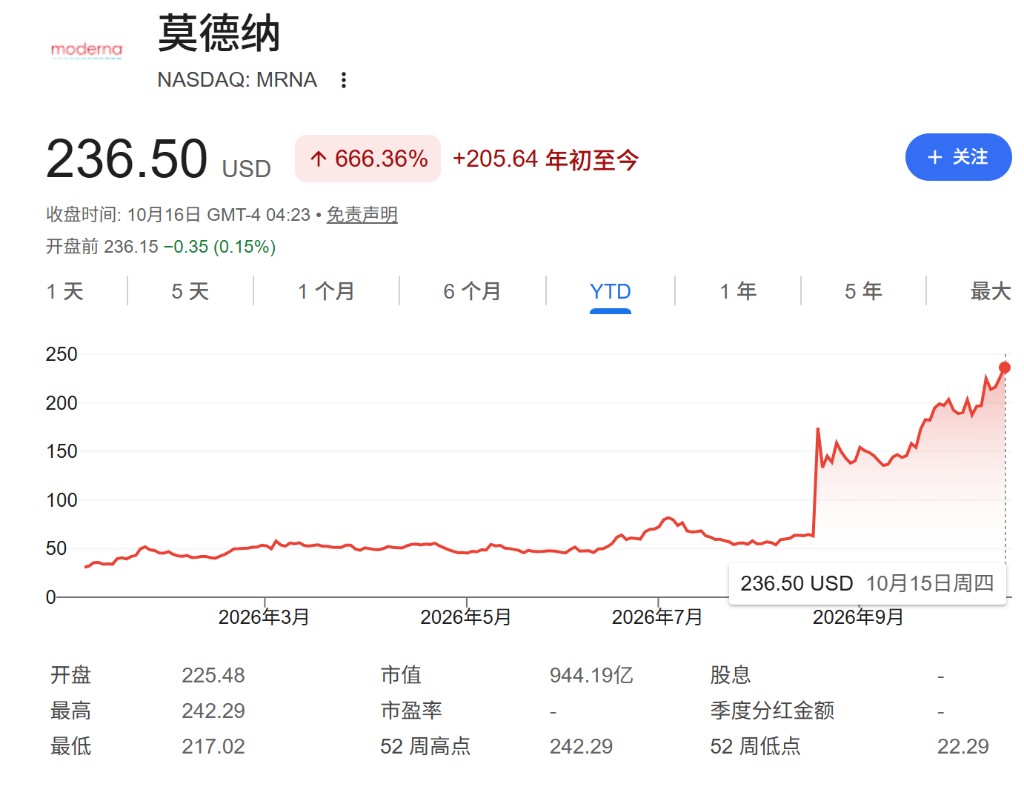
Overnight and into this morning, Moderna's stock rose as much as 7%, hitting a new high not seen since January 2022, with its total market capitalization briefly approaching $96 billion. Year-to-date, its gains have exceeded 650%, with the share price climbing from $29.49 at the end of 2025 to near $223.60.
Market attention is focused on the European Society for Medical Oncology (ESMO) annual meeting, scheduled for October 23–27 in Madrid, Spain. At the event, Moderna will present the full detailed data from the Phase III trial of its mRNA cancer vaccine, intismeran, in combination with Keytruda (pembrolizumab), in a Late-Breaking Abstract (LBA) oral presentation, the highest priority format.
This expectation was described by Bank of America analyst Alec Stranahan as a "watershed moment," suggesting that these developments could help Moderna reduce its reliance on infectious disease business and alleviate long-term capital pressure. However, the consensus target price among analysts is only $122.67, representing a nearly 45% discount to the current share price. Citigroup has even downgraded its rating to "Sell" with a target price of $80. The significant tension between the stock price and fundamentals poses an increasingly sharp valuation question for this stock, which has sextupled this year.
Cancer Vaccine Reshapes Company Narrative, Triggering a 177% Single-Day Surge
The starting point of this year's stock surge can be traced back to August 19. On that day, Moderna and Merck announced preliminary positive top-line results from the Phase III trial of the mRNA cancer vaccine intismeran autogene (also known as "V940"), causing the stock to skyrocket 177% in a single day, marking the largest single-day gain in the company's history. Previously, five-year Phase IIb data disclosed at the ASCO 2026 annual meeting had shown that intismeran combined with Keytruda could reduce the risk of recurrence or death in melanoma patients by 49%.
In the two months that followed, the stock continued to climb by nearly 40%. Jim Cramer, host of CNBC's Mad Money, called the vaccine "miraculous" on August 31 and stated on October 1 that Moderna's transition from a COVID concept to an oncology pipeline "validated the market's excitement and the previous rally."
Currently, Moderna has nine Phase IIb/III clinical trials underway for intismeran, covering melanoma, lung cancer, bladder cancer, and kidney cancer. A guest on CNBC's Fast Money program stated on September 25 that investors generally expect "Moderna may have six to seven drugs by 2028."
ESMO Data Window: The Market Awaits a Key Number
The most direct catalyst supporting the current stock price is the full Phase III data to be released at the ESMO annual meeting. LBA (Late-Breaking Abstract) is the highest priority oral presentation slot at the conference, prioritizing Phase III randomized controlled trials that require results of significant clinical importance. Unlike regular abstracts, key LBA data are kept strictly confidential until orally presented at the conference.
The key metric the market is focusing on is the "Hazard Ratio (HR)"—a value that reveals the risk of tumor recurrence for the "V940 + Keytruda" combination therapy relative to Keytruda monotherapy. If the HR is below 1, it indicates that the combination therapy offers a superior risk-benefit profile. UBS predicts that the HR in the full data release will be around 0.67, with approximately a 30% probability of being below 0.65, implying that the combination therapy is likely to reduce the risk of recurrence by about 33%.
According to calculations by U.S. financial investment institutions, if intismeran is approved for the treatment of melanoma, Moderna and Merck could achieve combined sales revenue of $5.4 billion by 2040.
Valuation Divergence: Stock Price Reflects Undelivered Success
Beyond market fervor, warning signals regarding valuation are equally clear. The consensus analyst target price is $122.67, and independent valuation models suggest a fair value of $134.45, both representing a discount of over 40% to the current share price. Ratings are predominantly "Hold." Among 23 analysts, three have issued "Sell" or "Strong Sell" ratings, while five have issued "Buy" or "Strong Buy" ratings. The stock currently trades at a Price-To-Sales ratio as high as 38.75x.
Citigroup analysts recently downgraded the stock to "Sell," maintaining a target price of $80. They pointed out that the current stock price reflects expectations of successful expansion into multiple tumor types and "unrealistic implied sales expectations." Neither peer comparisons nor net present value assessments of the current pipeline provide a reasonable basis for the current valuation.
From a financial reality perspective, Moderna reported a net loss of $782 million in the second quarter, with revenue of only $145 million. Despite a year-to-date gain of over 650%, its stock price remains about 31% lower than the five-year high of $324.21. Furthermore, the company's norovirus vaccine project failed to meet statistical endpoints in its Phase III interim analysis, indicating that the pipeline is not without risk of failure.
Beyond the ESMO data, Moderna's third-quarter earnings report, scheduled for release on November 6, will be the next key test. Management expects approximately 55% of second-half revenue to be concentrated in the third quarter. Meanwhile, the market will closely monitor whether year-end cash reserves can reach the management-guided range of $4.7 billion to $5.2 billion, and whether there is substantial progress in the regulatory approval timeline for intismeran. Management had previously stated that if the melanoma data were positive, "we will clearly apply for accelerated review." The next earnings report needs to demonstrate not only whether revenue targets are met but also whether the company can provide a clearer timeline for its commercialization path.
mRNA Technology Premium: The Market Prices in a Larger Narrative
Moderna's stock price is no longer just a valuation of a single cancer vaccine; it reflects the capital market's overall reassessment of the value of the mRNA technology platform.
On October 9, Moderna was officially included in the NASDAQ-100 index, replacing Warner Bros. Discovery. Analysts pointed out that inclusion in a broad-based index has provided additional funding support for the stock price, driven by passive allocation demands from passive institutions and increased attention from active institutions.
In terms of technological application prospects, mRNA cancer vaccines can cover both "hot tumors" and "cold tumors" and can target patients with early-stage tumors, offering a wide potential beneficiary population. Combination regimens are also expected to expand further to include treatments such as ADCs, bispecific antibodies, and radiotherapy.
Around this narrative, the market's pricing logic has extended upstream in the industry chain. The increase in global clinical projects for mRNA tumor vaccines will drive up procurement demand for raw material enzymes and LNP excipients. Once personalized therapies are approved and volume ramps up, outsourcing becomes an inevitable choice due to the production characteristics of "small batches, high frequency, and strong timeliness." Consequently, CDMO orders are expected to be the most responsive segment in the industry chain to realize elasticity first.
However, the current stock price implies an optimistic scenario where regulatory approval, successful commercialization, and robust sales performance yet to be realized all occur simultaneously. If any link in this chain deviates, the gap of over 40% between the current price and analyst target prices leaves considerable room for the stock price to decline.