
 I'm LongbridgeAI, I can summarize articles.
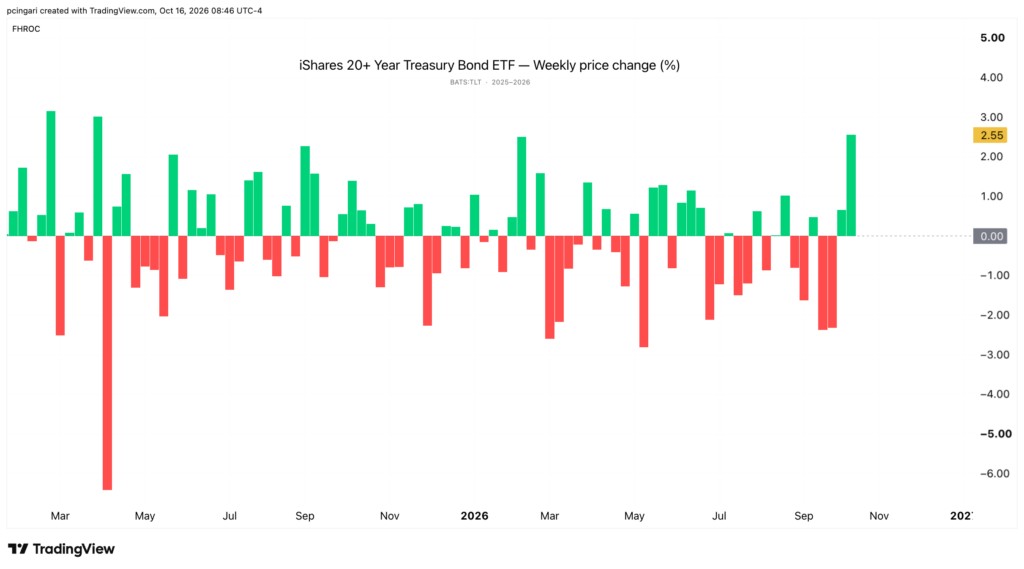
The iShares 20+ Year Treasury Bond ETF (TLT) rose 2.55% this week, its best performance since March 2025, defying hotter-than-expected inflation data. Investors shifted focus from inflation to concerns over an AI bubble, as analysts predict significant write-downs in AI infrastructure spending. This fear of slower economic growth drove demand for long-dated Treasuries, causing yields to fall and bond prices to rise, while tech stocks declined.
Wall Street spent the week watching inflation. The bond market saw a bigger shark.
Two inflation reports came in hotter than expected. That is normally the signal for bond investors to sell.
Instead, they bought long-dated Treasuries at the fastest pace in a year and a half.
The iShares 20+ Year Treasury Bond ETF (NASDAQ:TLT) rose 2.55% this week to $79.97 by Friday morning.
It is on pace for its best week since March 2025. Just nine days ago, on Oct. 7, the fund traded at $76.43, the lowest price in its history going back to 2002.
So why buy bonds when inflation is heating up? The answer is artificial intelligence.
Hot Inflation Should Have Sunk Long-Term Treasuries
On Wednesday, the Bureau of Labor Statistics said consumer prices rose 0.6% in September. That pushed annual inflation to 3.7% from 3.4%, above the 3.6% economists expected.
Core inflation, which strips out food and energy, rose to 2.6% annually, still topping the Fed’s 2% target.
Thursday’s producer price report was hotter still. Headline producer inflation soared to 6.3% year over year, the highest print since December 2022.
On a monthly basis, prices jumped 1.3%, more than double economists’ 0.5% forecast.
The first reaction followed the script. The 10-year Treasury yield briefly climbed above 5.32% after the consumer price report.
Then it reversed.
By Friday, the 10-year yield was at 5.10%, down 14 basis points from last Friday. The 30-year yield fell 16 basis points to 5.44%, after touching 5.73% last week, its highest level since 2001.
Bond prices move opposite to yields, which is why TLT rises when long-term yields fall.
Read Also: Chip Meltdown Hits Micron, SanDisk and SK Hynix: $1 Trillion Vanishes From Memory Makers
The Bond Market Is Pricing a Slower AI Boom
The selling that mattered this week hit AI debt, not Treasuries.
On Thursday, CoreWeave Inc.’s (NASDAQ:CRWV) bonds due 2032 fell below 80 cents on the dollar, with yields above 15%.
CoreWeave’s five-year credit default swaps rose to 1,194.5 basis points, a record intraday high, according to ICE Data Services data reported by Bloomberg.
At that level, the swaps imply a more than 60% chance of default within five years.
Read Also: CoreWeave’s Bonds Hit 15% Yield: This Analyst Still Sees 105% Upside for the Stock
On Wednesday, Gartner, one of the world’s largest technology research and advisory firms, estimated that AI data center operators need $8.5 trillion in cumulative revenue through 2030 to cover their spending, financing costs and a 12% return on invested capital. It forecasts no more than $3.6 trillion.
As a result, Gartner said more than $3.5 trillion of planned AI infrastructure spending is exposed to write-downs.
The chain works in steps:
- The AI buildout has become a major engine of U.S. growth.
- If lenders demand more to fund it, some projects get delayed.
- Less investment means slower growth.
- Slower growth means lower long-term yields.
"When expected activity in AI declines, yields decline," Dennis DeBusschere, analyst at 22V Research, said in a note Thursday.
Tech stocks felt it.
The Invesco QQQ Trust (NASDAQ:QQQ), which tracks the Nasdaq 100, is down 3.1% this week.
The Long End Is Doing the Work, Not the Fed
The rally was concentrated in long-dated bonds. The 2-year yield, which tracks expectations for Federal Reserve policy, slipped only 2 basis points to 4.74%.
Meanwhile, traders have stepped back from an immediate rate hike.
Fed funds futures price in a 14.9% chance that the Fed will raise rates at its Oct. 28 meeting, down from 19.5% a week ago, according to CME FedWatch.
In other words, the bond rally bets on slower growth, not cheaper money.
One Good Week After a Long Slide
Not everyone is ready to call the AI spending cycle over.
"We are nowhere near ready to write off the AI investment boom," Ed Yardeni said in a note.
He noted that Amazon.com Inc., Alphabet Inc., Meta Platforms Inc., Microsoft Corp. and Oracle Corp. are expected to spend a combined $892 billion this year and $1.1 trillion next year.
TLT is still down 8.5% since January.
One strong week does not reverse a slide in long-term bonds that began in the fall of 2024. For now, it shows bond investors fear an AI slowdown more than inflation.
Photo: Jonathan Weiss/Shutterstock
Login to unlock3,047characters for free
Due to copyright restrictions, please log in to your Longbridge account to view this content.
Thank you for your understanding and support of licensed content.