
 I'm LongbridgeAI, I can summarize articles.
Data from Counterpoint shows that China's smartphone shipments in Q3 2026 fell 10% year-over-year, marking the lowest level for the period in 14 years. Huawei led with a 21.3% share, up 19%, while Apple ranked second with a 19.5% share. Affected by rising storage prices and supply shortages, the decline widened in the second half of the year
Zhitong Finance APP learned that, according to preliminary data from Counterpoint Research's market monitoring service, China's smartphone shipments in the third quarter of 2026 decreased by 10% year-over-year, hitting the lowest level for a third quarter since 2012. The market decline was largely in line with Counterpoint Research's expectations; due to the continuous rise in storage prices, significantly increased bill of materials (BoM) costs, and further exacerbated supply shortages, the decline widened in the second half of the year.
Shipment Share of Top Six Smartphone Brands in China
Preliminary Data for Q3 2026
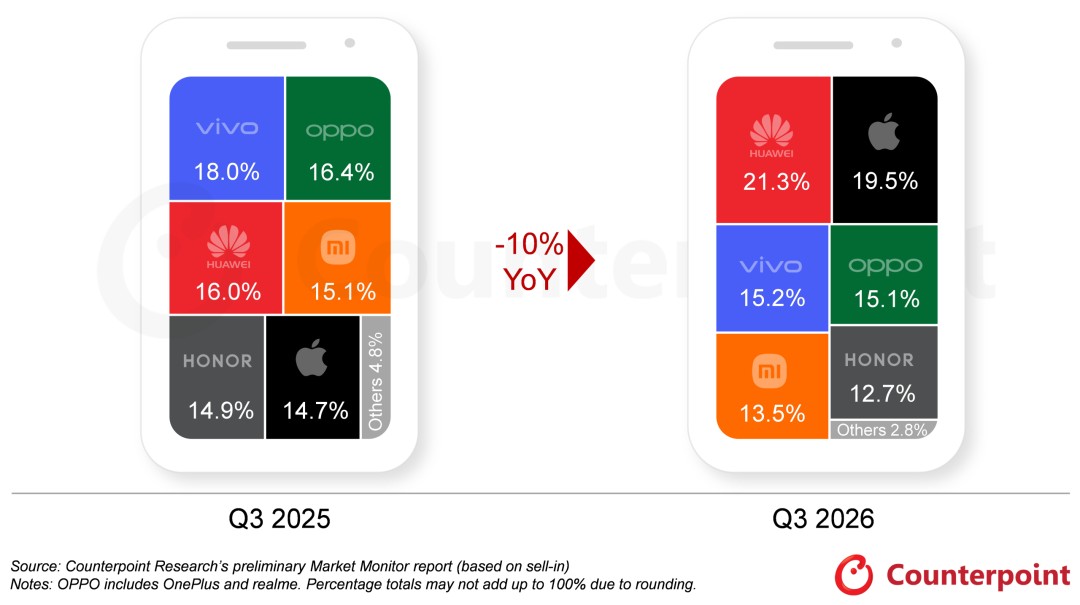
Source: Counterpoint Research Preliminary Market Monitor Report (based on Sell-in), Q3 2026
Note: OPPO includes OnePlus and realme. Due to rounding, the sum of percentages may not equal 100%.
In the third quarter of 2026, Huawei led the Chinese smartphone market with a 21.3% market share. Benefiting from stable prices in the early part of the quarter, Huawei's various product series performed steadily. Strong sales of the entry-level Changxiang 90 Pro Max, the mid-range Nova 16, and the flagship Mate 80 helped Huawei achieve a 19% year-over-year increase in shipments in the third quarter. However, Huawei officially raised product prices starting September 1, which may put further pressure on future sales.
Apple ranked second in the Chinese smartphone market in the third quarter of 2026 with a 19.5% market share. The iPhone 18 Pro series performed strongly in the Chinese market, with sales in the first three weeks after launch increasing by 23.5% year-over-year compared to the iPhone 17 Pro series. The delayed release of the base model iPhone 18 prompted some consumers to switch to Pro series models, thereby boosting the initial sales momentum of the Pro series.
September saw a wave of flagship launches, with most models hitting the market before the National Day holiday to capture the peak holiday consumption period. Chinese Android phone manufacturers adopted different product strategies: Xiaomi postponed the release of the standard Xiaomi 18, while vivo, OPPO, and Honor added Pro Max models to their flagship lineups. Meanwhile, OPPO and Honor also launched models positioned slightly below the base versions with more affordable prices, such as the Find X10E and Magic9 Super Edition. By expanding the price range, OEMs were better able to guide consumer price expectations, keeping the increase in starting prices within a certain range while absorbing the pressure of rising component costs. This allowed manufacturers to maintain growth in average selling prices (ASP) while minimizing the potential negative impact of price hikes on sales volume.
As Huawei and Apple also joined the price hike trend, the magnitude of cost increases indicates that OEMs are finding it increasingly difficult to fully absorb the rise in component costs. Facing the increasingly common trend of price increases, consumers have responded by delaying device upgrades, waiting for major promotional events to make purchases, or turning to the refurbished market for more affordable options. These behaviors may further weaken smartphone demand and bring additional pressure to sales in the fourth quarter.