
 I'm LongbridgeAI, I can summarize articles.
On October 19, iFLYTEK (002230) disclosed its third-quarter report for 2026. In the third quarter, the company achieved revenue of RMB 6.564 billion, a year-on-year increase of 7.99%. Net profit attributable to shareholders was RMB 226 million, up 31.05% year-on-year. Net profit after deducting non-recurring items was a loss of RMB 126 million. The non-recurring net loss for the first three quarters amounted to RMB 763 million, widening year-on-year
On October 19, iFLYTEK (002230) disclosed its third-quarter report for 2026. In the third quarter, the company achieved revenue of RMB 6.564 billion, a year-on-year increase of 7.99%. Net profit attributable to shareholders was RMB 226 million, up 31.05% year-on-year. Net profit after deducting non-recurring items was a loss of RMB 126 million. The non-recurring net loss for the first three quarters amounted to RMB 763 million, widening year-on-year.
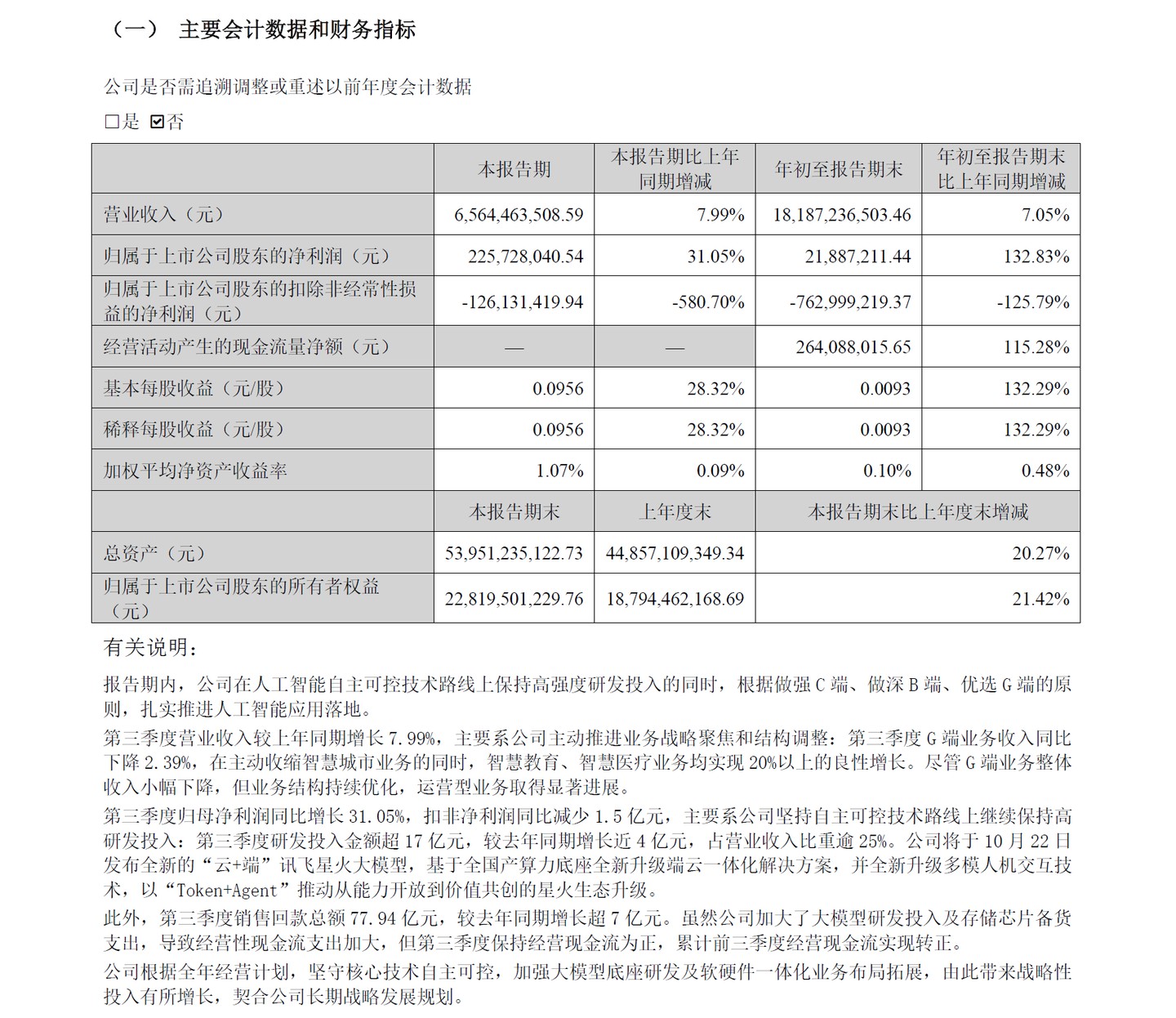
Regarding the profit structure, the company's revenue for the first three quarters totaled RMB 18.187 billion, a year-on-year increase of 7.05%. Net profit attributable to shareholders was RMB 21.8872 million, turning from a loss in the same period last year (approximately RMB 66.68 million) to a profit. During the same period, the net amount of non-recurring gains and losses was RMB 785 million, which is the amount after deducting the impact of income tax and minority interests.
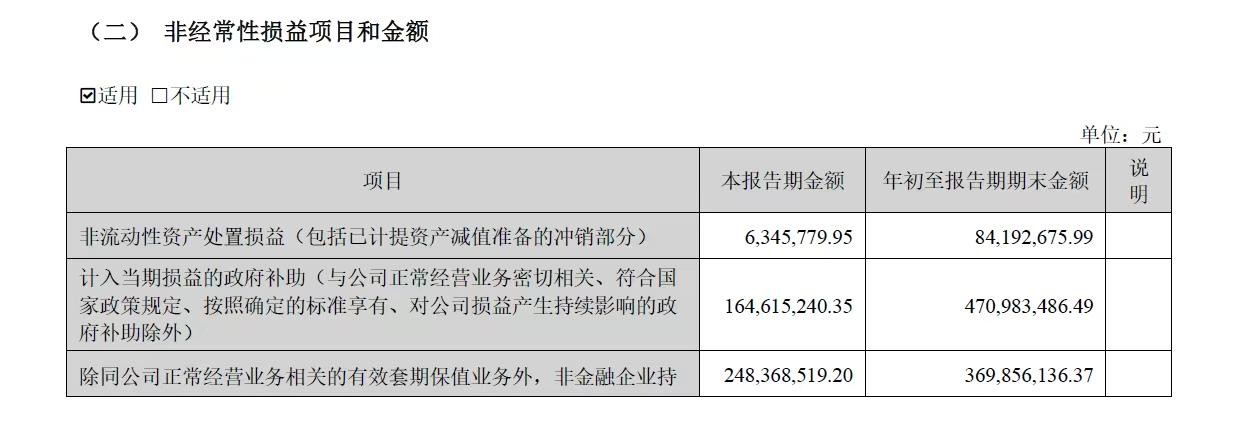
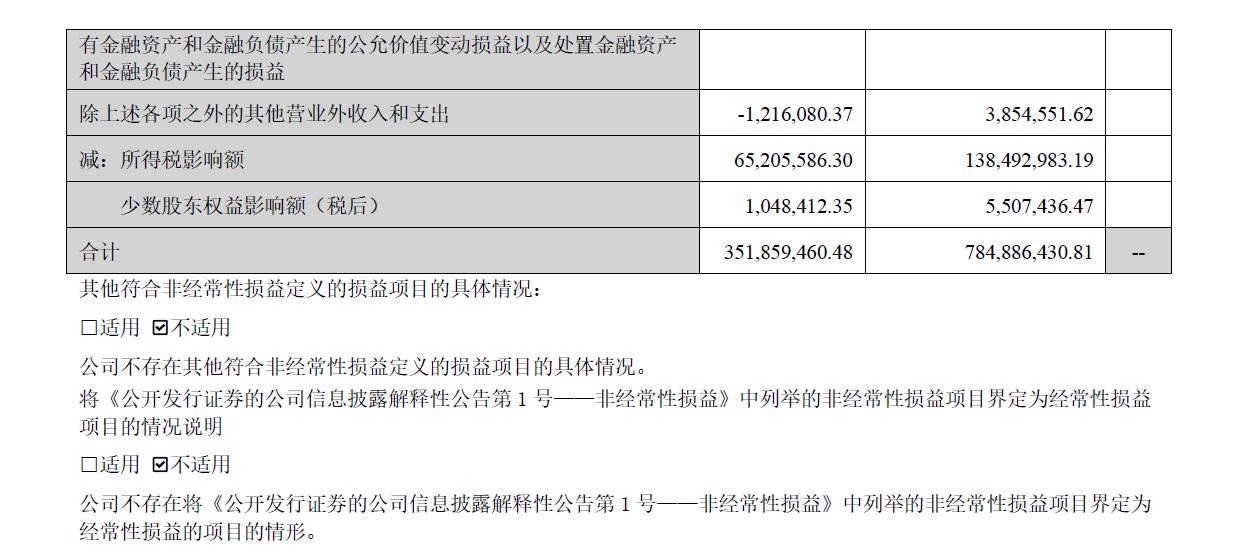
According to the statement of non-recurring gains and losses in the announcement, government subsidies amounted to RMB 471 million, and gains/losses from changes in fair value and disposal of financial assets and liabilities totaled RMB 370 million. The company stated that the latter was mainly due to an increase in the fair value of equity holdings in invested companies such as CIQTEK and Youdi after their listings. These two items are listed amounts and do not constitute a simple addition to the net figure. In comparison, there is a significant gap between the scale of net profit attributable to shareholders and the net amount of non-recurring gains and losses for the first three quarters. After exclusion, the non-recurring net profit remains a loss of RMB 763 million.
In the third quarter, the net amount of non-recurring gains and losses was RMB 352 million, including RMB 165 million in government subsidies and RMB 248 million in gains and losses related to financial assets and liabilities. The net profit after deducting non-recurring items was a loss of RMB 126 million.
At the business level, government-side revenue in the third quarter decreased by 2.39% year-on-year. The company attributed this mainly to the proactive contraction of its smart city business. During the same period, revenue from smart education and smart healthcare businesses both grew by more than 20%. Contract liabilities increased by 54.83% from the beginning of the year to RMB 2.579 billion. The company stated that this was mainly due to an increase in advance payments from customers. This account reflects the amount received or receivable from customers for which delivery obligations have not yet been fulfilled, and its subsequent conversion warrants attention.
In terms of R&D investment, the company stated that R&D spending in the third quarter exceeded RMB 1.7 billion, an increase of nearly RMB 400 million compared to the same period last year, accounting for more than 25% of operating revenue. R&D expenses for the first three quarters totaled RMB 3.85 billion, representing a year-on-year increase of approximately 20.8% based on calculations from the income statement.
Regarding cash flow, the net cash flow from operating activities for the first three quarters was RMB 264 million, a year-on-year increase of 115.28%, turning positive. Cash received from selling goods and providing services in the first three quarters amounted to RMB 19.69 billion, a year-on-year increase of approximately RMB 2.25 billion based on calculations from the cash flow statement. The company stated that total sales collections in the third quarter were RMB 7.794 billion, an increase of more than RMB 700 million compared to the same period last year.
The company stated that it increased investment in large model R&D and expenditures for stocking memory chips, leading to a corresponding increase in operating cash outflows. From a funding perspective, the net cash outflow from investing activities in the first three quarters was RMB 4.111 billion, while the net cash inflow from financing activities was RMB 6.059 billion. The A-shares issued by the company in 2025 to specific investors were listed on April 24, 2026. A total of 90.2323 million shares were issued at an issue price of RMB 44.33 per share, raising a total of RMB 4 billion, with a net amount of RMB 3.981 billion. The funds were designated for the Spark Education Large Model and typical products, computing power platforms, and supplementary working capital. Subscribers included 14 investors such as the National Artificial Intelligence Industry Investment Fund. As of the end of the reporting period, the National Artificial Intelligence Industry Investment Fund held a 0.80% stake, all of which is subject to lock-up restrictions. China Mobile is the largest shareholder with a 9.65% stake.
On the balance sheet, monetary funds at the end of the period totaled RMB 4.498 billion, an increase of 83.51% from the beginning of the year. The company attributed this mainly to the increase in raised funds. The balances of short-term borrowings, long-term borrowings, and bonds payable all rose from the beginning of the year, increasing by 62.95% to RMB 1.892 billion, 49.54% to RMB 4.062 billion, and 97.91% to RMB 1.602 billion, respectively. Inventory increased by 58.07% from the beginning of the year to RMB 4.791 billion. The company stated that this was mainly due to an increase in raw materials and finished goods. Combined with the aforementioned statement on stockpiling, the subsequent digestion of inventory warrants attention. Accounts receivable stood at RMB 17.802 billion. A simple comparison of the ending balance with the revenue for the first three quarters yields a ratio of approximately 97.9%. The high balance warrants attention regarding collection and changes in aging.
In terms of earnings quality, calculations based on announcement data show that the gross margin for the first three quarters was approximately 39.8%. This is calculated as operating revenue minus operating costs, divided by operating revenue, excluding taxes and surcharges and financial expenses. During the same period, the R&D expense ratio was approximately 21.2%, and the selling expense ratio was approximately 19.8%. The sum of these two ratios is approximately 41%, which is already higher than the gross margin under this calculation method, and does not yet include administrative and financial expenses. The above are the author's calculations and are not indicators disclosed by the company.
iFLYTEK will release the new "Cloud + Edge" Spark Large Model on October 22. Based on a domestically produced computing power foundation, it upgrades integrated cloud-edge solutions and multimodal human-computer interaction technology. The company's operational turning point awaits validation through the commercialization of the Spark Large Model and a narrowing of non-recurring losses.