
 I'm LongbridgeAI, I can summarize articles.
Semiconductor stocks recently declined, with the Philadelphia Semiconductor Index dropping 10% in six days and memory makers suffering sharper losses. The selloff was driven by inflation concerns and fears of future supply gluts from Chinese competitors like CXMT. Despite the drop, earnings growth has historically outpaced price increases, suggesting the sector is not yet in a bubble. However, investors are pricing in potential busts, particularly in memory chips, while AI chip designers remain supported by strong demand forecasts from industry leaders.
Picture a ski resort that has sold out every winter for the past three years, with this season fully booked too. Then a long-range forecast calls for a warm winter three seasons from now, and the resort’s shares tumble. Chip stocks are living through a version of that.
The Philadelphia Semiconductor Index, the main gauge of chip stocks, lost about 10% in the six trading days up to October 14th, and memory makers lost far more. A hotter inflation report that day added fuel by reviving talk of higher interest rates. The slide kept going: By the close on October 20th, the VanEck Semiconductor ETF (NASDAQ:SMH) was 14% below its October 5th high.
Chips carried the market for three years
Chips have carried the market for three years. SMH has nearly quadrupled over that span, delivering an annualized return of 57%. The iShares Semiconductor ETF (NASDAQ:SOXX) has more than tripled.
Much of that rally has been driven by two groups of companies: Nvidia Corp. (NVDA), whose chips power AI models, and memory makers Micron Technology Inc. (MU) and SK Hynix. Together, they account for 29% of SMH and 18% of SOXX.
For three years, investors have questioned how long the rally can last. So far, earnings growth has helped justify it.
Earnings Grew Faster Than Prices
Over the past 12 months, SMH returned 58%, while earnings at its constituent companies grew 104%. SOXX returned 71%, as earnings at its holdings increased 106%.
That is why the funds got cheaper while prices climbed: SMH’s trailing P/E declined to 30x from 39x. Over the same year the S&P 500’s earnings rose about 35%.

Memory Turned First
The selloff hit memory hardest. Over the five days to 15 October, SK Hynix fell 26%, Samsung Electronics 22% and Micron about 11%.
Two worries landed at once. CXMT, China’s leading memory maker, unveiled a denser chip design it plans to bring to servers by the end of the year, raising the prospect that it takes market share from Samsung, SK Hynix and Micron. Then a column in South Korea’s Maeil Business Newspaper, citing industry experts, warned of a glut of new capacity by 2029 and urged the country to find its next growth engine. Elon Musk weighed in on X: “China will be making a LOT of RAM in 2028.”
Inside the industry, the shortage still looks persistent. Analysts at Quilter Cheviot and Rosenblatt Securities doubt CXMT can make the new design at scale soon enough to tip supply and demand. Micron’s chief executive, Sanjay Mehrotra, said on 30 September that “in calendar year 27 as well as 2028, we see demand exceeding supply.” DRAM contract prices rose about a fifth in the three months to October, according to data from Barclays PLC (BCS).
Memory has long been a boom-and-bust business, and investors are pricing the bust years ahead. Trailing P/E of SMH’s constituents fell from about 32x in June to 7.7x.

On Micron’s own guidance for this quarter, its shares trade at about 6x, with a gross margin of 87% against year-ago 46%. The price assumes those profits fade.
The AI chip designers, Nvidia among them, also got cheaper: their trailing P/E is 36x, down from 62x a year ago, because their profits rose faster than their shares.
Is It A Bubble?
In a bubble, prices run ahead of earnings. Over the past year chip stocks did the opposite.
They are still expensive against their own history. SMH’s trailing P/E is higher than 61% of its monthly readings since 2017, and SOXX’s higher than 67%. Both are well below the June peak, when SMH reached 49x.
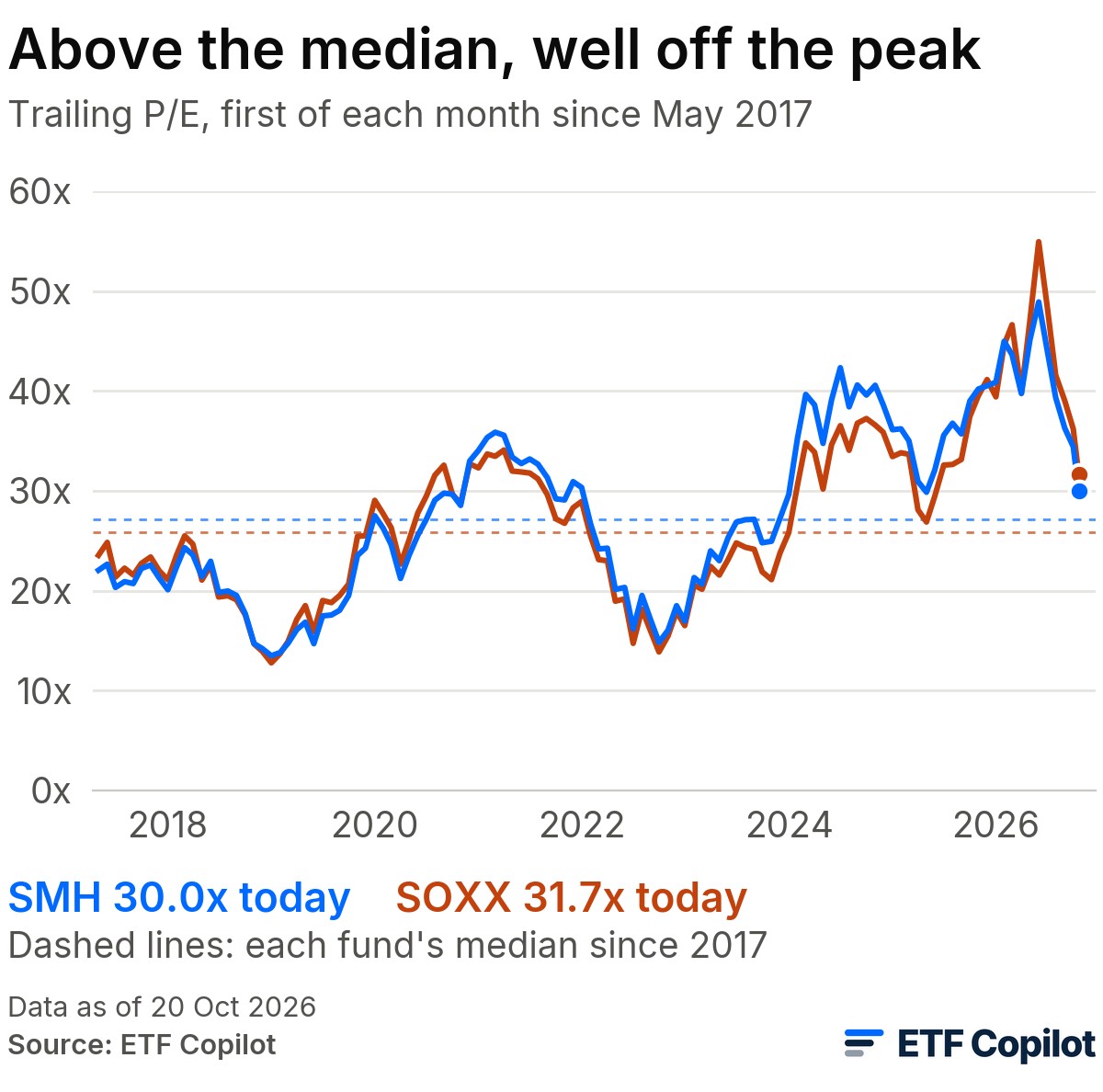
The companies’ own outlooks still point up. Taiwan Semiconductor Manufacturing Co. Ltd. (TSM) reported on 15 October and guided fourth-quarter revenue to $52.3 billion to $54.3 billion, up from $46.7 billion in the third quarter. A day earlier the chief executive of ASML Holding N.V. (ASML), Christophe Fouquet, said customers are raising their demand forecasts, “driven primarily by their views on the size and duration of AI-related investments.”
The wealth-management arm of UBS Group AG (UBS) called last week’s drop a recalibration of expectations, with the AI investment story intact.
What would turn it into a bubble is earnings that stop arriving. Profits at the top of a cycle are the easiest to lose, and memory’s single-digit multiple says investors already doubt part of them. Chip funds fall hard when that happens: in the year to October 2022, SMH and SOXX each lost a third.
Where This Leaves Chip Investors
For now the selloff looks like investors marking down the far end of the cycle while profits are still rising. The upcoming earnings reports are the test. If results keep pace with guidance, today’s prices rest on firmer ground than June’s peak did. If memory turns as early as the skeptics fear, the companies that led the climb may lead the fall.
Disclosure: Based on data as of 20 October 2026. This is not investment advice or a recommendation to buy or sell any security. ETF Copilot receives no compensation from the issuers of the funds mentioned, and may or may not hold positions in the funds mentioned.
An earlier version was published in the ETF Copilot newsletter.
Benzinga Disclaimer: This article is from an unpaid external contributor. It does not represent Benzinga’s reporting and has not been edited for content or accuracy.
Login to unlock3,850characters for free
Due to copyright restrictions, please log in to your Longbridge account to view this content.
Thank you for your understanding and support of licensed content.