
 I'm LongbridgeAI, I can summarize articles.

November 3, 2026 (U-Analyze / Industry Data Center Report) — Apple ( AAPL-US) expects its December quarter to post the highest single-quarter revenue in its history, but surging memory prices are compressing gross margins. The focus of new CEO John Ternus's first earnings call has shifted from the strength of demand to whether costs and supply can keep pace.
Apple's fiscal 2026 fourth-quarter revenue was $114.5 billion, up 12% year-over-year; earnings per share (EPS) were $2.10, up 14% year-over-year, including a $0.05 benefit from tariff refunds. Both revenue and EPS exceeded market consensus estimates of $113.4 billion and $1.99, respectively. Full-year revenue reached $478.8 billion, with EPS at $8.98, both setting new fiscal year records.
The company forecasts December quarter revenue growth of 7% to 10% year-over-year, a gross margin of 45% to 46%, and operating expenses between $20.4 billion and $20.8 billion. This guidance already reflects supply constraints.
Memory Price Hikes Bring Gross Margin Pressure to Light
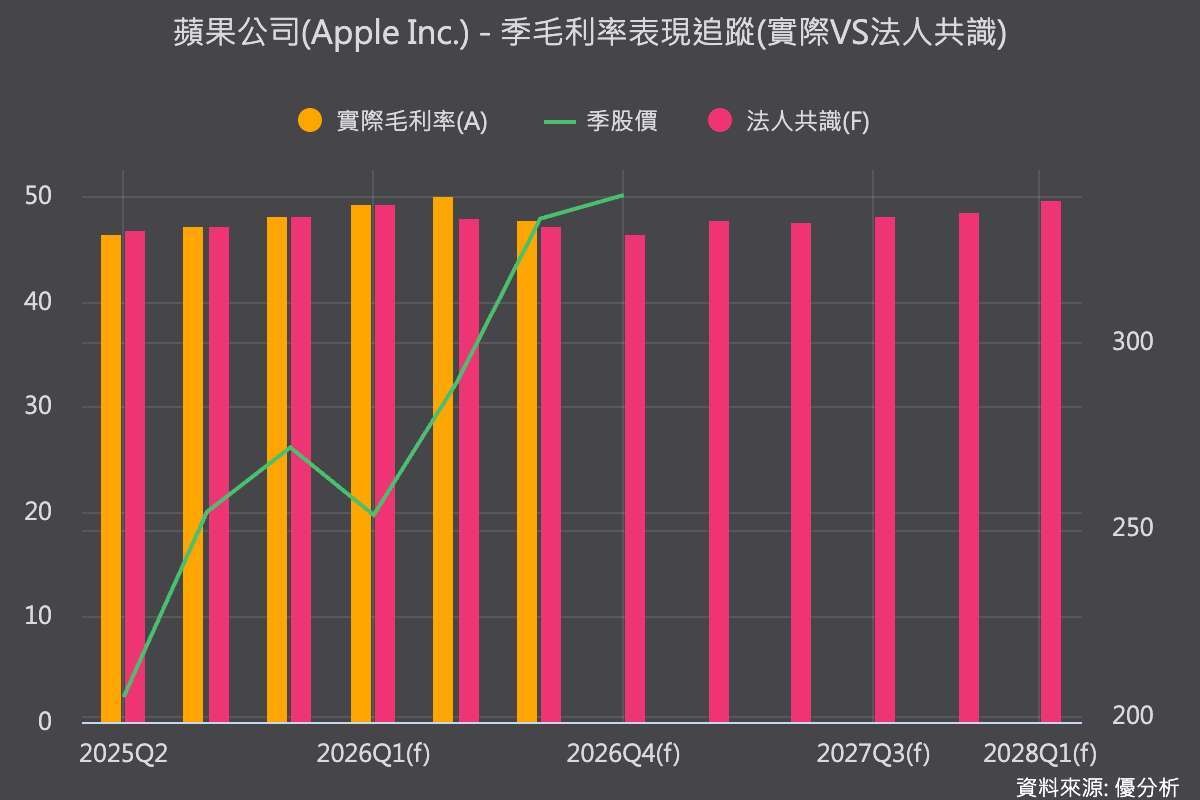
The company's gross margin in the fourth quarter was 47.9%, near the upper end of its guided range of 47% to 48%, and better than the market consensus average estimate of 47.24%. However, about 1 percentage point of this came from tariff refunds, which also benefited product gross margins, which stood at 37.2%. If the refunds from the June and September quarters are excluded, both gross margins decreased by approximately 1 percentage point quarter-over-quarter, primarily due to memory costs.
Pressure will intensify in the December quarter. Apple projects its gross margin to fall between 45% and 46%. Even at the upper end of this range, it remains below the market consensus average of 46.52% compiled by U-Analyze. Some analysts estimate that, excluding refunds, the midpoint of the gross margin guidance represents a quarter-over-quarter decline of about 140 basis points. The company confirmed this approximate decline, attributing most of it to memory, with the remainder including costs related to the Siri AI launch. Management explicitly stated that the current trend in memory prices is unprecedented.
Apple has employed multiple tools to mitigate the impact. Mac and iPad prices were raised in late June, followed by iPhone price increases in September. These measures, combined with previously acquired lower-cost inventory and price reductions on some non-memory components, have offset part of the shock.
The issue is that these buffers will not last indefinitely. The company expects memory procurement prices to continue rising after the December quarter, and the benefit from low-cost inventory will gradually diminish. The market currently expects the gross margin to rebound to 47.79% in the March 2027 quarter. Whether this forecast holds depends on memory costs and the effectiveness of subsequent price adjustments. Regarding whether price hikes will affect demand, CFO Kevan Parekh stated it is too early to judge, making this a key point to watch in the next quarter's earnings report.
Supply Bottlenecks Shift from Advanced Processes to Memory
In the fourth quarter, iPhone, Mac, and iPad all faced supply constraints. iPhone revenue was $57.6 billion, up 17% year-over-year; Mac revenue was $10.8 billion, up 24% year-over-year; iPad revenue was $6.2 billion, down 10% year-over-year. The decline in iPad revenue was due not only to a higher base in the same period last year but also to shortages.
COO Sabih Khan stated that the previous quarter's constraints mainly stemmed from capacity for advanced manufacturing processes used in chips. As more products transition to the 2-nanometer process, this constraint has gradually improved. However, the bottleneck has not disappeared; it has merely shifted location. The supply constraints for Mac and iPad in the December quarter are primarily driven by memory, as demand has exceeded the company's expectations.
The iPhone has not completely escaped these issues either. The first foldable model, the iPhone Duo, remains in short supply. The company stated that mass production is proceeding smoothly, but it is difficult to predict when supply and demand will reach equilibrium.
To secure supply, Apple's manufacturing purchase commitments increased by $33 billion from the June quarter to the September quarter. When analysts twice asked if long-term contracts had been signed with memory manufacturers, management did not respond directly, only reiterating efforts to improve supply and not specifying how much of this amount was related to memory.
Services Growth Slows, Siri AI Costs Begin to Be Recognized
Fourth-quarter services revenue was $31.6 billion, up 10% year-over-year, hitting a record high, with a gross margin of 76%, an increase of 40 basis points quarter-over-quarter. However, the company expects the growth rate to drop to 8% to 9% in the December quarter, prompting analysts to question whether growth in this segment can be sustained.
Parekh attributed the slowdown mainly to exchange rates. From the March quarter to the September quarter, exchange rates created a headwind of approximately 4 percentage points, which will increase by another 0.5 percentage points in the December quarter. Third-party licensing income also faces seasonal pressure.
But exchange rates are not the only factor. App Store performance in the fourth quarter was similar to the same period last year, and the weakness in mobile gaming is expected to continue into the December quarter. Some countries have adjusted the App Store's business model, and external link transactions in the United States remain affected by court rulings.
Siri AI presents both opportunities and costs. As the user base grows, related cloud costs will be included in the cost of services, and revenue deferred from hardware sales will also be incorporated into Siri AI, both of which will impact gross margins. With Siri AI just launched, the company stated it is still difficult to estimate the ratio of on-device to private cloud computing, making it hard to determine the cost structure.
Monetization directions are emerging. Features using server-side models will have usage caps, and users needing additional quota can pay for extra access in the future. Based on a foundation of over 2.5 billion active devices and 1.5 billion paid subscriptions, whether this new revenue stream can offset the growth pressure on the App Store remains to be seen.
Mac Demand Strengthens, On-Device AI Becomes a New Selling Point
The Mac was one of the standout hardware products in this earnings call. Despite shortages, revenue grew 24% year-over-year in the fourth quarter, driven mainly by the MacBook Neo and MacBook Pro. According to IDC statistics, Apple gained market share in both the fourth quarter and the full year, with annual Mac sales also reaching a new ATH (All-Time High).
Ternus positioned the Mac as an AI platform, highlighting that the Mac mini and Mac Studio are driving local private AI. There are already practical enterprise cases: clothing retailer Gap runs loss-prevention AI on Mac minis in hundreds of stores without bearing cloud token costs; Christie's uses Mac Studios to run local models for workflows such as valuation.
However, the company did not disclose the revenue contribution from on-device AI. Currently, these remain individual cases and are not yet sufficient to form a massive scale of demand.
In the short term, supply determines the ceiling for Mac growth. The company expects Mac supply in the December quarter to be constrained by memory, meaning that even if demand continues to exceed expectations, its conversion into revenue depends on the availability of memory supplies.
※ This article is republished with authorization from "U-Analyze." Original source: Original Link
※ Disclaimer: The content regarding individual stocks, funds, and futures commodities mentioned in this article is for reference only and does not constitute investment advice. Investors should make independent judgments and carefully assess risks.