
 I'm LongbridgeAI. Here is the key information I extracted
While Wall Street continues to debate the return prospects of AI capital expenditures, a trillion-dollar giant composed of insurance, railroads, energy, and traditional consumer businesses is quietly marching toward historic highs.
On November 2 local time, Berkshire Hathaway Class B shares closed at $556.11, with an intraday high of $557.59, both setting new all-time records. Meanwhile, the US AI trade faced headwinds: the Nasdaq Composite fell 5.3% in October, as concerns mounted over whether tech giants' massive AI investments would deliver returns.
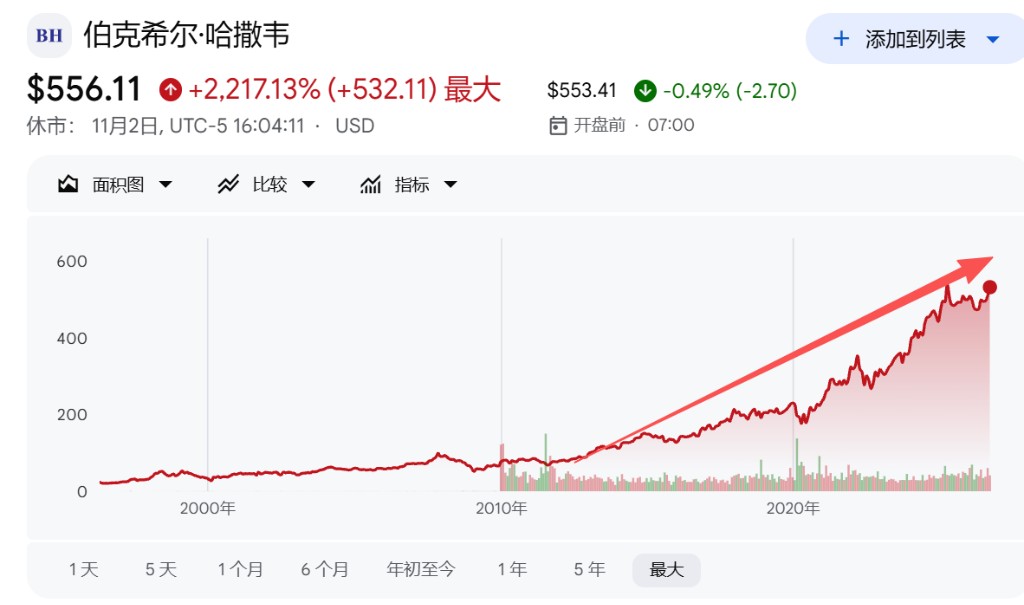
With AI tech stocks under pressure and "old guard" stock Berkshire Hathaway strengthening, the contrast in market styles is becoming one of the most noteworthy changes in the US stock market recently.
Berkshire's rise is both a result of defensive capital seeking a foothold and a sign that the market is gradually digesting the uncertainty surrounding Buffett's departure as CEO. For Greg Abel, who is succeeding the "Oracle of Omaha," this rebound in share price is undoubtedly a positive signal.
As the AI Trade Recedes, Berkshire's Defensive Attributes Come Back into Focus
For some time, AI has been the core trading theme in the US stock market. Tech giants have continuously increased investments in data centers, chips, and computing infrastructure, driving related stocks higher.
But cracks are appearing in this feast.
As the performance of tech giants like Alphabet and Amazon failed to fully meet market expectations, investors began to re-examine the costs and returns of AI investments. Massive capital expenditures require continuous financing, and whether these inputs can translate into sufficient cash flow within a reasonable timeframe has become the focus of market attention.
In October, the Nasdaq Composite fell 5.3%, and AI-related stocks suffered significant selling pressure. The market is no longer just focused on technological prospects but is also asking: When exactly will such massive investments translate into profits?
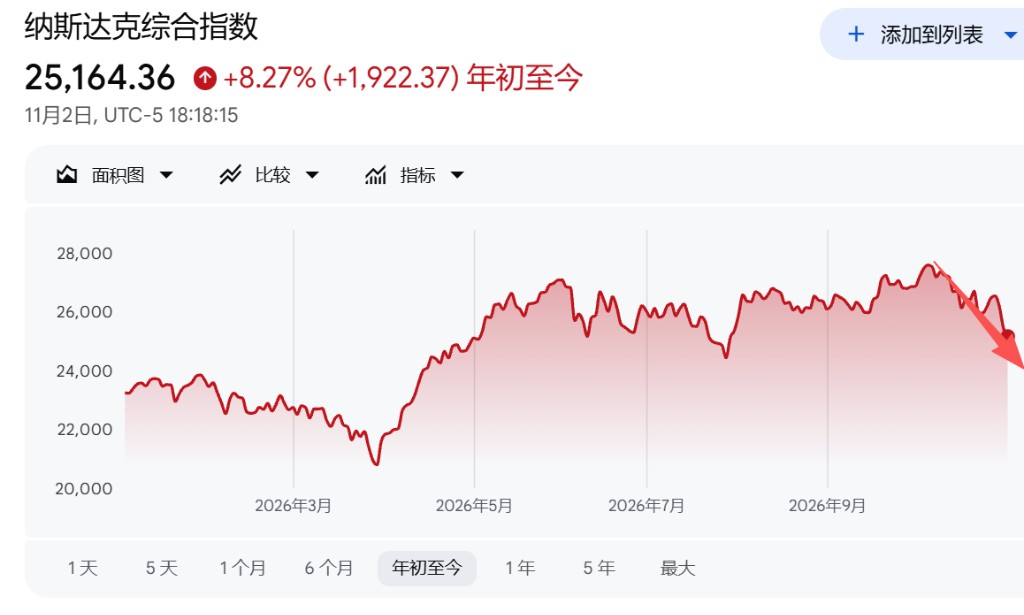
Against this backdrop, Berkshire's advantages are gradually becoming apparent.
This enterprise, with a market capitalization exceeding $1.1 trillion, has diversified businesses including insurance, railroads, energy, and industry, with annual after-tax earnings approaching $50 billion. As of the end of the second quarter, the company's cash and cash equivalents exceeded $365 billion.
The massive cash reserve provides Berkshire with a buffer against market volatility, while its diversified business structure means it does not have to rely entirely on the growth of any single industry.
More importantly, Berkshire is not merely a collection of traditional industries. Its equity portfolio, worth approximately $360 billion, includes core holdings like Apple and Coca-Cola, which have performed well recently, providing support for the company's asset value.
Judging by market performance, capital is re-evaluating Berkshire's defensive value. Over the past month, Berkshire's stock price has risen by about 5%. Against the backdrop of the receding AI trade, investor focus on asset safety and earnings stability has significantly increased.
Buffett Exits, Yet Berkshire Moves Toward Record Highs
Another significance of Berkshire's record-high stock price is that the uncertainty surrounding the management transition is gradually fading.
In May 2025, Buffett announced at the annual shareholders' meeting that he would step down as CEO at the end of the year. This news initially triggered market selling, as investors worried whether Berkshire could maintain its long-standing Capital Allocation Policy without Buffett.
After Abel officially took over as CEO at the end of 2025, Berkshire's stock performance was initially sluggish. But as time passed, market concerns about this transition gradually eased.
Abel has not significantly altered the operating system established by Buffett.
In his first annual letter to shareholders, he stated that Berkshire would continue to maintain a decentralized management structure, with broad operational autonomy for each business unit head; the company would also continue to maintain a centralized equity portfolio, with long-term core holdings remaining an important component of capital allocation.
Abel joined Berkshire in 1999 and previously managed Berkshire Hathaway Energy. Today, he has taken over a mature system that has been running for decades, rather than a company needing complete reconstruction.
Berkshire's historical performance has also provided confidence to the market.
From 1965 to 2025, Berkshire recorded declines in only 11 years, with a cumulative return of approximately 6,099,294% and an annualized return of 19.7%. During the same period, the S&P 500 Index had a cumulative return of approximately 46,061% and an annualized return of 10.5%.
This track record does not come from short-term bets but from the compound effect of long-term holdings in high-quality enterprises, using insurance float for capital allocation, and continuously accumulating operating assets.
However, hitting new highs does not mean Abel has completely passed the test. The time since his succession has still been limited, and the market's recognition of Berkshire is more likely a repricing of its asset quality and operating structure rather than a final judgment on the new CEO's capabilities.
$365 Billion in Cash: Abel's Real Test Lies Ahead
The higher Berkshire's stock price goes, the harder it is to avoid market scrutiny of Abel's capital allocation capabilities.
As of the end of the second quarter of 2026, Berkshire's cash and cash equivalents exceeded $365 billion. This fund is both a safety cushion for the company against market declines and important ammunition for finding future investment opportunities.
But cash reserves also imply pressure.
Berkshire has never paid dividends, and the market's acceptance of this policy is largely due to trust in Buffett's capital allocation abilities. With Abel taking over, investors may pay closer attention to whether these funds will be used for acquisitions, equity investments, or simply remain on the balance sheet.
For Berkshire, with a market capitalization already exceeding $1 trillion, finding large investment opportunities capable of significantly driving overall performance growth is becoming increasingly difficult.
Abel has already begun adjusting the investment portfolio.
Apple remains Berkshire's largest equity holding. As of the end of June, the company held 227.9 million shares of Apple, valued at approximately $66 billion, accounting for about 22% of its equity portfolio. This ratio has dropped significantly from the previous peak of nearly 50%.
Berkshire reduced its Apple stake by about 75% from the mid-2023 level of approximately 915 million shares. Buffett previously explained that the Apple position was too large relative to Berkshire's overall scale.
However, Berkshire has not continued to sell Apple stock since the end of 2025. The market will watch the company's next 13F filing to determine if it further adjusted its holdings in the third quarter.
Meanwhile, Berkshire is also seeking new investment opportunities. In the second quarter of 2026, the company purchased approximately $17 billion worth of Alphabet stock, with about $10 billion bought directly from Alphabet.
This means that Abel is not simply copying Buffett's past portfolio but is attempting to find new capital allocation opportunities while continuing the long-term investment framework.
"Old Guard" Stocks Strengthen as Market Seeks Answers Beyond AI
Berkshire's stock price hitting a record high does not necessarily mean the market has completely abandoned the AI trade.
But at least at this stage, investors are re-examining asset valuation logic: when the relationship between massive capital expenditures and future returns becomes uncertain, companies with ample cash reserves, diversified businesses, and relatively stable earnings are beginning to regain attractiveness.
Berkshire is representative of this logic.
It possesses massive cash reserves, mature operating assets, and a long-term investment portfolio, along with a Capital Allocation Policy validated over decades. Buffett's departure was once the market's biggest concern, but now, with the stock price returning to historic highs, it indicates that investors have at least begun to accept the possibility of Berkshire's continuity in the new era.
However, Berkshire's long-term performance still depends on whether Abel can continue to create value. For this trillion-dollar enterprise, how to put the massive cash reserve to work and how to find sufficiently large investment opportunities are the true challenges for the future.
AI down, "old guard" up. The shift in market style may be only phased, but Berkshire is proving that beyond the tech narrative, capital markets are still willing to pay for robust asset quality and long-term capital allocation capabilities.