
 I'm LongbridgeAI. Here is the key information I extracted
Zhitong Finance APP reports that Apple (AAPL.US) delivered a report card characterized by "strong revenue but weak guidance" in its latest fiscal quarter: both revenue and earnings per share exceeded Wall Street expectations, with iPhone revenue growing 17% year-over-year. However, the gross margin guidance and services growth outlook for the next fiscal quarter were significantly below market expectations, shifting investor focus from hardware resilience to medium-to-long-term challenges stemming from memory costs, Siri AI investments, and personalized AI agents. Following the earnings release, Apple's stock fell approximately 4% in pre-market trading on Tuesday.
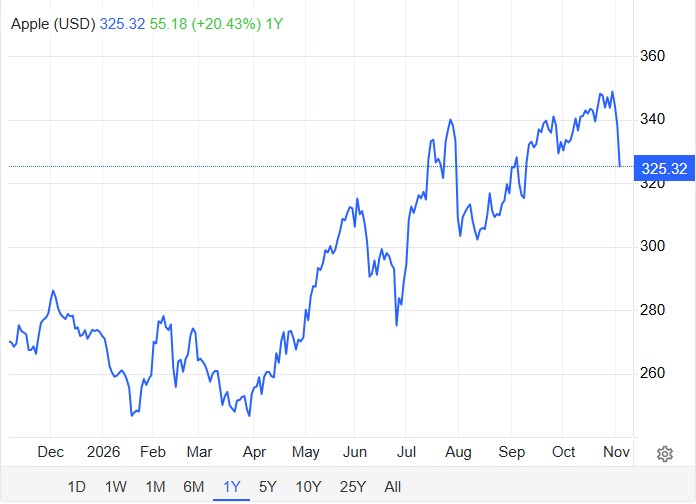
Specifically, Apple's fourth-quarter revenue amounted to $114.48 billion, surpassing Wall Street's expectation of $113.39 billion. Earnings per share stood at $2.10, also beating analysts' forecast of $1.98. Among these figures, iPhone revenue increased 17% year-over-year, and services revenue reached a record high of $31.57 billion, although its year-over-year growth slowed to 9.8%, down from 12.1% in the previous quarter. Revenue from wearables, home, and accessories also missed market expectations.
Looking ahead, Apple guided for revenue growth of 7% to 10% in the next fiscal quarter, with services revenue growth projected at 8% to 9%, below analysts' expectation of 12%. The gross margin guidance was set at 45% to 46%, which is not only lower than the previous quarter's 47.9% but also below the market expectation of around 47%. Apple attributed the pressure on gross margins primarily to the "unprecedented" rise in memory chip prices and the increasing costs associated with ramping up its Siri artificial intelligence (AI) assistant.
AI Agents: The "Biggest Risk" Apple Avoided Addressing Directly?
Gene Munster, a well-known tech investor and managing partner at Deepwater Asset Management, expressed disappointment via tweet regarding Apple CEO John Ternus's responses concerning personalized AI agents during the earnings call.
Munster posted on X that he had hoped Ternus would explain how Apple positions itself in the context of AI agents reshaping consumer tech interactions, rather than merely discussing improvements to Siri. "It’s clear they don’t want to talk about personalized agents," Munster wrote, labeling this the "biggest risk to the Apple ecosystem."

Munster estimates that approximately 20 million people currently use personalized AI agents, including Meta Platforms' (META.US) Muse and SpaceX's (SPCX.US) Grok Bot, predicting that this usage scale could eventually reach billions of users daily. In response to analysts' questions about how AI agents might impact Apple's services business, Ternus emphasized that Apple's AI-driven Siri retains the capacity to expand while maintaining user privacy and security. On a second question, he described the iPhone as a personal hub and highlighted Siri's ability to securely access user information.
However, in Munster's view, Apple's response to the competitive landscape of "agent AI" remains insufficient.
This concern echoes risk warnings from some investment banks. Morgan Stanley, in its report, listed the slowdown in services growth alongside "agent risk," noting that discussions about AI potentially impacting Apple's key services business—beyond App Store issues, third-party licensing, and foreign exchange headwinds—are gaining traction. Bernstein also listed "Apple falling too far behind in generative AI and its ecosystem being disrupted by AI-native competitors" as one of the downside risks.
Major Bank Ratings: Bullish Stance Maintained, but Target Prices and Earnings Forecasts Adjusted
Morgan Stanley lowered Apple's target price from $355 to $350. Analyst Erik Woodring and his team pointed out that while Apple's revenue guidance for the next fiscal quarter exceeded expectations, the downturn in services business and gross margins offset the positives, leaving the earnings per share forecast for the first fiscal quarter largely unchanged. Morgan Stanley also reduced its earnings per share forecasts for Apple's fiscal 2027 and calendar 2027 by 5 cents and 16 cents, respectively, to $9.85 and $10.00.
Morgan Stanley detailed that Apple's revenue growth guidance of 7% to 10% for the next fiscal quarter is about 260 basis points higher than the bank's and market expectations, despite the company facing supply constraints, a high base from the previous year, and fewer new flagship model launches. iPhone and Mac are the main growth drivers, with pricing expected to contribute over 100% of the year-over-year revenue growth. Channel inventory was below target at the end of September for iPhone, Mac, and iPad, bolstering the bank's confidence in product demand.
However, the services growth guidance of only 8% to 9% is 2 to 2.5 percentage points lower than market expectations, implying a further slowdown from the 9.8% recorded in the September quarter. Management attributed the pressure to third-party licensing (i.e., Google's TAC), a foreign exchange drag of approximately 50 basis points, weakness in mobile gaming, and changes in the App Store business model. Morgan Stanley expects services growth to slow further to a 7% year-over-year increase in the March quarter, with full-year fiscal 2027 growth at 9.3%, marking the first time since fiscal 2023 that it falls below 10%.
Regarding gross margins, Morgan Stanley stated that the midpoint of Apple's 45% to 46% guidance for the next fiscal quarter is 100 basis points lower than its expectation and 140 basis points below market expectations. The bank had previously anticipated about $1 billion in tariff refunds, which apparently did not materialize substantially; excluding this factor, the guidance "almost meets expectations."
Even so, the guidance implies a sequential compression of about 140 basis points from the 46.9% in the September quarter (excluding tariff refunds), mainly driven by rising memory costs. This impact outweighs the offsetting effects of price increases for iPhone, Mac, and iPad, benefits from carryover inventory, and declining costs of non-memory components. Management expects memory inflation to persist beyond the next quarter, while benefits from low-cost inventory will gradually fade, potentially leading to product gross margins that "worsen first, then improve." The incremental cloud inference costs brought by the launch of Siri AI will enter services business costs, but these are relatively small compared to memory costs.
Despite lowering the target price, Morgan Stanley maintains an "Overweight" rating, believing that the debate between bulls and bears has not fundamentally changed due to the earnings report. Bulls will emphasize the upside in next-quarter revenue, lower capital expenditures, strong free cash flow, and the continued strength of the core iPhone product. Bears will focus on the slowdown in services, the risks of agent-style AI, headwinds from memory costs, and the lack of substantial earnings per share upgrades post-earnings. The bank leans towards a constructive stance but sees limited upside potential for the new target price; as the market questions the overall AI trade, Apple's stability and cash flow predictability may be more rewarded.
Bernstein also maintains an "Outperform" rating on Apple, with a target price of $370. Analyst Mark C. Newman and his team noted that Apple's fourth-quarter revenue of $114.5 billion represented a 12% year-over-year increase, exceeding the bank's and consensus expectations by 1.6% and 0.9%, respectively. Earnings per share of $2.10 surpassed their expectation and the consensus by 6% and 5%, respectively. iPhone revenue grew 17%, slightly above the mid-double-digit guidance. Services revenue grew 10%; despite facing an incremental foreign exchange headwind of about 2.5 percentage points, the growth rate excluding foreign exchange was approximately 12.5%, basically consistent with the previous quarter's ~12%. Gross margin of 47.9% was at the high end of the 47% to 48% guidance range, exceeding the bank's and consensus expectations by 36 basis points, respectively. Operating margin was 31.1%, beating their expectation by 68 basis points and the consensus by 44 basis points.
However, Bernstein expressed greater disappointment with the next-quarter gross margin guidance: Apple guided for 45% to 46%, below its previous expectation of 46.2% and the market expectation of 46.7%. The bank stated that this guidance incorporates a more favorable iPhone product mix, but this is offset by accelerating rises in memory costs. If the benefit from the high-end mix is excluded and it is assumed that the base model of iPhone 18 is available, the next-quarter gross margin could be about 30 basis points worse than the guidance.
Management explicitly listed memory costs as the primary headwind for gross margins, stating that memory prices will continue to rise after the next fiscal quarter and benefits from low-cost inventory will diminish. Bernstein expects gross margin pressure to persist in the short term, with operating expenses estimated at $20.4 billion to $20.8 billion and a tax rate of approximately 17%.
Nevertheless, in the long term, the bank believes Apple's bullish logic remains intact: Apple is the gateway to the consumer-side intelligence revolution, situated at the intersection of hardware, software, and AI, with a high-quality installed base of over 2.5 billion active devices.
The "Bumpy Period" for Gross Margins and Re-acceleration of Services are Key
Additionally, analysts from Evercore ISI, led by Amit Daryanani, wrote in a report that Apple will have to face a "bumpy gross margin environment" until memory prices stabilize or decline, and there is evidence that Siri AI can achieve commercialization.
Analysts from Goldman Sachs, led by Michael Ng, expressed increased confidence in the iPhone replacement cycle but also emphasized the slowdown in services growth, partly dragged down by the App Store.
Regarding shareholder returns, Ross Hendricks, an analyst at Porter & Company, pointed out that Apple's quarterly buyback scale of $24 billion is not outstanding relative to its market capitalization of approximately $5 trillion. Annualized at $96 billion, the shareholder yield is about 2%.