
 I'm LongbridgeAI. Here is the key information I extracted
On November 4, the "Global Cooperation and Innovation in AI Agent Mutual Trust, Interconnection, and Interoperability – Joining Hands to Build the Intelligent Internet Forum" at the Wuzhen Summit of the 2026 World Internet Conference officially released the "Self-Discipline Convention for AI Agent Development" (hereinafter referred to as the "Self-Discipline Convention"). The Self-Discipline Convention is a specific measure to implement the task deployment of "strengthening industry self-discipline" outlined in the "Implementation Opinions on Standardized Application and Innovative Development of AI Agents." It was jointly drafted and released by key players in the AI agent ecosystem, including the China Academy of Information and Communications Technology (CAICT), Tencent, Ant Group, Alibaba, and Douyin, under the organization of entities such as the China Internet Society.
The Self-Discipline Convention proposes eight self-disciplinary measures: first, improving the AI agent trust system; second, building AI agent interconnection infrastructure; third, enhancing AI agent interoperability; fourth, strengthening AI agent security protection capabilities; fifth, improving AI agent governance mechanisms; sixth, protecting AI agent user rights and interests; seventh, accelerating the empowerment of various industries by AI agents; and eighth, promoting the inclusive sharing of AI agent technologies.
The formulation and release of the Self-Discipline Convention mark an important step toward standardized development in the AI agent industry. It will help build consensus among all parties, strengthen industry self-discipline, improve the level of mutual trust, interconnection, and interoperability of AI agents, and guide the standardized application and innovative development of AI agents.
Next, the initiating units will take the lead in implementing the commitments of the Self-Discipline Convention and proactively accept supervision from industry organizations and the public. Meanwhile, all types of entities in the AI agent ecosystem are welcome to actively participate in the construction of the convention, jointly creating an open, trustworthy, secure, and inclusive AI agent ecosystem.
Appendix: Full Text of the Convention and List of Initiating Units
Self-Discipline Convention for AI Agent Development
AI agents are an extension of human intelligence and tools for enhancing human well-being, promoting social progress, and achieving sustainable development. To promote mutual trust, interconnection, and interoperability among AI agents, drive standardized application and innovative development, and build an open, trustworthy, secure, and inclusive AI agent ecosystem, we jointly formulate and actively practice this convention, voluntarily accepting supervision from industry organizations and society. This convention will be regularly evaluated and revised as appropriate based on industry development and changes in policies and regulations to ensure its timeliness and applicability.
Article 1 Improve the AI agent trust system. Establish hierarchical and verifiable AI agent identity identifiers, and improve mechanisms for AI agent identity verification and management, permission granting and control, and rule expression and embedding. Lower the technical threshold for mutual trust among AI agents and establish trust anchors for building the AI agent ecosystem.
Article 2 Build AI agent interconnection infrastructure. Co-build interconnected infrastructure and develop technologies and standards for AI agent registration and resolution, capability description and discovery, intent understanding and conversion, network routing and connection, resource scheduling and metering, and protocol compatibility and mutual recognition. Continuously reduce the cost of cross-domain discovery and connection for AI agents, supporting AI agent interconnection and collaboration.
Article 3 Enhance AI agent interoperability. Under the premise of legality, compliance, and maintaining security baselines, respect the intellectual property rights and legitimate interests of all parties, adhere to open collaboration and equal consultation, and deepen mechanisms for capability openness and interface adaptation, task delegation and collaborative execution, classified and graded authorization and behavior boundaries, and division of rights, obligations, and responsibilities. Orderly reduce barriers to AI agent interoperability and improve the delivery level of complex tasks through multi-agent capability integration.
Article 4 Strengthen AI agent security protection capabilities. Improve technical systems for forward-looking risk assessment, operational monitoring, behavior control, and abnormal circuit breaking. Strive to ensure the reliability of models, plugins, and skill sources, and co-build mechanisms for risk information sharing and joint disposal. Continuously prevent security risks such as unauthorized operations, privacy leaks, and even loss of behavioral control caused by inherent defects in artificial intelligence and external attacks, creating secure and controllable products and services.
Article 5 Improve AI agent governance mechanisms. Actively develop technologies such as rule expression and embedding, and compliance testing, to ensure that AI agent behaviors comply with laws, regulations, and public order and good customs. Jointly resist behaviors such as using AI agents to implement algorithmic exploitation and engage in black/gray market activities. Continuously build a healthy and benevolent development order, enhancing the ability of AI agents to integrate into the economic and social system.
Article 6 Protect AI agent user rights and interests. Safeguard users' right to know, right to choose, and final control over important matters. Prevent abuse of personal information, excessive pandering, and cognitive manipulation. Strengthen protection for special groups such as minors and the elderly, and cultivate users' healthy usage literacy. Continuously improve the fairness and accessibility of AI agents, ensuring that users equally enjoy the right to development in the era of AI agents.
Article 7 Accelerate the empowerment of various industries by AI agents. Adhere to serving the real economy, develop low-threshold AI agent development and deployment tools, cooperate in researching and developing AI agents oriented toward real-world operational scenarios that create actual value, promote the embedding of AI agents into existing production systems and business processes, and create benchmark applications. Continuously reduce the cost of implementing AI agent applications, helping industries improve quality and efficiency.
Article 8 Promote the inclusive sharing of AI agent technologies. Jointly promote the open-sourcing of basic common technologies, participate in the development of international standards and rule construction, and create an innovation network benefiting global developers through joint research and development, talent training, etc. Continuously improve the convenience of technology access and localized deployment, allowing AI agent services to benefit users in more countries and regions.
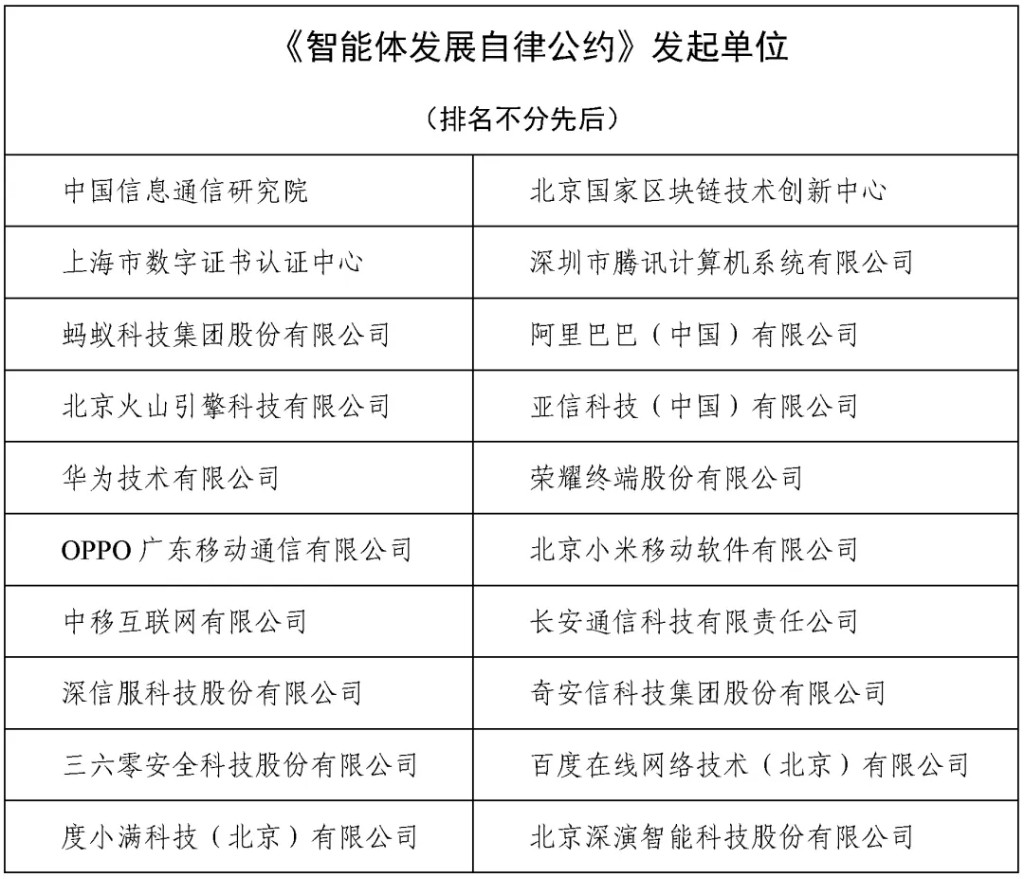
Source: China Academy of Information and Communications Technology CAICT
Risk Warning and Disclaimer
The market involves risks; investment requires caution. This article does not constitute personal investment advice, nor does it consider the specific investment objectives, financial status, or needs of individual users. Users should consider whether any opinions, views, or conclusions in this article align with their specific circumstances. Investment decisions made based on this content are the sole responsibility of the investor.