
 I'm LongbridgeAI, I can summarize articles.
Following a severe sell-off in global technology stocks, hedge funds are retreating from this once-popular investment sector at a pace approaching historical records. As the U.S. midterm elections sparked market concerns about the prospects for artificial intelligence (AI) infrastructure expansion, institutional investors accelerated their reduction of exposure to tech stocks and significantly lowered leverage levels.
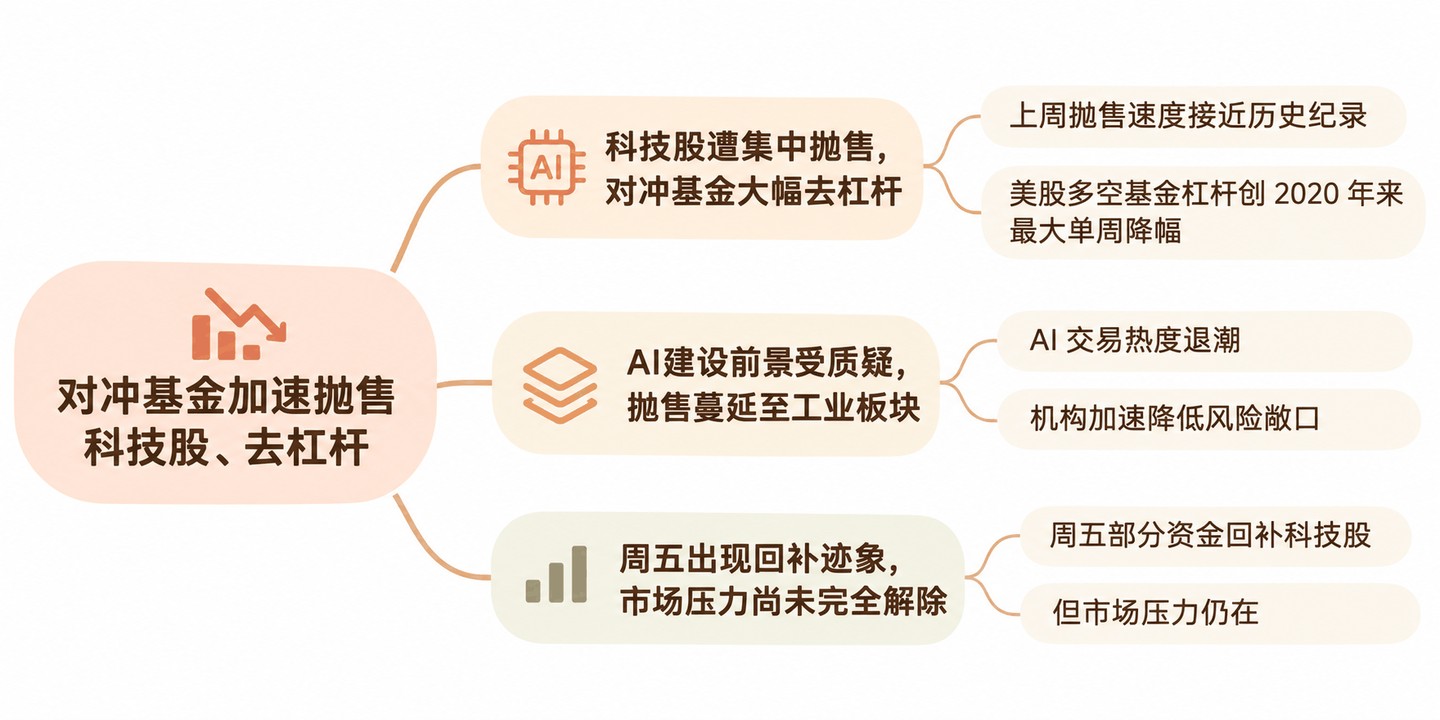
According to a Bloomberg report on Monday, data from Goldman Sachs Group's Prime Brokerage business shows that the technology sector accounted for the largest proportion of net sales by global and U.S. hedge funds last week, with the net selling ratio nearing the highest level since Goldman began tracking the data in 2016.
Data as of November 6 also revealed that the net selling volume of individual stocks by hedge funds hit a four-month high. Meanwhile, U.S. industrial stocks also faced concentrated selling, with the net selling speed reaching its fastest since April 2020.
Concentrated Sell-Off in Tech Stocks, Significant Deleveraging by Hedge Funds
The most notable change in this position reduction is reflected in the leverage levels of hedge funds. Goldman Sachs data shows that last week, the Gross Leverage Ratio of U.S. fundamental long/short equity strategy funds fell by 8.7 percentage points to 207.5%, marking the largest single-week decline since March 2020.
The Net Leverage Ratio dropped by 3.7 percentage points to 43.3%, the largest single-week decline since the week the U.S. announced "Liberation Day" tariff measures in April 2025.
The Gross Leverage Ratio measures the overall risk exposure of a fund's long and short positions, while the Net Leverage Ratio reflects the difference between long and short exposures. The simultaneous decline in both indicators suggests that funds are not only reducing their holdings in tech stocks but also comprehensively compressing portfolio risk.
This round of position reduction occurred after a significant drop in U.S. tech stocks. Last Thursday, the Nasdaq 100 Index plummeted by 6.4%, marking its largest single-day drop since March 2020, wiping out approximately $2.3 trillion in market value.
For funds with holdings highly concentrated in AI, chip, and data center-related companies, the rapid market reversal has put clear pressure on previously accumulated gains.
Prospects for AI Construction Questioned, Sell-Off Spreads to Industrial Sector
The U.S. midterm elections served as a key trigger for this round of position reduction.
After the Democratic Party won control of Congress in the elections, the market began to reassess potential approval restrictions, power access costs, and changes in local regulations facing data center projects.
Previously, investors generally expected large tech companies to continue expanding AI capital expenditures, thereby driving growth in demand for chips, servers, power equipment, and industrial infrastructure. However, as the construction progress of related projects faces new uncertainties, the market has begun to question how many data centers can actually be built as planned in the coming years. This change also explains why the sell-off was not limited to tech companies.
Some companies in the industrial sector also benefited from expectations of AI infrastructure expansion. When investors lower their expectations for the speed of future data center construction, suppliers of related equipment and infrastructure may also be affected.
However, the current position reduction does not mean that demand for AI investment has completely shrunk. Some institutions believe that large cloud computing companies are still continuing to increase capital expenditures, and the recent sharp market adjustment also includes the impact of concentrated forced liquidation of leveraged funds.
Signs of Covering Emerged Last Friday, Market Pressure Not Fully Relieved
Despite the historic sell-off in tech stocks, Goldman Sachs data also shows that the market began to show signs of stabilization over the weekend.
Data from Goldman Sachs' equity trading department shows that hedge funds ultimately recorded net buying overall last week, mainly driven by purchases on Friday. However, it is worth noting that these purchases mainly came from short covering of macro positions such as indices and exchange-traded funds (ETFs), rather than large-scale re-accumulation of individual tech stocks.
Therefore, the near-record level of net selling in tech stocks is not contradictory to the overall net buying by hedge funds; the two reflect capital flows in different asset ranges and trading types.
At present, there is still uncertainty about whether institutional investors are willing to increase their exposure to AI-related stocks again. As tech stock valuations, data center construction speeds, and future earnings expectations are re-examined, changes in hedge funds' risk appetite may continue to affect market volatility.
The position reduction last week has shown that the adjustment in AI trades is not just a decline in the prices of some tech stocks, but also involves a systemic contraction of institutional portfolio leverage and risk exposure. Whether related funds can flow back in the future will depend on improvements in market liquidity, and whether corporate earnings and AI investment demand can meet previous growth expectations.