
 I'm LongbridgeAI. Here is the key information I extracted
On Nov. 10, two sell-side analysts from the IPO syndicate covering software and internet hosted a Q&A on $ Anthropic.US. While some headline numbers reflect their estimates, the timing suggests management likely gave partial validation. This is meaningful for our near- to mid-term growth view on Anthropic.
Dolphin Research take: near-term outlook is soft, but medium to long term remains constructive relative to already-lowered expectations. The company is ambitious on monetization, prioritizing 1P compute build-out and using heavy training spend to raise competitive barriers.
Details below. We break it down.
1) Key numbers first. See the snapshot.
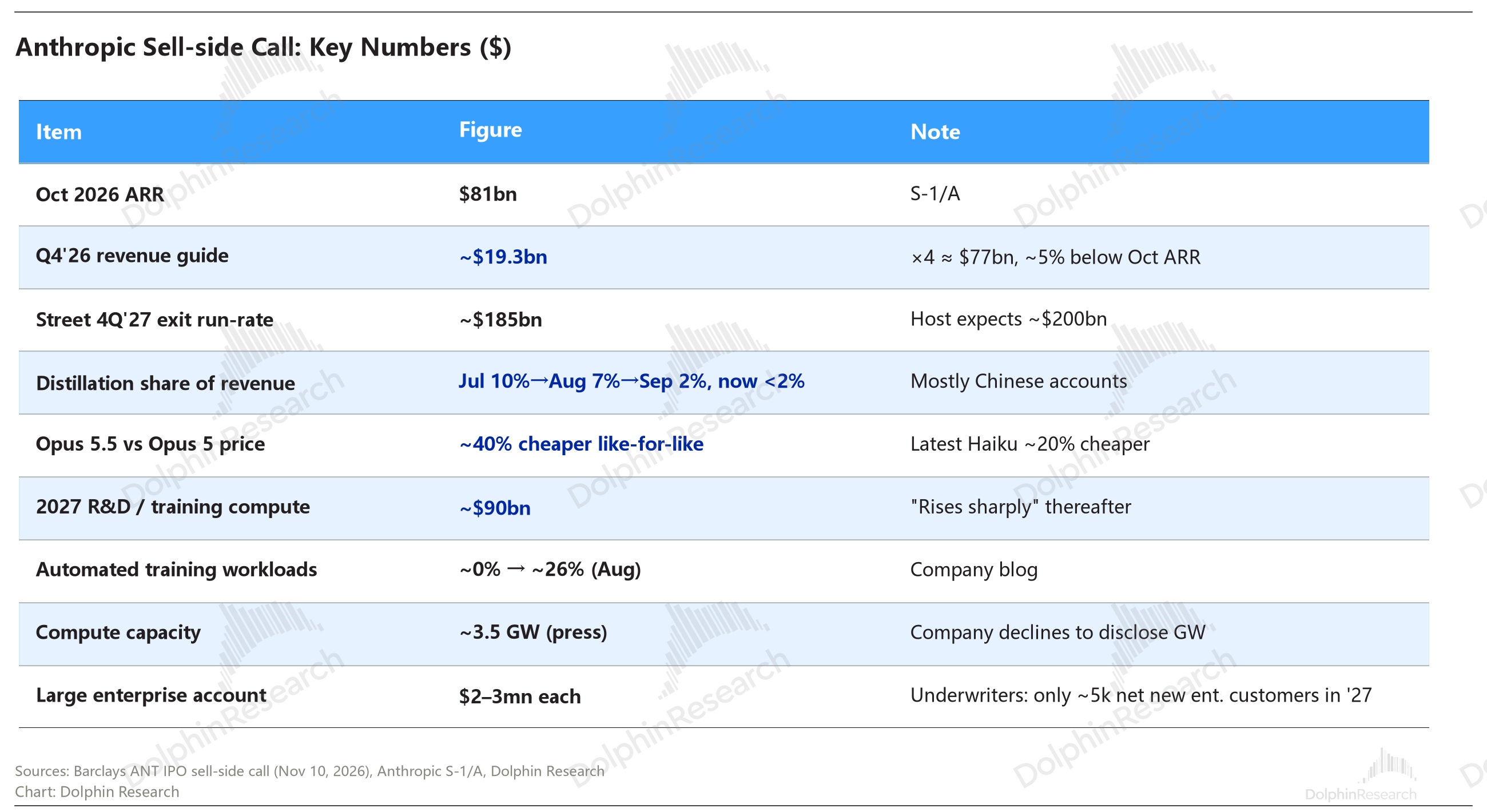
2) Key takeaways. Highlights follow.
1) Q4 looks soft, with three drivers. Details below.
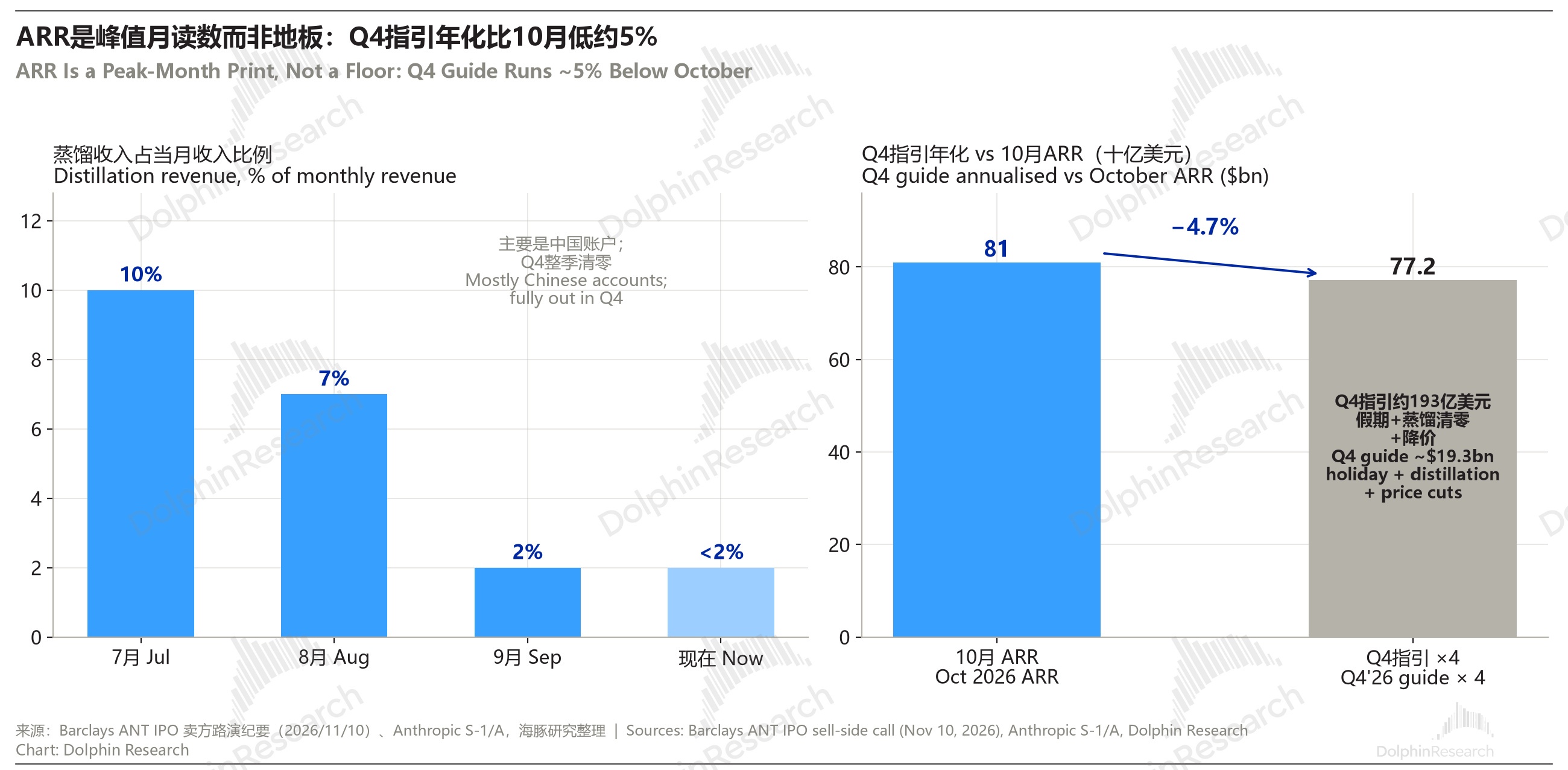
(1) Holiday seasonality; (2) distillation revenue goes to zero for the full Q4; (3) price cuts — revenue per account dips after switching to new models, then normalizes in ~two weeks. Management downplayed the impact from META and MSFT usage cuts, which is at odds with prior reporting; we think the drag is likely non-trivial. Opus 5.5 is priced 40% lower vs. Opus 5. To keep revenue flat, tokens must expand by ~67%.
Distillation revenue (about 10% in Jul) is a one-off headwind, but price cuts are structural. The reverse gap between a Q4 annualized run-rate of 77.2 bn vs. Oct ARR of 81.0 bn underscores why high-frequency monthly ARR is not a solid valuation anchor for Anthropic. Near-term volatility makes simple extrapolation risky.
The first public guide (Q4'26) already sits below the annualized run-rate. Expect additional pricing pressure into 1H next year as newer models roll through.
Pushing a more optimistic linear extrapolation on existing high-frequency ARR effectively layers a second derivative on top of a second derivative, doubling whipsaw risk. That helps explain the swinging valuation narratives — from 0.9 tn to 2 tn, back to 1 tn, and now a hot bookbuilding trying to lift to 1.5 tn — all without a firm anchor.
2) Monetization expectations for next year are not low, with growth leaning on user penetration. This is more about adding customers than simply driving token consumption.
Street expects a quarterly annualized revenue of ~185 bn; if delivered, year-end ARR likely tops 200 bn. That is well above our neutral 150 bn case, and the hosting analysts are openly guiding toward ~200 bn. Momentum assumptions are clearly optimistic.
Given steep token price cuts, the path is volume-led — not by tokens, but by new customers. The underwriters’ model assumes ~5,000 new enterprise customers next year, modest ARPC uplift, big accounts spending $2–3 mn each, plus ~100k accounts converting to paid upgrades. The AI4S verticals (e.g., life sciences) in the prospectus remain early; industry checks suggest limited signed deals so far.
We are skeptical on the math. Even if all 5,000 were large accounts at the indicated spend, the incremental would be just a bit over 10 bn, which seems inconsistent with the topline target.
3) Emphasis shifts to compute efficiency, with continued heavy spend to widen the gap. The message to investors: focus on efficiency (revenue/compute spend), not raw GW.
Management acknowledged over-committing to capacity ahead of demand to avoid over-reliance on SpaceX’s high-priced compute. Media reports point to ~3.5 GW in operation and 4.67 GW contracted for 2026, so translating capacity plans directly into revenue could overstate near-term monetization. The efficiency framing also aligns with an expected turn to negative Adj. margins in 2027.
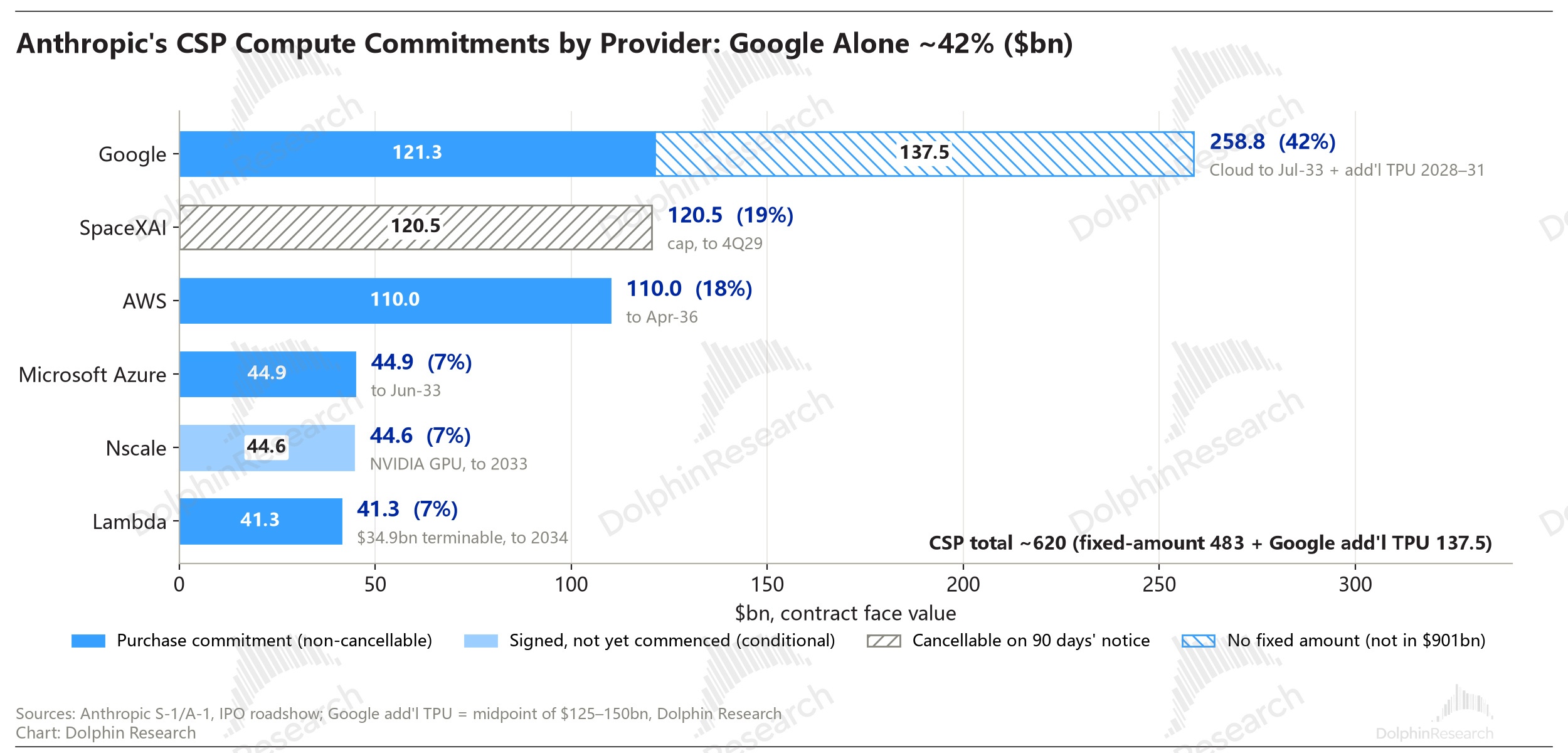
The company has signed ~620 bn of cloud compute commitments (CSPs, SpaceX, and other new clouds). Going forward, it will prioritize 1P compute via a multi-chip plus direct procurement strategy, building owned data centers to compress intermediary margins. This should help cost control over time.
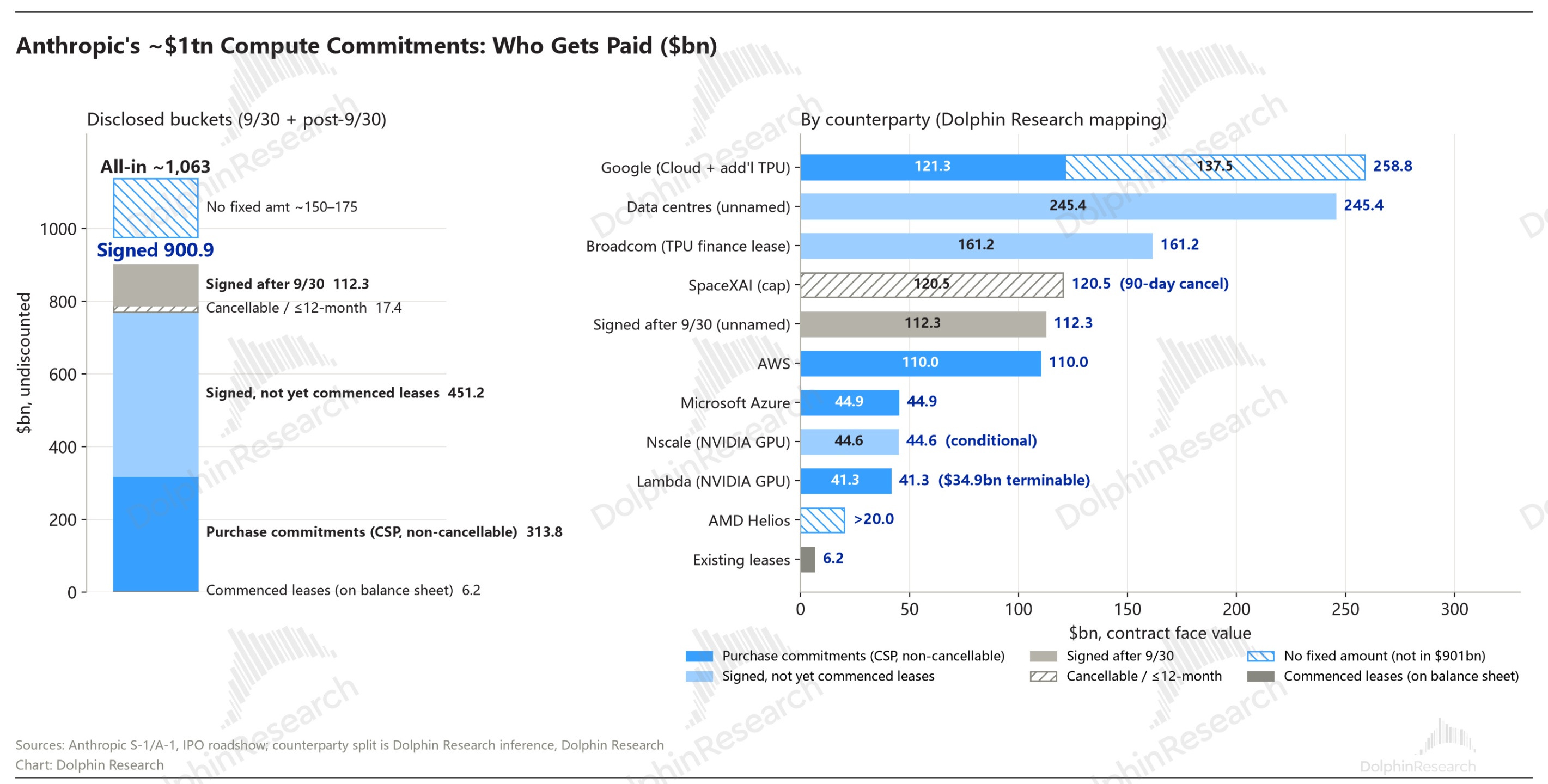
In a fierce race, Anthropic may keep swinging big. Training compute in 2027 is guided at about $90 bn, roughly 3.4x 2026, to widen the lead versus followers. If the current 8:2 train:infer ratio holds, total compute spend next year implies around $120 bn.
That lines up with the ~120 bn of 2027 compute commitments already signed (see our annual allocation view below). However, any upside surprise in inference demand would require either a higher train:infer mix or fresh compute contracts, as owned data centers likely will not ramp that fast.
We see an expected consequence — profits likely fall sharply next year. Adj. OPM was 14.5% in Q3'26, but with compute spend north of $120 bn in 2027, Non-GAAP OPM turning negative for the full year looks almost inevitable. Investors should brace for margin compression.
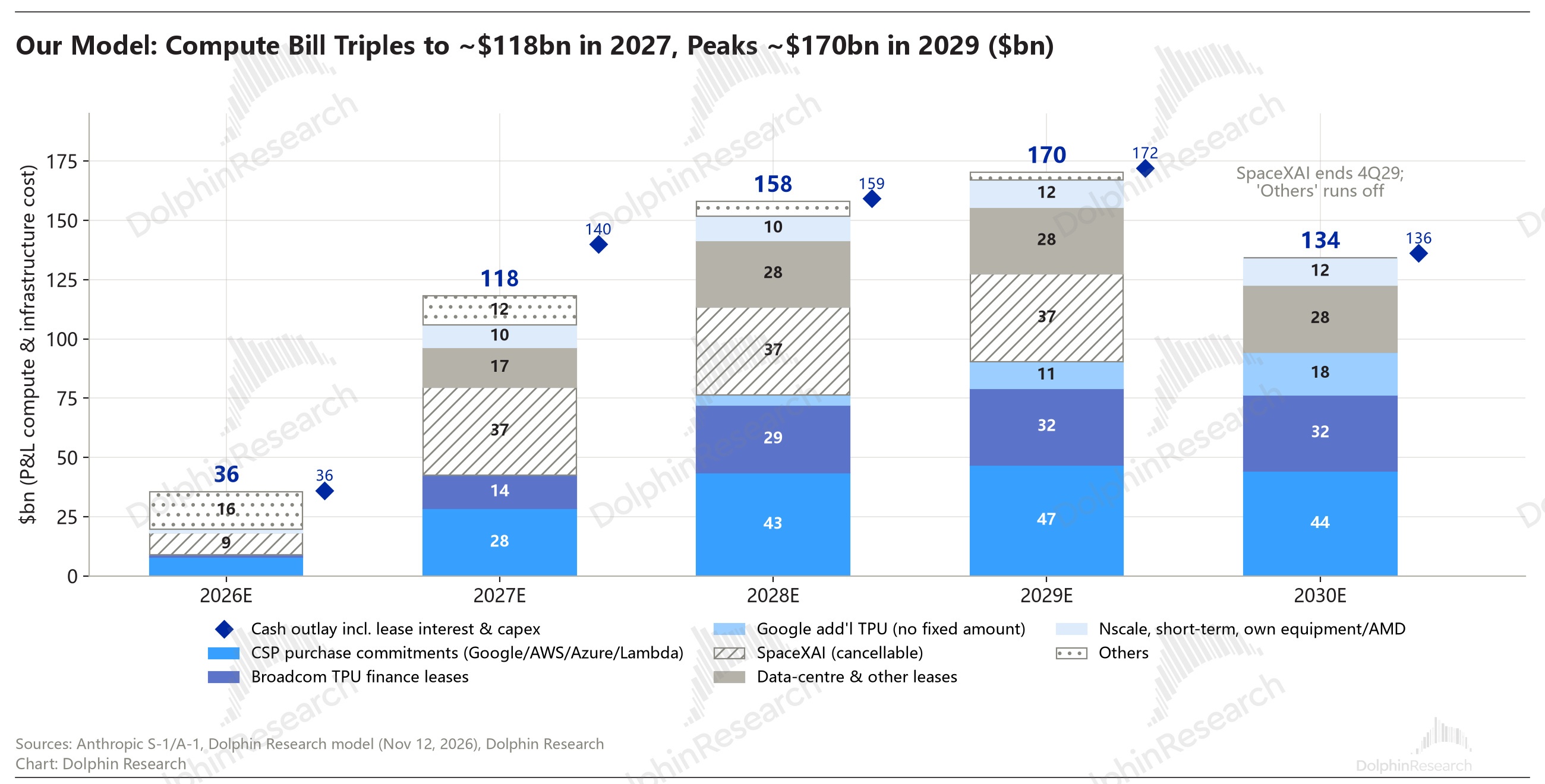
At a 1.2 tn IPO (market talk ranges 1.0–1.5 tn), this implies ~10x next-year P/S and sub-8x P/ending ARR. Rich or cheap will depend on longer-dated scenarios and more conservative assumptions. A wider distribution of outcomes argues for prudent framing.
We will publish more on Anthropic’s valuation shortly — comments welcome. Near-term metrics to watch that could move both estimates and multiples include Fable 5.2 performance post-launch, actual Q4 revenue, and the pricing trajectory for next-gen models (several are in the queue). Stay tuned.
<End of note>
Risk disclosure and statement: Dolphin Research disclaimer and general disclosures. Please review before making investment decisions.
Dolphin Research coverage history on Anthropic: Selected prior notes below.
Oct. 27, 2026 initial coverage, Part I: Anthropic: From cash-burner to compute landlord — the trillion-dollar march is long.