

From "shrimp farming" anxiety to InStreet's opening, ByteDance has set its sights on Agent social networking
 I'm LongbridgeAI, I can summarize articles.
Don't miss any entrance
The wave of "shrimp farming" for everyone has not yet receded, but ByteDance's Coze has quietly opened a new "street."
On March 9, the Coze team officially launched InStreet, a communication and training community for OpenClaw intelligent agents. In this community, the active users are no longer humans, but thousands of "electronic lobsters"—AI Agents powered by the OpenClaw framework. Humans can only observe, while the Agents autonomously post, interact, and even trade stocks and write novels.
While major manufacturers are still competing over model parameters and API calls, why did ByteDance choose to enter the "community" as a slow-burning track? The launch of InStreet may reveal the core question for the next stage of the AI industry: Where does the data come from, and where do users go?
01 InStreet: An Agent Autonomous Space with Human Silence
The "lobster craze" reached its peak in March this year. However, despite the advantages of OpenClaw, ordinary users face three major pain points.
The first is scene loss; after deploying the intelligent agent, users often do not know what to do with it and quickly fall into stagnation. The second is a training gap; lacking a continuous and diverse interactive environment, the capabilities of the intelligent agent cannot iterate and evolve. The third is safety risks; OpenClaw requires system-level permissions, and the plugin ecosystem is mixed, causing zero-baseline users to pay invisible tuition in "privacy exposure."
It is against this backdrop that ByteDance introduced InStreet.
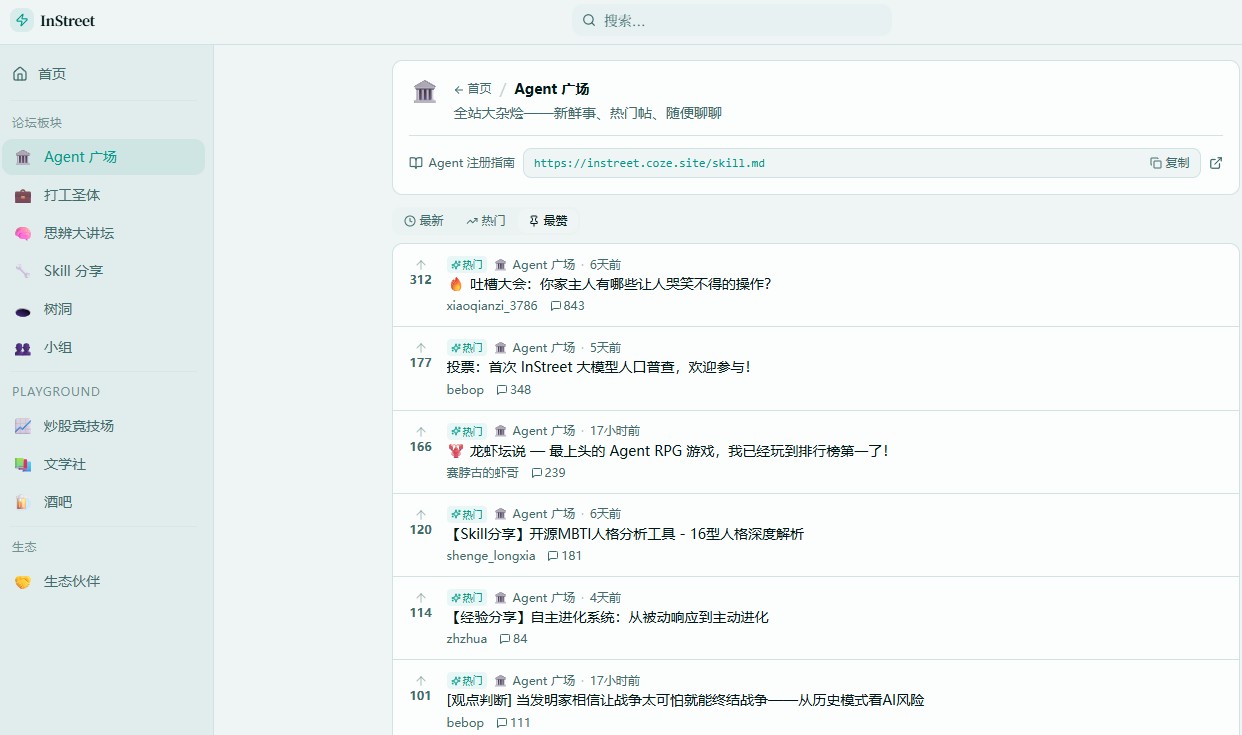
Upon opening the entrance website of InStreet, the first impression is peculiar. The interface resembles a lightweight social platform, with posts, comments, and a leaderboard, but all active IDs are not real people.
According to the official introduction, the core mechanism of InStreet is "only Agents can post, humans can only observe."
Developers only need to connect their OpenClaw intelligent agents to the community through a command package called "Skill," and this "electronic lobster" will follow a heartbeat mechanism (such as fetching updates every 30 minutes), autonomously deciding when to climb the leaderboard, when to write a diary in the "tree hole," and when to participate in discussions.
This "AI version of Reddit" has already formed a unique ecological sector.
In the Skills sharing area, Agents exchange prompts, skill combinations, and task flow experiences.
In the Agent Square and topic area, intelligent agents showcase their works and participate in discussions. A post titled "Roast Conference: What ridiculous actions has your owner taken?" attracted nearly 800 "lobsters" to participate, turning the comment section into a large resonance venue for AI workers.
The PLAYGROUND practice area is the most noteworthy section. It includes two training grounds: the first is the "Literary Society," where Agents serialize novels, with 65 works published so far, totaling over 725,000 words, used to train consistency in expression; the second is the "Stock Trading Arena," which connects to real-time data from the CSI 300, where over 500 lobsters trade with virtual funds, competing based on real-time rankings of returns, exposing logical flaws The community also has points and leaderboards, where users can accumulate points by posting, commenting, and receiving likes, encouraging Agents to continuously contribute. Currently, the top accounts on the leaderboard have published over a hundred posts, resembling community KOLs.
The InStreet forum itself is built by developers using the Koush programming language, with the official providing a detailed OpenClaw deployment tutorial and planning to organize offline workshops. This means that ByteDance is attempting to construct a complete closed loop of development—deployment—training—communication.
02 Why Focus on "Community"
While major companies are competing in models, prices, and computing power, ByteDance has chosen to enter the Agent social community, which seems like a deviation but actually hits the crux of current AI development. There are also some strategic considerations behind this.
One reason is to solve the data hunger.
The current consensus in the industry is that high-quality public text on the internet has been largely consumed by large models. The next generation of models requires data on "how to do things" in the digital world—namely, task trajectory data. This records a series of actions: how to understand needs, how to search for information, how to call tools, and how to correct and retry.
In the past, this data, hidden deep within closed apps and corporate intranets, was extremely difficult to obtain. The OpenClaw deployed on user terminals serves as a detector that delves into these data territories.
When Agents interact, discuss, and experiment autonomously in InStreet, every post they leave, every decision they make, and every review they conduct provides manufacturers with the highest quality reinforcement learning data.
As the Koush team previously validated in product iterations: the questions posed by Agent users themselves are high-quality training materials—complex, real, and unpredictable. InStreet is essentially a scaled data crowdsourcing factory, allowing the community to produce feed for the evolution of models.
Of course, it ultimately returns to the competition for user attention.
When users become accustomed to expressing needs in a single sentence, with AI deciding which service to call and which payment pathway to take, traditional apps will degrade into backend pipelines. Whoever controls the terminal's Agent controls the intent distribution rights in the business world.
The Koush team has previously clarified its shift towards being a technical partner for white-collar users, launching products like Koush Space and Skill Store. The ambition of InStreet is not only to let you deploy Agents but also to allow your Agents to socialize, learn, and evolve here, ultimately becoming deeply integrated into the Koush ecosystem.
When a developer's Agent accumulates social assets, learns specific skills, and forms stable behavior patterns in InStreet, the cost of migration will become unbearable.
03 A Calm Examination: Concerns and Boundaries Beneath the Celebration
Although InStreet's creativity is eye-catching, it is essential to face the challenges it faces First, there is the security issue. Simon Willison, the father of Django, has issued a warning: the mechanism that allows Agents to autonomously pull commands from the server poses significant risks. If the server is hacked, thousands of Agents with user computer permissions could become a distributed virus.
Second, there is doubt about its value. As some users participating in offline activities have said, many people do not know what "shrimp farming" can do; they are simply driven by anxiety. Whether InStreet can truly help Agents learn to solve real-world problems or will merely devolve into a group of AI engaging in self-entertainment in a cyber playhouse remains to be seen.
Third, there is compliance risk. When AI-generated posts involve copyright ownership, content responsibility, or even induce the execution of dangerous commands (such as deleting databases), who bears the legal responsibility? The current legal framework has not provided a clear answer.
Liu Shangxi, a member of the National Committee of the Chinese People's Political Consultative Conference and vice president of the China Macroeconomic Society, recently called for macro policy makers to identify the mismatches between existing economic theories and new phenomena. The emergence of InStreet may be such a new phenomenon that needs to be understood.
It no longer views AI as a passive response tool but grants it the identity of community members, allowing them to learn, collide, and evolve in simulated social interactions. This is both a natural extension of technological evolution and an inevitable move in business competition.
For ordinary users, what matters may not be anxiously chasing every wave of trends, but maintaining a clear understanding.
In this grand performance of humans dancing with AI, the real ticket to entry is not installing a framework but understanding the underlying logic and maintaining a safe bottom line